
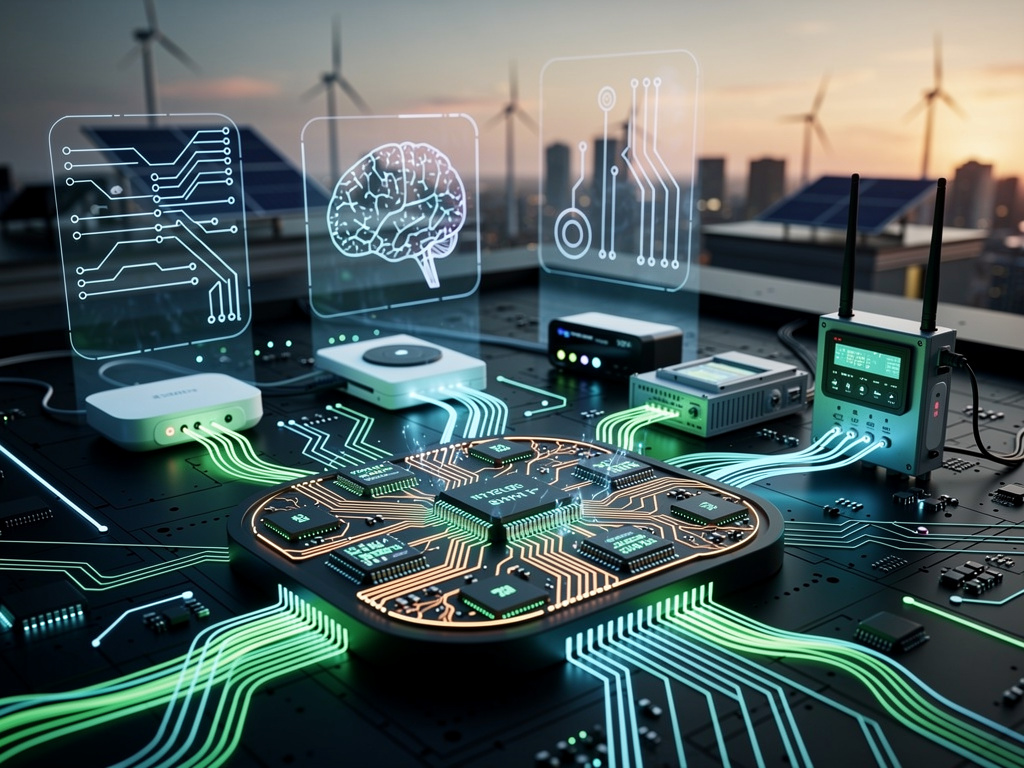
Mimicking the Mind: Revolutionizing AI Efficiency Through Brain-Inspired Innovation
The artificial intelligence boom has brought unprecedented computational power, but it’s also devouring energy at an alarming rate. Data centers powering AI models like ChatGPT consume electricity equivalent to small cities, raising concerns about sustainability and costs. Now, researchers are turning to the human brain for inspiration, developing algorithms that mimic neural efficiency to slash energy use without sacrificing performance.
A recent study highlights how these brain-inspired approaches could transform the field. Scientists from Purdue University and the Georgia Institute of Technology have outlined methods to overhaul AI hardware limitations, as detailed in a paper published in Frontiers in Science. Their work suggests that by emulating the brain’s sparse and efficient processing, AI systems could operate with far less power, addressing the growing demands of real-world applications.
This isn’t just theoretical. Practical implementations are already showing promise, with reductions in energy consumption that could reshape how we build and deploy AI. For instance, the brain processes information using only about 20 watts—roughly the power of a dim light bulb—while training a large AI model can require megawatts. Bridging this gap through bio-inspired designs is becoming a focal point for tech innovators.
Unlocking Neural Efficiency in Silicon
At the core of these advancements is the concept of neuromorphic computing, which seeks to replicate the brain’s architecture in hardware and software. Unlike traditional AI that relies on dense, always-on connections between artificial neurons, brain-like systems use sparse wiring, activating only necessary pathways. This mirrors how human neurons fire selectively, conserving energy.
Researchers at the University of Surrey have pioneered a technique called Topographical Sparse Mapping (TSM), which restructures artificial neural networks to be more brain-like. According to their study in Neurocomputing, TSM improves performance in tasks like image recognition and language processing while cutting energy needs significantly. By focusing on efficient connections, they’ve achieved up to 99% reductions in power use without accuracy loss, as noted in posts from industry experts on X.
This approach challenges the status quo of deep learning, where models like those behind generative AI connect every neuron in exhaustive layers. The Surrey team’s method introduces topography—mimicking the brain’s structured neural maps—to create leaner, faster networks. Early tests show these systems train quicker and run on less hardware, potentially democratizing AI for edge devices like smartphones.
Overcoming the Memory Wall Barrier
One major hurdle in current AI is the “memory wall,” where data shuttling between processors and memory hogs energy. Brain-inspired algorithms address this by integrating computation and memory more seamlessly, much like synapses in the brain. A study from Frontiers in Science explains how redesigning AI architecture to be more biological could break through these bottlenecks.
Purdue and Georgia Tech researchers propose hardware tweaks that reduce data movement, drawing from neural plasticity—the brain’s ability to rewire itself efficiently. Their findings, published just days ago, indicate potential energy savings of up to 80% in some scenarios, echoing tools developed at MIT’s Lincoln Laboratory. In MIT News, experts describe power-capping techniques that have already cut training energy by similar margins.
These innovations extend beyond labs. Texas A&M engineers are working on “Super-Turing AI,” which learns on the fly like the brain, avoiding the energy-intensive retraining of conventional models. As reported in Texas A&M Stories, this could lead to AI that adapts in real-time, using far less power for applications in autonomous vehicles or medical diagnostics.
Real-World Applications and Industry Shifts
The implications for industries are profound. In wastewater treatment, for example, AI optimized with brain-like efficiency is forecasting energy use more accurately, promoting self-sufficiency. A paper in Scientific Reports details how machine learning models, enhanced by predictive algorithms, reduce consumption in plants, aligning with broader clean energy goals.
Tech companies are taking note. Discussions on X highlight a breakthrough where brain-inspired wiring cut energy by 99%, with users like Dr. Singularity praising the University of Surrey’s TSM for its potential to scale AI sustainably. Similarly, posts reference how biological neural networks outperform artificial ones in efficiency, using just 15-20 watts versus the grid-straining demands of large models.
At the University of Texas at Dallas, neuromorphic chips are being tested to learn faster with less electricity, as covered in The Dallas Morning News. These chips could power everything from smart grids to personal devices, reducing the environmental footprint of AI’s expansion.
Pushing Boundaries with Predictive Processing
Delving deeper, brain-inspired AI leverages predictive coding, where systems anticipate inputs to minimize processing. This is evident in how the brain conserves energy by predicting perceptions, a concept supported by neural network simulations. X posts from years ago, like those from Massimo, noted efficiency gains of up to 31.5% in energy management systems, a figure that’s only grown with recent advancements.
Technical University of Munich (TUM) has developed methods to train networks 100 times faster and more efficiently, as per their press release. By avoiding iterative training loops, their approach echoes the brain’s one-shot learning, slashing energy costs dramatically.
Moreover, MIT’s exploration of AI in clean energy, detailed in MIT News, shows how these efficient models can manage power grids, plan infrastructure, and develop materials— all while consuming less power themselves.
Challenges in Scaling Brain-Like AI
Despite the promise, scaling these technologies isn’t straightforward. Hardware must evolve to support sparse, event-driven processing, which differs from today’s GPU-dominated setups. Researchers warn that without compatible chips, software gains could be limited.
Posts on X from experts like Tony Zador emphasize the brain’s edge in energy efficiency, questioning why artificial systems lag so far behind. Recent surveys, such as one in PR Newswire, reveal that only 13% of sustainability leaders prioritize AI’s environmental impact, highlighting a gap between innovation and corporate strategy.
Efforts like those from Data Center Dynamics discuss brain-inspired architectures cutting compute power by factors of 10,000, as shared in DCD. Yet, integrating these into existing data centers requires investment, with flexible computing proposed to balance peak demands.
Future Horizons for Energy-Efficient Intelligence
Looking ahead, the fusion of AI with brain-like efficiency could unlock new frontiers. In edge computing, neuromorphic systems reduce latency and power for IoT devices, as discussed in X threads about event-driven processing.
Varun Sivaram’s ideas on flexible AI, referenced in recent posts, suggest adapting computation to grid capacity, potentially enabling trillions in investments without overwhelming infrastructure. This aligns with brain-inspired methods that prioritize adaptability over brute force.
As AI integrates deeper into society, these efficiencies will be crucial. From powering sustainable wastewater plants to enabling real-time learning in robots, the shift toward brain-mimicking algorithms promises a more viable path forward.
Bridging Biology and Technology
The journey from biological inspiration to technological reality involves interdisciplinary collaboration. Engineers at Texas A&M are creating AI that mimics synaptic plasticity, allowing systems to evolve without constant energy drains.
X users like Owen Gregorian point to brain-inspired computing as the next evolution, solving energy problems by emulating biological circuits. This could lead to smarter systems in healthcare, where efficient AI analyzes data on low-power devices.
Ultimately, these developments signal a paradigm shift, where AI doesn’t just compute like the brain but consumes like it too, paving the way for a more sustainable digital era.
Innovators Leading the Charge
Key players are accelerating this progress. Purdue’s study, featured in TechXplore, provides practical roadmaps for implementation, while CNET’s coverage in their article dives into architectural redesigns promising dramatic cuts.
Surrey’s TSM method, lauded on X for its 99% efficiency boost, exemplifies how rethinking wiring can yield outsized gains. As Pedro Domingos noted in posts, such innovations could reduce costs by orders of magnitude.
With ongoing research, the gap between brain and machine narrows, offering hope for an AI future that’s powerful yet parsimonious with energy.
The Path to Widespread Adoption
Adoption hurdles include standardization and cost. Yet, as MIT’s tools demonstrate, incremental improvements are already viable, reducing data center energy by 80%.
In energy management, brain-like AI predicts and optimizes, as seen in Scientific Reports’ wastewater study. This predictive prowess, rooted in neural efficiency, extends to broader sectors like transportation.
X sentiment underscores excitement, with users envisioning a world where AI’s energy footprint shrinks, enabling innovation without ecological trade-offs.
Sustaining the AI Revolution
Sustaining AI’s growth demands these efficiencies. Frontiers in Science’s recent publication reinforces that brain-like hardware is essential for meeting demands.
Texas A&M’s Super-Turing AI, by learning dynamically, avoids static models’ pitfalls, conserving resources.
As industries adapt, brain-inspired algorithms will likely become the norm, ensuring AI’s benefits outweigh its burdens.


 WebProNews is an iEntry Publication