
When the Clocks Faltered: A Tiny Temporal Rift Shakes America’s Timekeeping Core
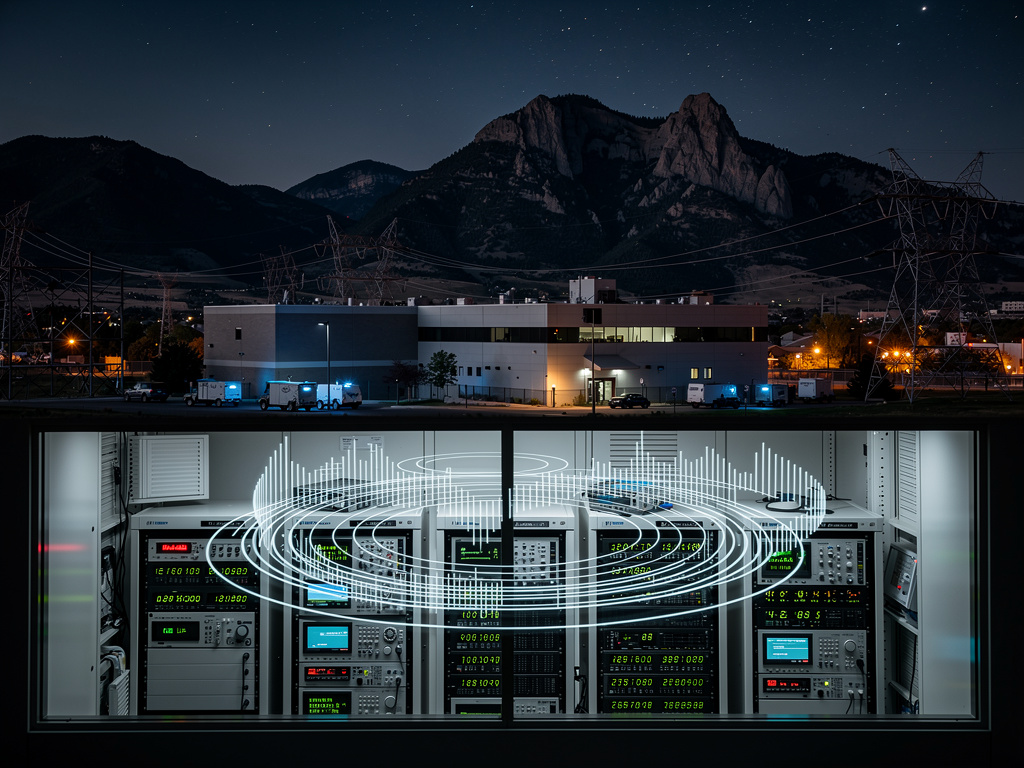
In the quiet labs of Boulder, Colorado, where the nation’s heartbeat of time is meticulously maintained, a sudden power outage last week threw a wrench into the gears of precision. The National Institute of Standards and Technology (NIST), the federal agency responsible for disseminating the official U.S. time, experienced a brief but notable disruption. According to reports, this incident caused the official time to drift by a mere 4.8 microseconds—a sliver so small it’s imperceptible to everyday life, yet potentially disruptive to high-stakes systems reliant on split-second accuracy.
The outage stemmed from proactive measures by utility provider Xcel Energy, which shut down power lines across parts of Colorado to prevent wildfires amid hurricane-force winds. This precautionary step, while averting one disaster, inadvertently impacted NIST’s Internet Time Service facility in Boulder. Officials at NIST quickly assured the public that “time is not broken,” emphasizing that backup systems kicked in to maintain continuity, even as the primary atomic clocks lost their power source temporarily.
For those in the tech and infrastructure sectors, this event underscores the fragility of even the most robust systems. Atomic clocks, which form the backbone of global timekeeping, rely on the vibrations of cesium atoms to define the second with extraordinary precision. When power fails, these clocks can drift, albeit minutely, highlighting the need for redundant safeguards in an era where timing underpins everything from financial transactions to satellite navigation.
The Anatomy of a Time Drift
Delving deeper into the mechanics, NIST’s time service operates through the Network Time Protocol (NTP), a system that synchronizes clocks across the internet. The Boulder facility houses some of the world’s most accurate clocks, contributing to Coordinated Universal Time (UTC). During the outage, as detailed in a report from NPR, the clocks drifted by about 4.8 microseconds because they lacked an active reference signal for a short period.
This isn’t the first hiccup for NIST’s time services this month, with another disruption noted earlier, as reported by Tom’s Hardware. The agency warned that several of its NTP servers in Boulder might provide inaccurate time stamps until full restoration. For industries like telecommunications, where microsecond precision is crucial for signal synchronization, such drifts could cascade into broader issues if not corrected swiftly.
Experts point out that while 4.8 microseconds seems negligible—equivalent to a billionth of a second times 4.8—it’s significant in contexts like GPS, where timing errors translate to positional inaccuracies. A microsecond off in time can mean a location error of about 300 meters, potentially affecting navigation systems, though NIST’s redundancies likely mitigated widespread fallout.
Ripples Through Critical Infrastructure
The implications extend far beyond Boulder’s labs. Critical sectors such as power grids, transportation, and healthcare depend on precise timing for operations. For instance, synchronized clocks ensure that electrical grids maintain phase alignment, preventing blackouts or inefficiencies. A report from The Register highlighted NIST’s warning about NTP inaccuracies post-outage, noting it as a “rare case of deliberately trying to induce an outage”—referring to the utility’s preventive shutdown.
In the financial world, high-frequency trading platforms execute orders in microseconds, where even tiny discrepancies can lead to millions in losses or unfair advantages. Telecommunications networks, too, rely on exact timing for data packet routing, and any drift could increase latency or errors in voice and data transmission.
Moreover, the event draws attention to the vulnerabilities in digital infrastructure. As CBS Colorado reported, time “very briefly stood still” at the facility, but NIST emphasized that overall timekeeping remained intact thanks to backup generators and alternative sites. This resilience is a testament to the agency’s foresight, yet it prompts questions about preparing for more severe disruptions, like cyberattacks or natural disasters.
Historical Context and Technological Evolution
To appreciate the gravity, consider the evolution of timekeeping at NIST. Established in 1901, the institute has long been at the forefront of metrology, with its Boulder campus becoming a hub for atomic time standards since the 1960s. The current system uses cesium fountain clocks, capable of accuracy to within one second over millions of years, far surpassing earlier quartz or mechanical methods.
Posts on X (formerly Twitter) from users and official accounts, including NIST itself, have buzzed with discussions on this incident, reflecting public fascination and concern. One official post from NIST clarified that backups prevented major issues, with the drift limited to microseconds, aligning with news reports. This social media chatter underscores growing awareness of how interconnected our world is with precise time.
Comparatively, past incidents offer lessons. In 2012, a leap second addition caused widespread software glitches, from airline systems to Reddit servers. The Colorado outage, while smaller in scale, echoes these events, reminding engineers of the need for robust error-handling in time-dependent protocols.
Safeguards and Future-Proofing Strategies
NIST’s response was swift: officials monitored the drift and planned corrections upon power restoration. As per details in The Denver Post, the outage affected an atomic clock amid statewide power cuts due to high winds. The agency maintains multiple sites, including in Fort Collins, Colorado, and Gaithersburg, Maryland, ensuring no single point of failure.
For industry insiders, this highlights the importance of distributed time sources. Many organizations use GPS-derived time or alternative NTP pools to avoid over-reliance on NIST servers. Emerging technologies, like optical lattice clocks using ytterbium or strontium atoms, promise even greater stability, potentially losing only a second over the universe’s age.
Furthermore, the incident spotlights climate-related risks. With extreme weather events on the rise, utilities’ preventive shutdowns could become more common, necessitating enhanced backup power solutions for critical facilities. NIST is already exploring renewable energy integrations and advanced battery systems to bolster resilience.
Broader Implications for Global Time Standards
On a global scale, the U.S. time signal contributes to the International Bureau of Weights and Measures’ UTC, coordinated across dozens of labs worldwide. A drift in one contributor, even minor, requires adjustments to maintain harmony. This event, as echoed in various web reports, could prompt international discussions on redundancy protocols.
In the realm of emerging tech, quantum computing and 5G networks demand unprecedented timing precision. A microsecond error in quantum synchronization could invalidate computations, while 5G’s ultra-reliable low-latency communications hinge on nanosecond accuracy.
Industry experts, drawing from this outage, advocate for hybrid timekeeping models—combining atomic clocks with satellite and fiber-optic signals—to mitigate risks. The Colorado incident serves as a case study in resilience, illustrating how even the guardians of time must adapt to an unpredictable environment.
Lessons Learned and Path Forward
Reflecting on the outage, it’s clear that while the 4.8-microsecond drift was corrected without major incidents, it exposes seams in our temporal fabric. NIST’s proactive communication, including updates on X, helped quell potential panic, reinforcing trust in the system.
For engineers and policymakers, this prompts a reevaluation of infrastructure interdependencies. Power grids and time services are intertwined; disruptions in one ripple to the other. Investing in smart grids with AI-driven predictive maintenance could foresee and avert such issues.
Ultimately, this microsecond mishap in Colorado reminds us that time, though abstract, is a foundational pillar of modern society. As we push technological boundaries, ensuring its unwavering accuracy remains paramount, blending human ingenuity with cutting-edge science to keep the world’s clocks ticking in unison.
The episode also invites contemplation on the philosophical underpinnings of time. Scientists at NIST have long explored how relativity and quantum effects influence measurements, as noted in historical NPR pieces on redefining the second. This outage, trivial in daily terms, amplifies the intricate dance between nature’s forces and our engineered precision.
Innovations on the Horizon
Looking ahead, NIST is pioneering next-generation clocks that could revolutionize fields from navigation to fundamental physics. Optical clocks, for instance, operate at higher frequencies than cesium models, offering stability that could detect gravitational waves or test theories of relativity more stringently.
Collaboration with private sectors is accelerating these advancements. Companies like those in Silicon Valley are integrating NIST time signals into blockchain for tamper-proof timestamps, enhancing security in digital transactions.
Moreover, the outage has sparked renewed interest in decentralized time networks, where peer-to-peer systems distribute timing loads, reducing vulnerability to localized failures. This could transform how global infrastructure handles time, making it more robust against both natural and man-made disruptions.
Enduring Precision in an Uncertain World
In the aftermath, Xcel Energy’s decision to cut power preemptively saved lives and property from wind-driven fires, a trade-off that NIST navigated adeptly. Reports from El-Balad.com confirm that while the atomic clock operations were affected, overall time integrity held firm.
For insiders, this serves as a blueprint for crisis management: rapid assessment, transparent communication, and layered redundancies. As climate challenges intensify, such events may recur, testing the mettle of our technological foundations.
Yet, in Boulder’s labs, the pursuit of perfect time continues undeterred. The 4.8-microsecond blip, now a footnote, propels forward innovations that will safeguard the seconds, ensuring our world remains synchronized in an ever-accelerating future.


 WebProNews is an iEntry Publication