
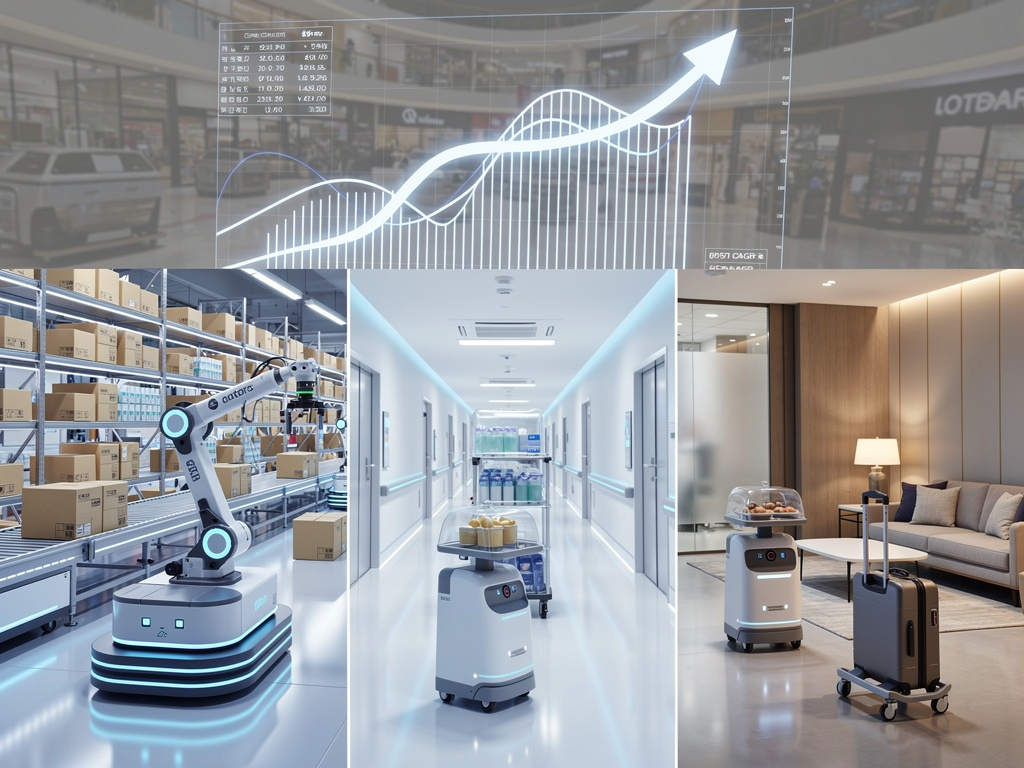
In the high-stakes arena of automation, service robotics is surging ahead, propelled by artificial intelligence breakthroughs and acute labor shortages. The global market, valued at $28.46 billion in 2024, is forecast to balloon to $497.95 billion by 2033, posting a compound annual growth rate of 37.44%, according to Renub Research. This explosive trajectory outpaces many tech sectors, as robots infiltrate hospitals, warehouses, hotels, and farms, executing tasks once reserved for humans with precision and tireless efficiency.
Unlike rigid industrial arms confined to factories, service robots navigate dynamic, human-filled environments. They assist surgeons, deliver medications, scrub floors autonomously, and even chat with guests. “Advancements in Artificial Intelligence and Automation” are the prime catalysts, enabling object recognition, natural language processing, and adaptive navigation, notes Vocal Media. Declining hardware costs and sensor fusion further democratize deployment, turning science fiction into boardroom reality.
Yet forecasts vary, underscoring the sector’s nascent volatility. Grand View Research pegs growth more conservatively at a 12.4% CAGR to $107.75 billion by 2030, while Mordor Intelligence eyes $175.46 billion by 2030 at 19.53% CAGR. IDTechEx predicts service robots exceeding $120 billion by 2036, with logistics and cleaning leading commercialization.
Logistics Leads the Charge
Autonomous mobile robots, or AMRs, dominate logistics, handling inventory picking, sorting, and last-mile delivery amid e-commerce booms. Amazon deploys over 750,000 units, slashing pick times below 30 seconds, per Mordor Intelligence. The AMR segment grows fastest, fueled by same-day delivery demands and supply chain snarls. Robotics-as-a-Service models, with monthly fees from $1,500, unlock adoption for small firms, projecting $34 billion in revenue from 1.3 million installations by 2026.
Serve Robotics exemplifies this shift, expanding from Uber Eats sidewalk bots to hospitals via its January 2026 acquisition of Diligent Robotics for $29 million in stock. Diligent’s Moxi has logged 1.25 million deliveries across 25 facilities, generating $200,000-$400,000 per site annually, as reported by TipRanks. This deal ports Serve’s AI stack indoors, targeting the $15 billion humanoid market by 2030.
Micro-fulfillment centers, numbering over 6,600 by 2030, amplify AMR needs, creating a $36 billion opportunity, adds Mordor Intelligence. Zetes’ October 2024 stake in Robotize bolsters AMR capabilities against labor gaps.
Healthcare’s Precision Revolution
Medical robotics claims the highest growth at 23.4% CAGR through 2030, per Mordor Intelligence. Intuitive Surgical’s da Vinci systems, Stryker’s Mako, and disinfection bots thrive amid aging populations and post-pandemic hygiene mandates. Professional service robots hold 72% market share, with hardware at 65.3% but software surging at 22.1% CAGR.
In the U.S., the largest market, surgical aids and patient monitors proliferate, though high costs and regulations pose hurdles. Germany’s Industry 4.0 subsidies and India’s urbanization spur adoption for cleaning and delivery. Saudi Arabia’s Vision 2030 funds hospital and hotel bots, positioning it regionally.
Recent moves underscore momentum: Pudu Robotics partnered with SoftBank in October 2023 for cleaning and delivery, while KEENON unveiled AI-driven models at NRA Show 2024, per Grand View Research. iRobot’s January 2026 sale to Picea Lodge ensures U.S.-based innovation in consumer bots.
Cleaning and Hospitality Gain Traction
Professional cleaning robots, like those from iRobot and Ecovacs, capture logistics-adjacent demand, with ground-based systems at 81.4% share. Hospitality deploys greeters and room-service bots; United Robotics Group’s uLink series, launched at VivaTech 2024, handles interactions and deliveries.
Agriculture robots target labor shortages, forecasting 35.9 million hand-eye coordinated units by 2030. Underwater and aerial variants grow fastest at 21.7% CAGR, aiding ocean research and inspections.
Government backing accelerates: Europe’s France 2030 and Asia’s Made in China 2025 pour funds into AI robotics. Hyundai’s CES 2026 showcase of NVIDIA-powered Atlas and Spot signals industrial scale-up.
Players and Power Struggles
Giants like ABB, KUKA, Fanuc, and Panasonic lead, alongside specialists: Intuitive Surgical in surgery, SoftBank in social bots, Locus in warehousing. Startups like Pudu and Serve innovate rapidly via partnerships.
Funding hit $6 billion in H1 2025, per X posts, with Asia-Pacific at 38% share and 20.57% CAGR, led by China, Japan, South Korea. North America follows at 27.6%, Europe at 33.7%.
Challenges persist: Regulatory lags on safety and ethics, plus job displacement fears. “Fear of job replacement leads to resistance,” warns Vocal Media. Reskilling and cobots mitigate this, positioning robots as augmenters.
Regional Powerhouses Emerge
Europe dominates revenue at 33.7%, with Germany’s manufacturing prowess. Asia-Pacific grows fastest at 14.7% CAGR, via China’s policies and India’s e-commerce. U.S. innovation hubs drive healthcare and logistics.
Serve’s hospital pivot and Khosla Ventures’ 2026 “GPT-3 moment” prediction signal acceleration. As robots handle repetitive toil, humans pivot to oversight and creativity, redefining workforces worldwide.


 WebProNews is an iEntry Publication