
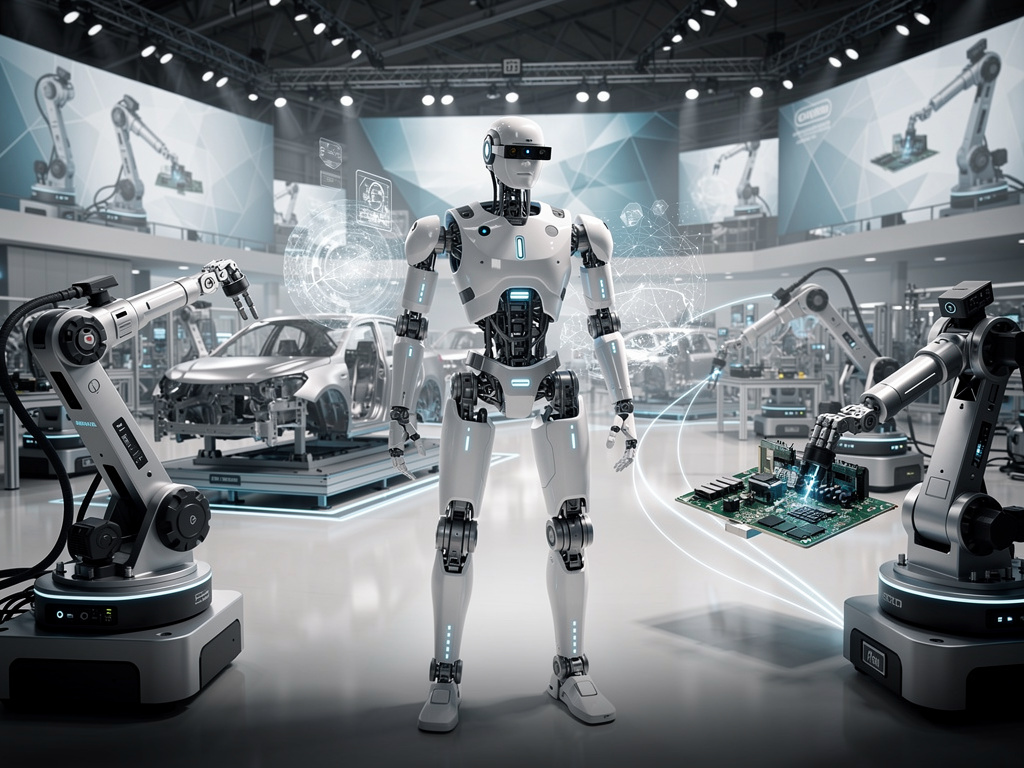
Atlas Awakens: Boston Dynamics’ Leap into Commercial Humanoid Robotics
In the bustling halls of CES 2026 in Las Vegas, Boston Dynamics unveiled a spectacle that blurred the lines between science fiction and industrial reality. The company’s humanoid robot, Atlas, performed a live demonstration that left attendees both awestruck and unsettled, showcasing movements that mimicked human agility with an eerie, almost unnatural precision. This wasn’t just another viral video; it was a declaration that humanoid robots are ready for prime time in factories and beyond. Drawing from recent announcements, Boston Dynamics has transitioned Atlas from a research prototype to a production-ready machine, poised to transform manufacturing processes.
The demo highlighted Atlas’s ability to navigate complex environments, manipulate objects with finesse, and recover from disruptions—skills honed through years of development. According to reports from the event, the robot executed tasks like sorting components and assembling parts autonomously, demonstrating a level of dexterity that rivals human workers. This advancement comes at a pivotal moment for the robotics industry, where companies are racing to integrate AI-driven machines into everyday operations. Boston Dynamics, now under Hyundai’s ownership, is leveraging this technology to address labor shortages in sectors like automotive manufacturing.
Central to this reveal is the partnership with Hyundai, which plans to deploy Atlas in its electric vehicle factories. As detailed in an article from NBC News, the robot will begin operations at Hyundai’s facility near Savannah, Georgia, by 2028. This move underscores a strategic shift toward automating repetitive and hazardous tasks, potentially reshaping workforce dynamics in heavy industry.
Engineering Marvels Behind the Movements
Atlas’s design represents a culmination of engineering innovations, including 360-degree rotating joints that allow for superhuman agility without the constraints of traditional wiring. Posts on X have buzzed with excitement over these features, noting how the absence of wires crossing moving parts enhances reliability and reduces maintenance needs. The robot’s three-fingered hands, equipped with tactile sensors, enable precise pressure control and mode switching, making it versatile for various industrial applications.
Integration with advanced AI is another cornerstone. Boston Dynamics has formed a new partnership with Google DeepMind to infuse Atlas with foundational intelligence, combining athletic prowess with cognitive capabilities. As outlined in a blog post from Boston Dynamics, this collaboration aims to make the robot more adaptive, allowing it to learn from environments and collaborate with humans and other machines. Nvidia chips power the robot’s brain, facilitating real-time processing for tasks that require quick decision-making.
The production version emphasizes manufacturability, with features like extended battery life and weather resistance, enabling operations in diverse conditions, including rain. Industry observers on X have highlighted how these upgrades position Atlas as a rival to competitors like Tesla’s Optimus, with superior strength—capable of lifting up to 50 kilograms—and intelligent adaptability.
Strategic Alliances and Market Implications
Boston Dynamics’ announcements extend beyond hardware. The company is prioritizing initial deployments with key partners, starting with Hyundai and Google DeepMind. An Engadget report notes that this phased rollout allows for real-world testing and refinement before broader commercialization. By focusing on automotive assembly, where precision and endurance are critical, Atlas could streamline production lines, reducing costs and improving efficiency.
This strategy aligns with broader trends in enterprise robotics, where humanoid forms offer advantages over specialized machines in dynamic settings. Boston Dynamics’ own blog post on enterprise robotics describes Atlas as built for the “new industrial revolution,” emphasizing its strength, range of motion, and serviceability. For insiders, this signals a potential disruption in supply chains, as robots like Atlas could handle tasks from inventory management to complex assembly without human intervention.
Moreover, the partnership with Google DeepMind introduces cutting-edge AI models that enable Atlas to interpret natural language instructions and adapt to unforeseen challenges. Sentiment on X reflects optimism, with users praising the robot’s ability to work alongside humans, fostering a collaborative rather than replacement dynamic in workplaces.
From Lab to Factory Floor: Challenges Ahead
While the CES demo was impressive, transitioning Atlas to widespread use isn’t without hurdles. Reliability in uncontrolled environments remains a concern, as past prototypes have faced issues with balance and endurance. However, the latest iteration addresses these through reinforced structures and AI-driven error correction, as evidenced in the live performance where Atlas recovered seamlessly from simulated stumbles.
Regulatory and ethical considerations also loom large. As humanoid robots enter factories, questions about job displacement and safety standards arise. Industry experts point to the need for robust frameworks to ensure these machines operate without posing risks to human workers. Boston Dynamics has emphasized safety features, such as collision avoidance and emergency shutdowns, but scaling these to mass production will require ongoing scrutiny.
Financially, the investment in Atlas reflects Hyundai’s commitment to robotics. Acquired by the automaker in 2021, Boston Dynamics has accelerated its commercial focus, moving away from purely demonstrative projects. A piece from The Verge details how the robot’s increased degrees of freedom will aid in car assembly, potentially cutting production times and errors.
Unnerving Agility and Public Perception
The “skin-crawlingly unnatural movements” described in a Futurism article capture the demo’s visceral impact. Atlas’s ability to contort in ways humans cannot—such as full-body rotations and rapid recoveries—evokes both admiration and unease. This reaction underscores a broader societal dialogue about anthropomorphic machines: Are they tools or something more akin to companions?
Public sentiment, gleaned from recent X posts, mixes awe with speculation about future applications. Users have shared videos and analyses, highlighting how Atlas’s autonomy, powered by machine learning, allows it to sort items and navigate factories independently. This echoes earlier demonstrations, like those from 2024 where Atlas showcased grasping policies without end-to-end AI, evolving now into fully autonomous operations.
For industry insiders, these perceptions influence adoption rates. Companies must navigate public relations to emphasize benefits like enhanced productivity over fears of automation-driven unemployment. Boston Dynamics’ track record with robots like Spot, which has been used in inspection and data collection, provides a blueprint for Atlas’s integration.
Pioneering the Next Wave of Automation
Looking ahead, Atlas’s deployment at Hyundai marks the beginning of a broader rollout. The company’s blog on unveiling the new Atlas outlines plans for immediate manufacturing, with scalability in mind. This could extend to other sectors, such as logistics and healthcare, where humanoid robots offer flexibility over fixed automation.
Competitive pressures are intensifying. Rivals like Figure and Agility Robotics are advancing their own humanoids, but Atlas’s blend of physical prowess and AI integration sets it apart. X discussions often compare it favorably, noting superior hardware like reconfigurable hands that mimic multiple grip types.
Economically, the implications are profound. By automating labor-intensive tasks, Atlas could boost output in manufacturing hubs, potentially reshaping global trade dynamics. Insiders anticipate that as costs decrease with mass production, smaller enterprises might adopt similar technologies, democratizing access to advanced robotics.
Innovation’s Ripple Effects on Society
The CES 2026 reveal also spotlights ethical AI development. Google DeepMind’s involvement ensures Atlas benefits from ethical guidelines in AI training, focusing on transparency and bias mitigation. This is crucial as robots like Atlas handle sensitive tasks, where errors could have significant consequences.
Workforce training will evolve alongside these machines. Programs to upskill employees for robot-assisted roles could mitigate displacement, turning potential threats into opportunities. Industry reports suggest that such integrations often lead to net job creation in oversight and maintenance positions.
Ultimately, Boston Dynamics’ progress with Atlas exemplifies how robotics is maturing from novelty to necessity. The demo’s goosebump-inducing moments serve as a reminder of technology’s rapid pace, urging stakeholders to prepare for a future where humanoids are commonplace collaborators.
Charting the Path Forward for Humanoids
As production ramps up, monitoring Atlas’s performance in real settings will be key. Hyundai’s 2028 timeline provides a testing ground, with data from these deployments informing iterations. Partnerships like the one with Google DeepMind could accelerate advancements, incorporating feedback loops for continuous improvement.
Broader adoption hinges on cost-effectiveness. While initial units are earmarked for partners, wider availability could follow, as hinted in various news sources. This phased approach minimizes risks while maximizing learning.
In the grand scheme, Atlas represents a milestone in humanoid robotics, bridging the gap between experimental demos and practical utility. For industry leaders, it’s a call to action: embrace these technologies or risk falling behind in an era defined by intelligent automation.


 WebProNews is an iEntry Publication