
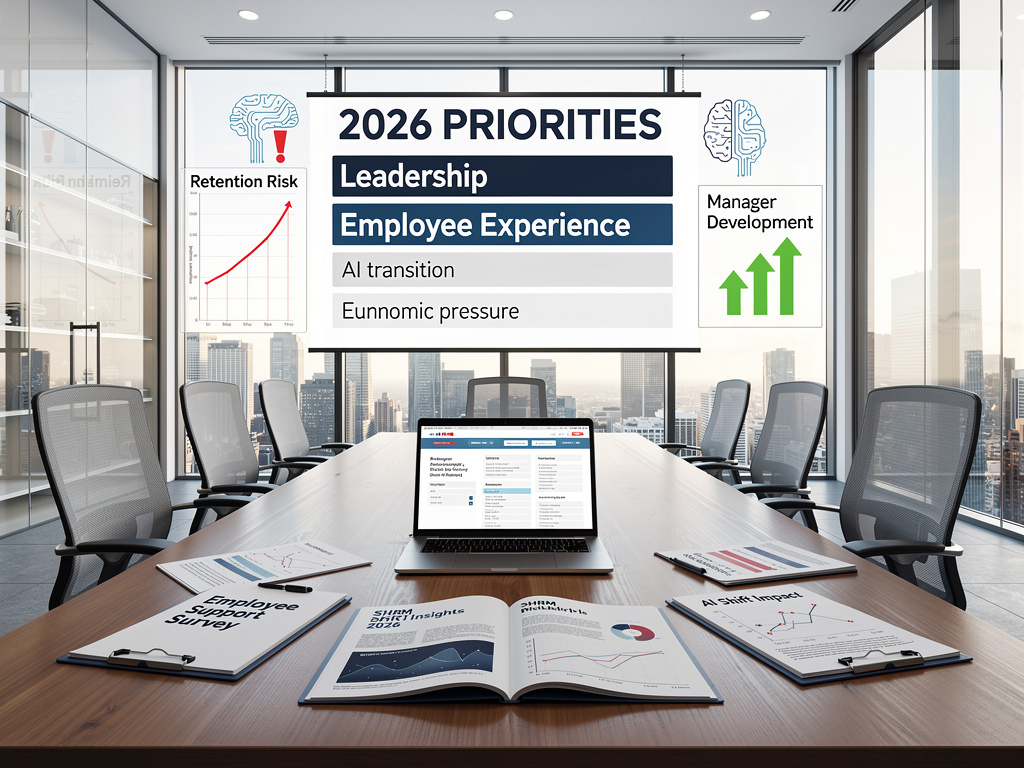
Effective leadership and management emerged as the paramount concern for U.S. employers entering 2026, eclipsing persistent issues like salaries and burnout, according to the Society for Human Resource Management’s (SHRM) 2026 State of the Workplace report. Surveying 1,856 HR professionals and executives from Oct. 24 to Nov. 6, alongside 2,079 workers from Oct. 31 to Nov. 7, the study revealed a workforce grappling with heightened expectations amid economic pressures.
“Our research shows investing in leadership and employee experience remains essential for organizational health,” said Jim Link, SHRM’s chief human resource officer. The findings, while not sector-specific, resonate across industries, including senior living, where operators face similar talent strains, as noted in McKnight’s Senior Living.
Seventy-two percent of HR leaders reported workers demanding more from employers, a trend fueling dissatisfaction. Among those viewing their organizations as ineffective at meeting needs, job satisfaction plummeted to 44%, versus 91% for effective ones, with 51% of the former group eyeing exits within a year.
CHROs Double Down on Managers
SHRM’s companion 2026 CHRO Priorities and Perspectives report, based on 129 top HR executives surveyed Oct. 7 to Nov. 5, underscored leadership development as the top focus for the second straight year, cited by 46% of chief HR officers. Employee experience ranked for 29%, while workplace culture emphasis jumped to 31% from 15% in 2025.
Economic uncertainty supplanted wage inflation as the chief worry, with 43% flagging rising operational costs and 42% financial goal pressures. Yet, 92% anticipate deeper AI integration in operations, and 84% expect AI upskilling surges, positioning tech as an enabler, not a human replacement.
“By blending technology with the irreplaceable value of human connection, leaders create work environments ready to adapt, grow and thrive,” Link added. Expectations include more transparency in leadership (40%), multigenerational workforce management (47%), and AI hiring bias reduction (57%).
Burnout and Retention Pressures Mount
Beyond SHRM, DHR Global’s Workforce Trends Report 2026 surveyed 1,500 knowledge workers across regions, pinpointing declining engagement, rising burnout, and AI-driven change as core hurdles. Professional development topped engagement drivers at 71%, outpacing hybrid work (63%) and GenAI tools (55%).
Culture emerged vital, deemed somewhat or very important to experience by 93%. Clear AI communication boosted engagement most in tech (37%), but leadership gaps persisted: 69% of C-suites claimed clarity versus just 12% of entry-level staff. Burnout afflicted 83%, steady from 2025.
Frontline disconnects amplify risks. HR Executive reported 72% of frontline workers lack company strategy grasp, with over three-fourths feeling unheard by leaders, per Unily’s chief people officer Jenny Shiers. Gallup data showed 98% of CHROs dissatisfied with performance management.
AI’s Double-Edged Sword
AI acceleration demands human-centric countermeasures. SHRM stressed “high-touch leadership” amid 92% expecting broader integration. PwC’s global survey found over 80% of daily GenAI users anticipating efficiency gains, yet EY noted leadership communication gaps and training shortfalls threatening agentic AI enthusiasm.
HR Executive highlighted performance overhaul needs, with Klaar’s Lana Peters advocating continuous feedback over annual reviews. MRA’s Hot Topic survey flagged rising benefits costs (63%), wage pressures, and efficiency shifts, prioritizing onboarding and leadership development.
Hybrid structures evolve: My HR Professionals noted more in-office mandates (three days weekly), demanding structured flexibility. UKG’s 10-country poll showed 76% frontline burnout in 2025, 56% paycheck-to-paycheck living, and 47% sensing dual cultures.
Skills and Culture as Resilience Engines
Upskilling bridges gaps. DHR found workers prioritizing domain expertise (35%), cross-functional knowledge (29%), soft skills like leadership (22%), and AI literacy (13%). AIHR’s statistics linked diverse executive teams to financial gains, with 25% of employees feeling non-belonging.
Zoom’s data revealed hybrid norms (63% leaders, 53% employees splitting time), but Gen Z shuns leadership roles (6%). Situational’s trends forecast human-centered approaches amid flatter structures and burnout, urging learning cultures.
Employers must act: predictable schedules, financial security, growth paths, and feedback loops curb turnover. As SHRM warned, balancing tech with human elements builds enduring resilience.


 WebProNews is an iEntry Publication