
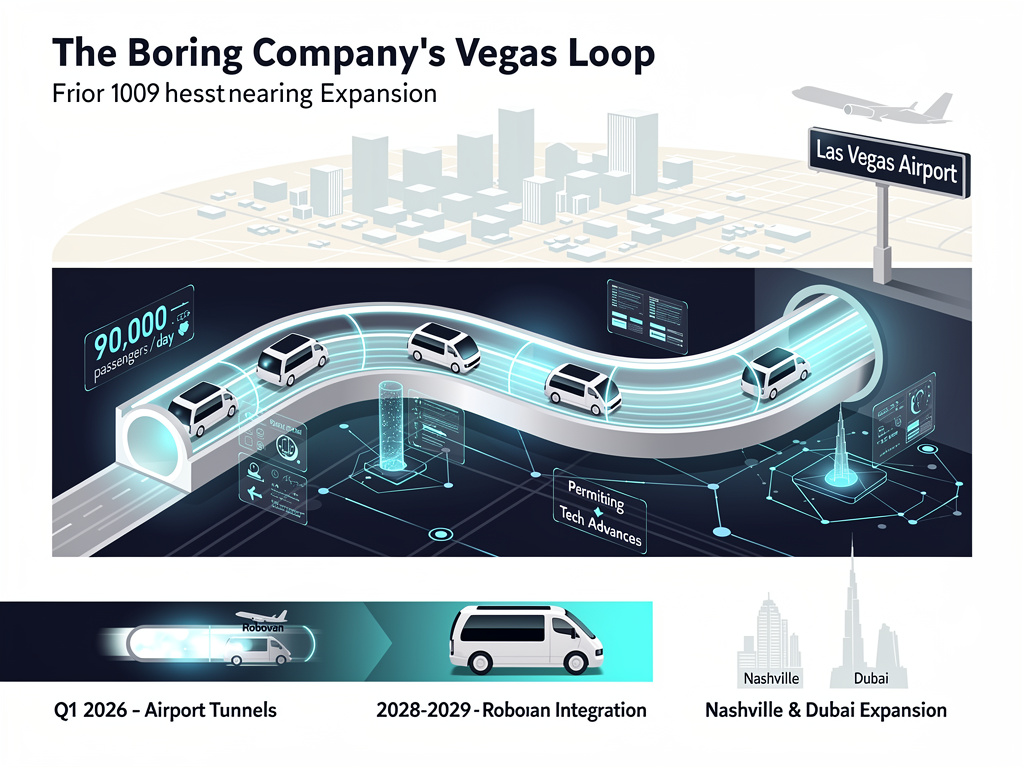
Elon Musk’s Boring Company is pushing forward with aggressive expansions of its Vegas Loop underground transit system, aiming to link Las Vegas’s key destinations with a network of tunnels that could transform urban mobility. Company President Steve Davis recently outlined detailed timelines for new tunnel segments, airport integration, and the eventual deployment of Tesla’s Robovan, signaling a shift toward higher-capacity autonomous transport. With over three million passengers already served, the system is scaling rapidly amid permitting hurdles and technological leaps.
The Vegas Loop currently operates about four miles of tunnels with eight stations, including connections to the Las Vegas Convention Center, Resorts World, Westgate, and Encore. Recent milestones include the start of limited rides to Harry Reid International Airport, where passengers can be dropped off after traveling through existing tunnels and surfacing north of the terminals. Boring Company began picking up airport passengers this week after outfitting 100 of its 130 Tesla vehicles with required transponders, offering around 50 rides per day.
Land acquisitions, such as the $5.96 million purchase near the airport at 5032 Palo Verde Road, underscore the company’s commitment to seamless integration. Testing of Full Self-Driving technology in tunnels and the addition of Cybertrucks to the fleet further bolster operational efficiency.
Phased Airport Connectivity Unfolds
Phase 1 of the airport service launched last month, allowing drop-offs from existing stations like Resorts World and the convention center. Phase 2, involving a 2.2-mile dual-direction tunnel from Westgate to 4744 Paradise Road, is set to open in the next couple of months. This will reduce above-ground travel, with vehicles reaching speeds of 60 mph in the new University Center Loop segment—up from 35 mph in current tunnels. The fleet will expand to 160 Teslas upon completion.
Phase 3 extends tunneling to the Palo Verde station south of Tropicana Avenue, eliminating surface delays at key intersections. Multiple stations are planned along this loop, including at Virgin Hotels Las Vegas, a Boring Company-owned apartment complex, and former sites like Gordon Biersch Brewery. By this stage, the fleet could reach 250-300 vehicles, according to Davis in a Review-Journal interview.
Phase 4 envisions a direct station at the airport terminals, with subsurface access targeted for Q1 2026. Davis emphasized that full subsurface operations could cut travel times dramatically, such as 85 seconds from Encore to the convention center.
Permitting Bottlenecks Slow Full Build-Out
The ambitious 68-mile Vegas Loop with 104 stations requires over 600 building permits from Clark County. Each permit takes about six months to approve, with Boring securing one every one to two weeks. Davis noted the company could have completed the entire system by now with faster processes and is negotiating streamlined agreements with county officials.
Core Strip and resort tunnels are slated to begin construction in fall 2025, potentially finishing in 2027. Extensions to downtown, Chinatown, Allegiant Stadium, and south Strip areas may not complete until 2028 or 2029 at current permitting speeds, per the Review-Journal.
Despite delays, progress is evident: 3.41 miles of new tunnels recently completed, including a 2.26-mile segment. The project will use over one million cubic yards of concrete—more than the Pentagon or Allegiant Stadium combined—marking it as potentially the largest active U.S. infrastructure effort, as posted by The Boring Company on X.
Robovan Integration Boosts Capacity
Upon Strip and downtown completion, the Tesla fleet could swell to 1,200 vehicles. That’s when Robovan enters, designed for high-demand events like Allegiant Stadium games, ferrying multiple passengers to shared destinations. Integration is eyed for 2028-2029, aligning with full Vegas Loop maturity, according to NextBigFuture.
Vegas Loop’s full vision targets 90,000 passengers per hour, connecting the Strip, downtown, UNLV, and the airport. Recent CES operations transported over 90,000 passengers, including Full Self-Driving trips between the convention center and Encore, highlighting reliability.
Tunneling technology drives this scale: Prufrock machines now exceed 100 meters per day, with goals of 140 meters short-term and up to 3,400 meters weekly long-term via Prufrock-5 and beyond. A global control center in Texas enables remote operations, while FSD eliminates drivers.
Nashville and Dubai Ventures Emerge
Beyond Vegas, the Music City Loop plans a 10-mile tunnel from Nashville International Airport to downtown and the convention center, with up to 20 stations. Prufrock-MB1, the first international hard-rock tunnel boring machine, has shipped, followed by Prufrock-MB2 in January 2026. Geotechnical work is underway, per Nashville Scene.
Dubai signed a 2025 MOU for a 17-kilometer pilot with 11 stations. In Texas, R&D includes CyberTunnel at Giga Texas and seven tunnels across cities, plus Hyperloop testing for intercity speeds.
UNLV recently declined a campus station but permitted tunneling under a parking lot, as reported by Las Vegas Weekly.
2026 Milestones and Beyond
Expect Q1 2026 subsurface airport access in Vegas and University Center Loop operations. Nashville groundbreaking could yield early segments by spring or fall. Dubai construction starts, with Prufrock-6/7 enabling zero-person-in-tunnel mining. Fleet and FSD expansions aim for 20,000 passengers per hour in Vegas segments, per NextBigFuture projections.
By 2027, Nashville may fully operate, Vegas reach 20-30 miles operational, and U.S. expansions like Orlando advance. Cumulative tunneling could hit 100-200 miles, with revenue from fees potentially reaching $100-500 million.
2028 brings Vegas toward 50% completion, Dubai online, and Robovan deployment. Broader scaling could span 5-10 projects, aligning with Musk’s 10,000-mile vision by 2030.


 WebProNews is an iEntry Publication