
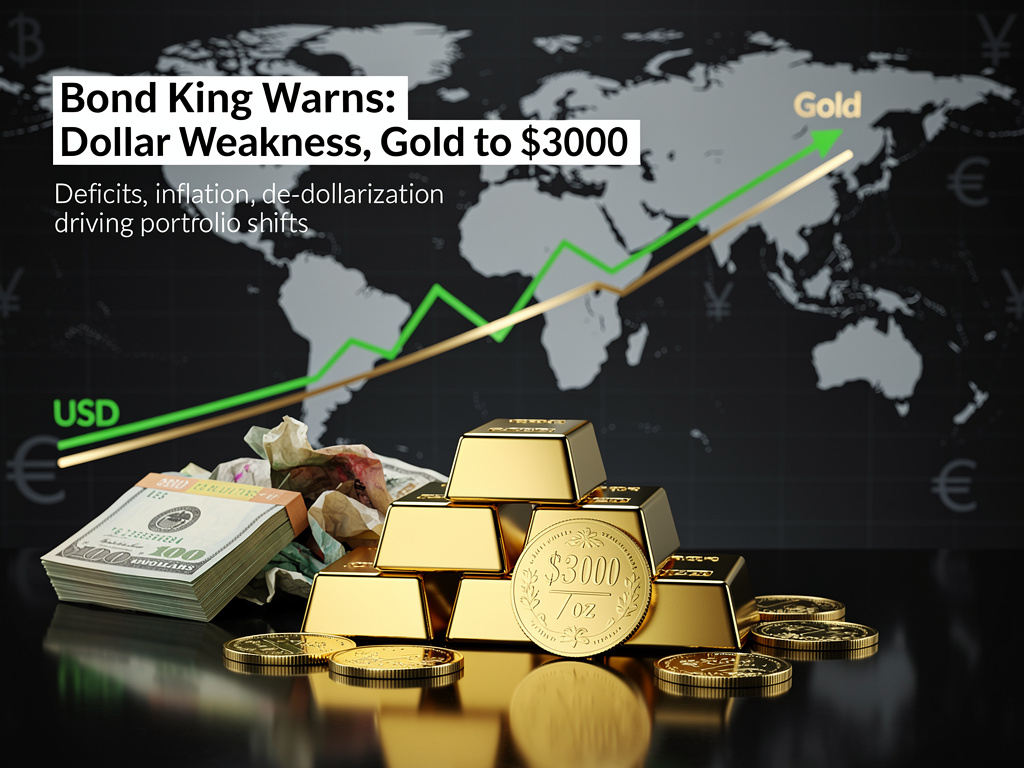
Jeffrey Gundlach, the billionaire investor known as the “Bond King” for his prescient market calls, is sounding alarm bells about the U.S. dollar’s trajectory while positioning for a significant rally in gold prices. Speaking at a recent investment conference, the founder and chief executive of DoubleLine Capital outlined a contrarian investment thesis that challenges conventional Wall Street wisdom about American economic exceptionalism and the greenback’s enduring strength.
According to Business Insider, Gundlach predicts the dollar will weaken substantially in the coming years, driven by mounting federal deficits, inflationary pressures, and a potential shift in global reserve currency dynamics. The veteran money manager, who oversees more than $90 billion in assets, argues that investors should reduce their exposure to dollar-denominated assets and increase allocations to gold, which he believes could surge to $3,000 per ounce or higher within the next 18 to 24 months.
This bearish dollar outlook represents a notable shift from the consensus view among many institutional investors, who have grown accustomed to the greenback’s resilience despite recurring predictions of its demise. Gundlach’s track record, however, commands attention. He correctly predicted the 2008 financial crisis, called the bottom in Treasury yields in 2020, and accurately forecasted inflation’s return when most economists dismissed such concerns as transitory.
Deficit Dynamics and Currency Credibility
At the heart of Gundlach’s thesis lies a fundamental concern about America’s fiscal trajectory. The federal government’s budget deficit has expanded dramatically in recent years, reaching levels typically associated with wartime or severe economic crises. With the deficit approaching $2 trillion annually and total federal debt exceeding $35 trillion, Gundlach argues that international confidence in the dollar as the world’s primary reserve currency faces an existential test.
The bond manager points to historical precedents where reserve currencies lost their privileged status following prolonged periods of fiscal mismanagement. While the British pound’s decline from global dominance took decades, Gundlach suggests that modern financial markets could accelerate such transitions. He notes that central banks worldwide have been diversifying their reserve holdings, reducing dollar allocations in favor of gold, euros, and even yuan-denominated assets.
Gundlach’s concerns extend beyond simple deficit arithmetic. He emphasizes that the weaponization of the dollar through sanctions and financial restrictions has prompted many nations to seek alternatives to dollar-based transactions. This de-dollarization trend, while gradual, could accelerate if geopolitical tensions intensify or if the U.S. continues to deploy its currency as a foreign policy tool. The implications for American borrowing costs and living standards could prove profound if foreign appetite for Treasury securities wanes.
The Golden Opportunity in Precious Metals
Gold has long served as a hedge against currency debasement and economic uncertainty, and Gundlach believes the metal is positioned for a historic bull market. Central bank purchases of gold have reached record levels, with institutions from China to Poland accumulating physical bullion at an unprecedented pace. This official sector demand provides a fundamental floor under gold prices, even as private investors remain relatively underweight the asset.
The DoubleLine chief executive notes that gold’s performance in various currency terms reveals the metal’s underlying strength. While dollar-denominated gold prices have advanced modestly in recent years, gold has reached all-time highs when measured in euros, yen, and numerous emerging market currencies. This divergence suggests that the dollar’s relative strength has masked gold’s true momentum, a dynamic that could reverse sharply if the greenback weakens as Gundlach anticipates.
Technical factors also support Gundlach’s bullish gold thesis. Mining production has plateaued, with few major discoveries in recent years and rising extraction costs limiting supply growth. Meanwhile, industrial and technological demand for gold continues expanding, particularly in electronics and renewable energy applications. The combination of constrained supply, robust central bank buying, and potential investment demand creates what Gundlach describes as a “perfect storm” for higher prices.
Inflation’s Persistent Shadow
Underpinning Gundlach’s investment recommendations is a conviction that inflation will prove more persistent than Federal Reserve officials and many market participants expect. While headline consumer price increases have moderated from their 2022 peaks, the bond manager argues that structural factors will prevent a return to the low-inflation regime that characterized the 2010s.
Demographic shifts, including aging populations in developed economies and tight labor markets, are pushing wages higher across multiple sectors. Deglobalization and supply chain reconfiguration following the pandemic have increased production costs, while the energy transition requires massive capital investments that will likely translate into higher consumer prices. Gundlach contends that the Fed’s 2% inflation target may prove unattainable without triggering a severe recession, a trade-off policymakers appear unwilling to accept.
The implications for bond investors are particularly concerning in Gundlach’s view. If inflation remains elevated while the Fed maintains relatively accommodative monetary policy to support economic growth and government financing needs, real yields on Treasury securities could remain negative or barely positive. This environment would punish traditional bond portfolios while favoring real assets like gold, commodities, and inflation-protected securities.
Portfolio Positioning for Currency Volatility
Translating these macro views into actionable investment strategies, Gundlach recommends a significant overweight to gold and precious metals miners within diversified portfolios. He suggests allocations of 10% to 15% for conservative investors and potentially higher percentages for those with greater risk tolerance. The bond manager emphasizes physical gold or securities backed by physical metal rather than paper derivatives, citing counterparty risks in complex financial instruments.
Beyond gold, Gundlach advocates for international diversification, particularly in emerging markets with strong commodity sectors and improving fiscal positions. He notes that many developing economies have learned from past currency crises and now maintain more prudent policies than some developed nations. Select Asian and Latin American markets offer attractive valuations and could benefit from a weaker dollar, which typically supports commodity prices and emerging market assets.
Within fixed income portfolios, Gundlach favors shorter-duration bonds and floating-rate securities that adjust to changing interest rates. He remains cautious on long-dated Treasuries, viewing them as vulnerable to both inflation surprises and potential foreign selling. Corporate credit in sectors with pricing power and hard asset backing receives more favorable assessments than companies dependent on cheap financing or discretionary consumer spending.
Contrarian Risks and Alternative Scenarios
Despite his conviction, Gundlach acknowledges that his dollar bearish thesis faces significant headwinds. The U.S. economy has demonstrated remarkable resilience, with productivity growth accelerating and corporate profitability remaining robust. American capital markets continue to dominate globally, attracting investment flows that support the dollar regardless of fiscal concerns. The lack of viable alternatives to the dollar as a reserve currency remains perhaps the strongest argument for continued greenback strength.
Technology sector dominance, particularly in artificial intelligence and digital infrastructure, could extend American economic advantages and dollar demand. If productivity gains from AI adoption exceed current expectations, they might offset fiscal concerns and support higher asset valuations. Additionally, geopolitical instability often drives safe-haven flows to dollar assets, potentially overwhelming the de-dollarization trend Gundlach anticipates.
The bond manager also concedes that central bank policies remain unpredictable, with the potential for more aggressive inflation fighting than markets currently expect. A determined Fed willing to tolerate recession to restore price stability could strengthen the dollar and pressure gold prices, at least temporarily. However, Gundlach views such scenarios as increasingly unlikely given political pressures and the government’s financing requirements.
Historical Parallels and Future Implications
Gundlach draws parallels between the current environment and the 1970s, when persistent inflation, expanding deficits, and currency instability drove gold from $35 per ounce to over $800. While he doesn’t predict an exact replay of that tumultuous decade, he believes similar forces are aligning to support precious metals and challenge dollar hegemony. The key difference, he notes, is the much larger scale of global debt and the interconnectedness of modern financial markets, which could amplify volatility.
The investment implications extend beyond individual portfolios to broader questions about American economic policy and global financial architecture. If Gundlach’s predictions prove accurate, the U.S. government may face difficult choices between fiscal consolidation, financial repression through negative real rates, or accepting diminished international influence. For investors, positioning for such scenarios requires moving beyond traditional asset allocation frameworks toward strategies that explicitly hedge currency and inflation risks.
As markets digest these warnings from one of fixed income’s most respected voices, the debate over dollar dominance and monetary stability intensifies. Whether Gundlach’s bearish dollar call proves as prescient as his previous predictions remains to be seen, but his arguments reflect growing unease about America’s fiscal trajectory and the sustainability of current policy approaches. For investors seeking to preserve purchasing power in an uncertain environment, his emphasis on gold and real assets offers a time-tested, if contrarian, path forward.


 WebProNews is an iEntry Publication