
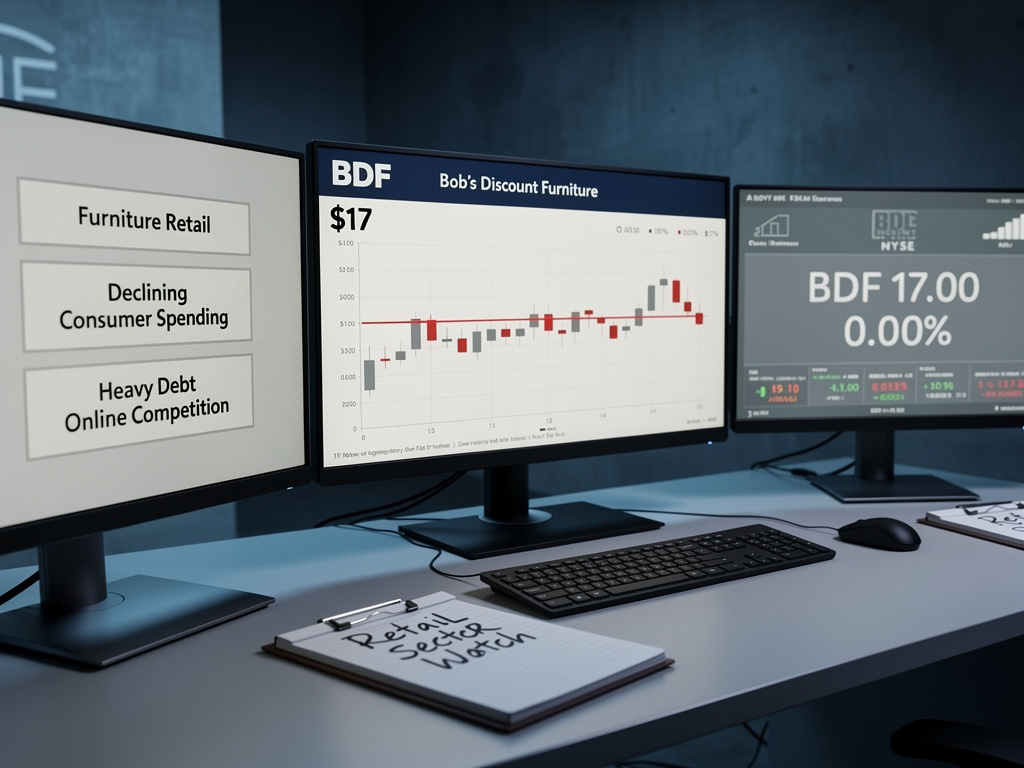
Bob’s Discount Furniture made its long-anticipated debut on the New York Stock Exchange Thursday morning, pricing its initial public offering at $17 per share and opening at precisely that level in what industry observers characterized as a notably subdued entrance to public markets. The Connecticut-based furniture retailer’s flat opening contrasts sharply with the exuberant first-day pops that characterized many recent IPOs, reflecting broader concerns about consumer discretionary spending and the challenges facing brick-and-mortar retailers in an increasingly digital marketplace.
According to CNBC, the company priced its offering at the lower end of expectations, raising approximately $340 million through the sale of 20 million shares. The proceeds will primarily be used to pay down existing debt accumulated during its years under private equity ownership by Bain Capital, which acquired the company in 2014 for approximately $1 billion. The muted reception suggests investors remain skeptical about the furniture retailer’s growth prospects despite its established presence across the Eastern United States.
The timing of Bob’s Discount Furniture’s public offering comes at a particularly challenging moment for the home furnishings sector. Consumer spending on furniture and home goods has declined substantially from pandemic-era peaks, when homebound Americans invested heavily in upgrading their living spaces. Industry data indicates that furniture sales have contracted by double digits year-over-year as inflation-weary consumers prioritize essential purchases over discretionary home improvements.
Private Equity Exit Strategy Meets Market Reality
Bain Capital’s decision to take Bob’s Discount Furniture public represents a classic private equity exit strategy, though one that may not deliver the returns the firm initially envisioned. During its twelve-year ownership period, Bain expanded Bob’s footprint from approximately 50 stores to more than 165 locations across 24 states, while simultaneously loading the company with significant debt to fund aggressive expansion and extract dividends. The company’s debt burden, estimated at over $800 million prior to the IPO, has raised concerns among analysts about its financial flexibility in a deteriorating retail environment.
The furniture retailer’s business model centers on offering value-priced furniture with an emphasis on customer service and same-day delivery capabilities in many markets. Founded in 1991 by Bob Kaufman in Manchester, Connecticut, the company built its reputation on accessible pricing and a no-pressure sales approach that resonated with budget-conscious consumers. However, the competitive dynamics have shifted dramatically in recent years with the rise of online furniture retailers like Wayfair and the expansion of IKEA’s U.S. presence, forcing traditional furniture stores to adapt or perish.
Structural Challenges Facing Furniture Retail
The furniture retail sector has undergone seismic shifts over the past decade, with numerous legacy players filing for bankruptcy or substantially downsizing their operations. Art Van Furniture, once the Midwest’s largest furniture retailer, liquidated in 2020. Pier 1 Imports closed all stores the same year. More recently, Bed Bath & Beyond’s collapse sent shockwaves through the home goods sector, underscoring the existential challenges facing retailers that failed to successfully transition to omnichannel models.
Bob’s Discount Furniture has invested in e-commerce capabilities, but online sales still represent a relatively modest portion of overall revenue compared to pure-play digital competitors. The company’s reliance on physical showrooms creates a significant fixed-cost structure that becomes particularly burdensome during periods of declining foot traffic. Real estate expenses, coupled with labor costs for sales associates and delivery personnel, compress margins in ways that digital-native competitors can avoid.
Macroeconomic Headwinds Intensify
The broader macroeconomic environment presents additional obstacles for Bob’s Discount Furniture as it enters public markets. The Federal Reserve’s extended period of elevated interest rates has dampened housing turnover, which traditionally drives furniture purchases as homebuyers furnish new residences. Existing home sales remain near decade lows, directly impacting demand for furniture and home furnishings. Additionally, persistent inflation has squeezed household budgets, forcing consumers to delay major discretionary purchases.
Tariff uncertainty adds another layer of complexity to the company’s outlook. A substantial portion of furniture sold in the United States is manufactured overseas, particularly in China and Southeast Asia. Any escalation in trade tensions or imposition of additional import duties could significantly impact Bob’s cost structure and force difficult decisions about whether to absorb higher costs or pass them along to price-sensitive customers. The company’s discount positioning leaves limited room for price increases without risking customer defection to competitors.
Competitive Pressures From All Directions
Bob’s Discount Furniture faces competition from multiple directions, each presenting distinct challenges. On the value end, Big Lots and discount chains offer low-priced furniture alternatives, while mid-market players like Ashley HomeStore and Rooms To Go compete for similar customer demographics. At the premium end, Restoration Hardware and Crate & Barrel appeal to affluent consumers willing to pay higher prices for design and quality. Meanwhile, online retailers like Wayfair, Amazon, and Overstock.com offer vast selection and convenience without requiring showroom visits.
The company’s geographic concentration in the Eastern United States, while providing operational efficiencies, also limits its addressable market compared to national competitors. Expansion into new markets requires substantial capital investment in showrooms, distribution centers, and delivery infrastructure—commitments that become riskier in an uncertain economic environment. The company must balance growth ambitions against the imperative to reduce its debt burden and demonstrate profitability to public market investors.
Investor Skepticism Reflects Broader Retail Concerns
The flat opening price for Bob’s Discount Furniture shares reflects investor skepticism about retail IPOs more broadly. Recent years have witnessed numerous high-profile failures among newly public retailers, from Casper Sleep’s disappointing performance to the struggles of direct-to-consumer brands that went public during the SPAC boom. Investors have become increasingly discriminating, demanding clear paths to profitability and sustainable competitive advantages rather than simply betting on growth narratives.
Institutional investors who participated in the IPO likely secured shares at the offering price with plans to flip them for quick gains, but the absence of first-day momentum suggests limited appetite from retail investors and momentum traders. The subdued debut may actually prove beneficial in the long term if it sets more realistic valuation expectations and attracts shareholders focused on fundamentals rather than speculation. However, it also limits the company’s ability to raise additional capital at attractive valuations should operational needs arise.
Strategic Imperatives for Public Company Success
As a newly public company, Bob’s Discount Furniture faces pressure to articulate a compelling growth strategy that differentiates it from competitors while addressing the structural challenges facing furniture retail. Key priorities likely include accelerating e-commerce penetration, optimizing the store footprint to focus on high-performing locations, and enhancing supply chain efficiency to reduce costs. The company must also invest in data analytics and customer relationship management to better understand purchasing patterns and personalize marketing efforts.
Same-day and next-day delivery capabilities represent potential competitive advantages that could justify premium pricing relative to online-only competitors. However, maintaining the logistics infrastructure to support rapid delivery is capital-intensive and operationally complex. The company must demonstrate that these services drive customer loyalty and repeat purchases sufficient to justify the investment. Additionally, expanding private-label offerings could improve margins while creating product differentiation that reduces direct price comparisons with competitors.
The furniture retailer’s ability to navigate the transition from private to public ownership will depend heavily on execution across multiple dimensions simultaneously. Management must balance the demands of quarterly earnings expectations with long-term strategic investments, all while managing a substantial debt load that limits financial flexibility. The company’s performance in coming quarters will provide crucial signals about whether Bob’s Discount Furniture can successfully compete in an increasingly challenging retail environment or whether it becomes another cautionary tale of private equity-backed retailers struggling under debt burdens in difficult market conditions.
The muted market debut ultimately reflects a more mature and skeptical investor base that has learned painful lessons from previous retail IPOs. For Bob’s Discount Furniture to win over these investors, it must demonstrate consistent execution, market share gains, and progress toward deleveraging its balance sheet. The road ahead promises to be challenging, with little margin for error in an unforgiving sector where consumer preferences and competitive dynamics continue to evolve rapidly.


 WebProNews is an iEntry Publication