
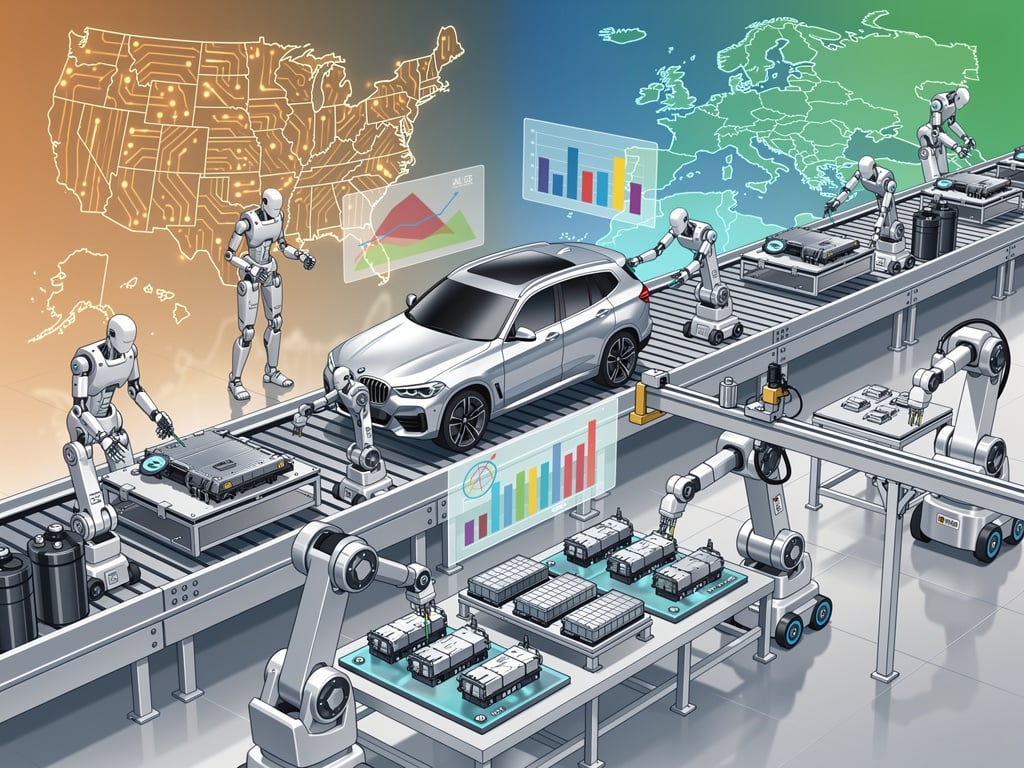
BMW Group has moved beyond experiments. After an 11-month trial at its Spartanburg, South Carolina plant, the automaker is expanding humanoid robots into European production. The results from America surprised even the company’s own engineers. Two Figure 02 robots logged 1,250 runtime hours. They handled more than 90,000 parts. They contributed to the assembly of over 30,000 BMW X3 vehicles.
And the numbers kept climbing. Ten-hour shifts, five days a week. Success rates improved dramatically over time. The deployment, detailed by Figure AI, marked one of the first sustained real-world uses of bipedal humanoids on an active automotive line. Figure has since retired the 02 fleet as it shifts focus to the next generation. BMW, for its part, shows no signs of slowing down.
The German manufacturer announced in late February that it would deploy humanoid robots at its Leipzig plant in Germany. This marks the first such effort in a European BMW facility. Two AEON robots from Hexagon Robotics, a unit of the Swiss measurement technology giant, have already begun test work. An initial deployment occurred in December 2025. Further testing starts in April 2026. Full pilot operations are scheduled for summer 2026. The robots will tackle high-voltage battery assembly and other component manufacturing tasks that combine precision with physical repetition.
Michael Nikolaides, head of process management and digitalisation at BMW, didn’t mince words. “This will be the future of automotive production,” he told the BBC. His confidence rests on data from Spartanburg and a deliberate internal strategy. BMW created a Center of Competence for Physical AI in Production. The Munich-based team coordinates research, programming, and on-site support across plants. It draws specialists from around the world.
The Spartanburg pilot delivered more than raw output. Figure 02 robots started slow. Early success hovered around 70 percent on certain tasks. By the end, the system achieved consistent performance that impressed plant managers. The robots positioned sheet metal for welding in the body shop. They walked more than 1.2 million steps. They operated alongside human workers without major safety incidents. Yahoo Finance reported that the trial exceeded BMW’s expectations on multiple fronts.
Yet success came with lessons. Integration required extensive safety protocols. Programming had to account for the unpredictable nature of a moving assembly line. Retrofitting existing factory infrastructure proved expensive and time-consuming. Still, the payback looked promising. Repetitive, ergonomically challenging jobs that contribute to worker fatigue and injury now have a potential alternative. BMW executives see humanoids not as replacements but as collaborators that free people for higher-value work.
Hexagon Robotics brings a different design philosophy. Unlike Figure’s fully bipedal platform, the AEON robot combines legs with wheels for faster movement across long factory distances. Its hands offer a wide range of grips. The hybrid mobility suits the layout of BMW’s iFACTORY in Leipzig, which produces electric vehicles and combustion models on the same lines. Early lab tests and the December 2025 factory trial convinced BMW to accelerate.
The move aligns with broader industry pressure. Labor shortages, aging workforces in Germany, and rising demand for electric vehicles have pushed automakers to explore every automation avenue. Mercedes, Volkswagen, and others watch closely. Tesla pushes its own Optimus project. But few have matched BMW’s documented production hours. The Spartanburg results, shared openly by Figure AI, provide rare transparency in a field often dominated by glossy videos and vague timelines.
Brett Adcock, founder of Figure, highlighted the achievement. The 11-month run proved humanoids could handle the physical and cognitive demands of automotive work at scale. As the company retires Figure 02, it folds those learnings directly into Figure 03. BMW has not confirmed a follow-on contract, but the pattern suggests continued cooperation. The Leipzig pilot will test different tasks in a different regulatory environment. European works councils and stricter safety rules add complexity.
Costs remain a central question. Humanoid robots still carry high price tags. Maintenance, software updates, and energy consumption add to the total. BMW has declined to disclose specific return-on-investment figures. Industry analysts estimate that payback periods must fall below three years to justify widespread adoption. The Spartanburg data offers the first real benchmark. If uptime stays high and task success rates hold above 95 percent, the math improves quickly.
Suppliers sense opportunity. Actuator makers, sensor companies, and AI software firms court BMW’s competence center. Hexagon itself already supplies metrology equipment to multiple BMW plants. The robotics partnership builds on that relationship. Other vendors, including those from Asia, pitch aggressively. The field grows crowded. Differentiation now depends on proven factory hours rather than prototype demonstrations.
BMW’s approach stands out for its pragmatism. No grand pronouncements about transforming the entire industry overnight. Instead, targeted pilots in carefully chosen processes. The company tests, measures, iterates. It treats Physical AI as another tool in the manufacturing toolkit, not a silver bullet. That mindset has served BMW well in everything from flexible assembly lines to digital twins.
Leipzig represents the next proving ground. Success there could open doors across BMW’s global network. Plants in China, Mexico, and elsewhere face their own labor and efficiency challenges. A standardized humanoid platform, even with local adaptations, offers intriguing possibilities. The company has hinted at expanding its Center of Competence staff and deepening partnerships.
Challenges persist. Battery assembly involves high voltages and delicate components. Any mistake carries financial and safety risks. Human supervision will remain essential for years. Training the robots for new tasks still requires significant engineering effort. Generalization across vehicle models and plant layouts has yet to be fully demonstrated.
But the trajectory looks clear. BMW has doubled its commitment. From one U.S. pilot to a European production test in under two years. The data from Spartanburg provided the evidence. The AEON robots in Leipzig will supply the next chapter. Industry insiders expect more announcements before year-end. Other automakers may accelerate their own programs once BMW publishes additional performance metrics.
The factory floor is changing. Human workers and humanoid robots now share space in ways once confined to science fiction. BMW isn’t predicting the end of human labor in auto plants. It is betting that smart, adaptable machines can handle the dull, dirty, and dangerous parts. So far, the bet pays off. Thirty thousand cars later, the case grows stronger.


 WebProNews is an iEntry Publication