
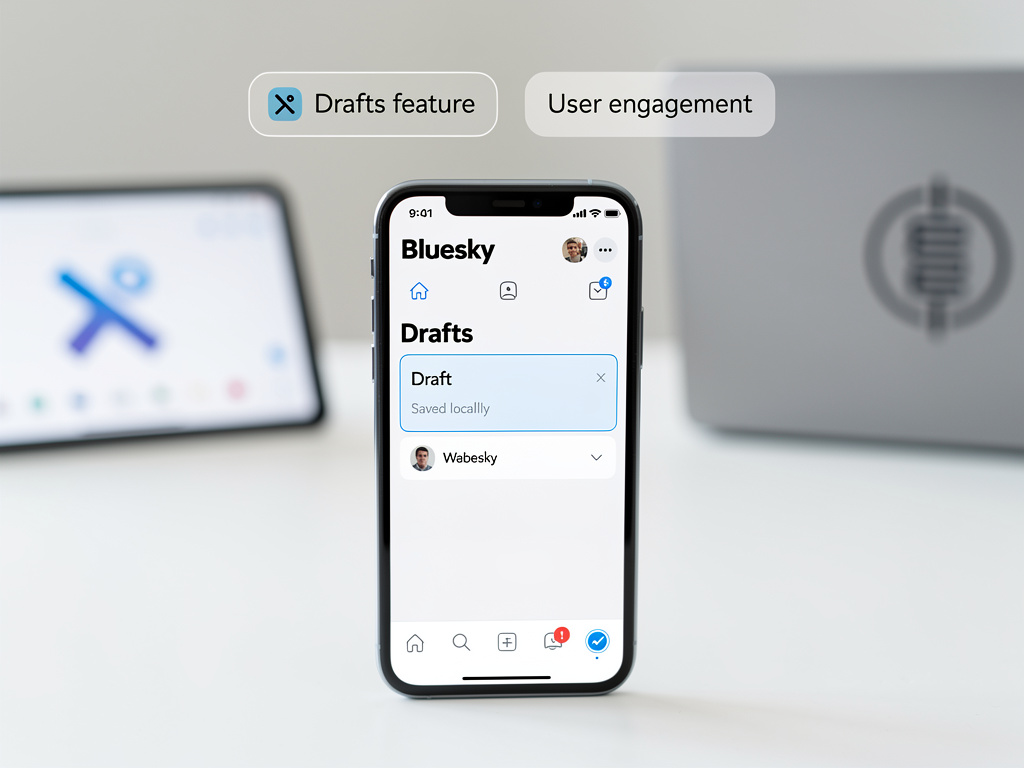
For years, users of Bluesky — the decentralized social media platform born out of a Twitter-funded research initiative — have pleaded for one of the most basic features in digital communication: the ability to save a draft. That wait is finally over. Bluesky has rolled out a drafts feature, a seemingly modest addition that nonetheless carries outsized significance for a platform positioning itself as a serious alternative to X, Meta’s Threads, and the broader constellation of social networking services.
The announcement, first reported by TechCrunch, confirms that Bluesky users can now save unfinished posts and return to them later — a capability that has been standard on competing platforms for years. The feature is available on both iOS and Android versions of the Bluesky app, as well as the web client, and allows users to store multiple drafts simultaneously. For a platform that has attracted millions of users in recent months, the addition addresses one of the most frequently requested quality-of-life improvements in Bluesky’s community forums and feedback channels.
A Feature That Took Longer Than Expected — And Why That Matters
The road to drafts on Bluesky has been a long one. Users have been requesting the feature since the platform’s earliest invite-only beta days in 2023. Community feedback threads on Bluesky’s official GitHub repository and within the app itself have consistently ranked drafts among the top desired features, alongside direct messaging improvements and better content moderation tools. The delay in shipping such a fundamental feature underscores both the challenges and the philosophy of Bluesky’s development approach.
Bluesky operates on the AT Protocol, an open and decentralized framework that allows for federated social networking. Unlike centralized platforms where feature development follows a relatively straightforward engineering pipeline, building on a decentralized protocol introduces additional layers of complexity. Data persistence, synchronization across clients, and ensuring that drafts remain private and local to a user’s device rather than being broadcast across the protocol’s relay infrastructure all required careful architectural decisions. According to TechCrunch, Bluesky’s engineering team opted to store drafts locally on users’ devices, a design choice that prioritizes privacy but means drafts won’t sync across multiple devices — at least not yet.
The Competitive Calculus: Small Features, Big Stakes
To industry observers, the drafts rollout is more than a checkbox on a product roadmap. It is a signal that Bluesky is entering a phase of maturation where polish and feature parity with established competitors become critical to user retention. The platform experienced explosive growth in late 2024 and into 2025, fueled in large part by waves of users departing X amid controversies surrounding owner Elon Musk’s management decisions, content moderation policies, and political entanglements. Bluesky surpassed 25 million registered users in early 2025 and has continued to climb since.
But attracting users is only half the battle. Retaining them requires delivering the kind of seamless, friction-free experience that power users — journalists, creators, academics, and public figures who drive engagement on any social platform — have come to expect. The absence of drafts was a recurring pain point, particularly for users who compose longer, more considered posts. Writers and journalists, who often draft and revise before publishing, found the lack of this feature particularly frustrating. Its arrival removes a tangible barrier to the kind of thoughtful, high-quality content creation that Bluesky has sought to cultivate as part of its brand identity.
How the Feature Works in Practice
The implementation is straightforward. When composing a post, users now see a save option that stores the in-progress post to a dedicated drafts folder accessible from the compose screen. Multiple drafts can be saved, edited, and deleted. The feature supports text, images, and link cards, meaning users can build out a fully formed post and return to it at their convenience. As reported by TechCrunch, the current version does not support cross-device syncing, so a draft saved on a user’s iPhone will not appear on their desktop browser session. Bluesky has indicated that cross-device sync is a possibility for future updates but has not committed to a timeline.
This local-storage approach is consistent with Bluesky’s broader emphasis on user privacy and data minimization. By keeping drafts on-device, Bluesky avoids creating yet another data store on its servers that could become a target for breaches or subpoenas. It also sidesteps potential complications with the AT Protocol’s data model, which is designed around public and semi-public social interactions rather than private, unpublished content. The tradeoff is convenience, but for privacy-conscious users — a demographic that Bluesky has actively courted — it may be a welcome one.
Bluesky’s Broader Product Momentum
The drafts feature arrives amid a broader acceleration of Bluesky’s product development cadence. Over the past several months, the platform has shipped a series of updates aimed at closing the gap with more established competitors. These include improvements to its direct messaging system, the introduction of video support, enhanced content moderation tools including configurable labeling systems, and the rollout of custom feeds powered by algorithmic choice — a signature differentiator that allows users to curate their own experience rather than being subject to a single, opaque recommendation engine.
Bluesky has also made strides in building out its developer ecosystem. The AT Protocol’s open nature means that third-party developers can build alternative clients, custom feed generators, and moderation services. This ecosystem approach mirrors the early days of Twitter’s developer platform, which was instrumental in driving innovation before Twitter progressively restricted API access — a history that Bluesky’s leadership has explicitly cited as a cautionary tale and a motivation for their open approach.
The Revenue Question Looms Large
For all its product progress, Bluesky faces existential questions about sustainability. The company, which spun out as an independent public benefit corporation, has raised venture capital but has yet to articulate a clear revenue model. Competitors like X and Threads benefit from the financial backing of massive parent companies — X through Musk’s broader business empire and Threads through Meta’s advertising juggernaut. Bluesky has hinted at potential subscription tiers and premium features as future revenue streams, but specifics remain scarce.
Industry analysts note that features like drafts, while not directly monetizable, contribute to the kind of user engagement and retention metrics that underpin any future business model. A platform where users invest time crafting and saving posts is a platform where users are deeply engaged — and deeply engaged users are the foundation upon which advertising, subscriptions, or other monetization strategies can be built. The question is whether Bluesky can reach the scale and engagement levels necessary to sustain itself before its runway runs out.
What Comes Next for the Decentralized Challenger
Looking ahead, Bluesky’s product roadmap is expected to continue prioritizing features that enhance usability and attract mainstream users. Cross-device draft syncing, improved search functionality, analytics tools for creators, and expanded video capabilities are all areas where the platform currently trails its competitors. The company has also signaled interest in enabling more robust identity verification and trust signals — features that could prove critical as the platform scales and faces the inevitable challenges of spam, impersonation, and misinformation that plague every social network at scale.
The drafts feature, modest as it may seem, represents something larger: evidence that Bluesky is listening to its community and executing on their feedback, even if the pace has at times tested users’ patience. In a social media environment where trust between platforms and their users has eroded significantly, that responsiveness may prove to be Bluesky’s most valuable asset. For the millions of users who have made the leap to a decentralized alternative, the ability to save a draft is a small but meaningful affirmation that they chose a platform that is, however gradually, building something worth staying for.


 WebProNews is an iEntry Publication