
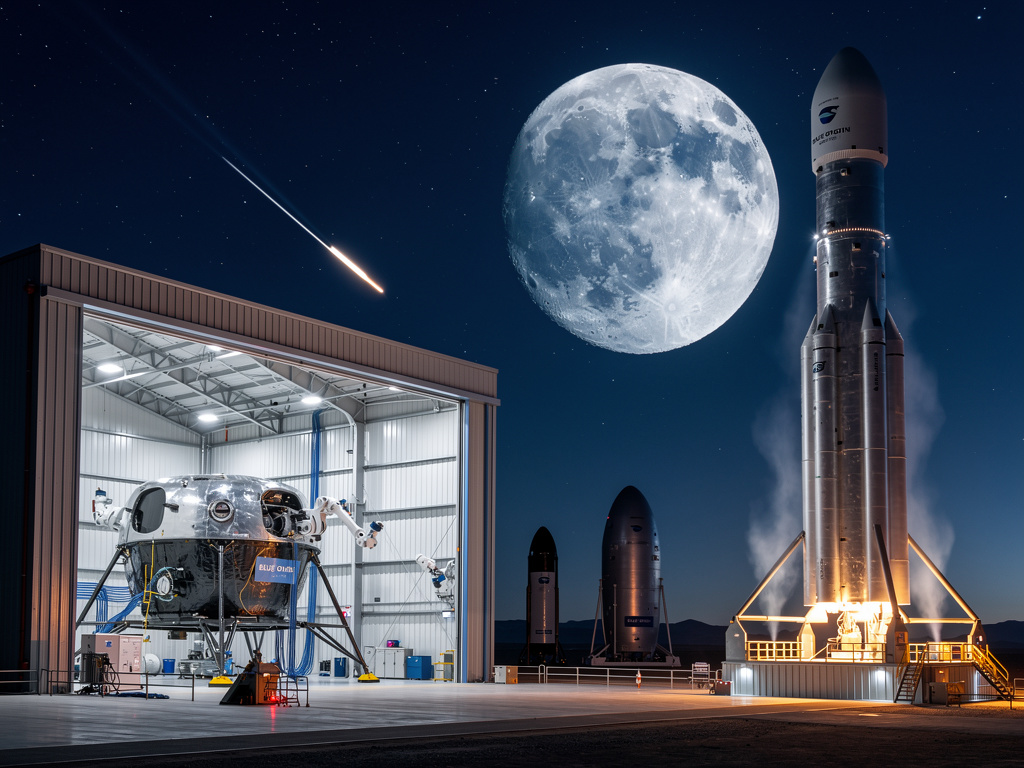
Jeff Bezos’s Blue Origin has announced an unexpected two-year suspension of its New Shepard space tourism flights, marking a dramatic strategic shift as the company redirects its resources toward lunar ambitions and the development of its New Glenn orbital rocket. The decision, which effectively sidelines the suborbital tourism program that carried celebrities and wealthy adventurers to the edge of space, signals a fundamental recalibration of priorities as Blue Origin faces mounting pressure to deliver on NASA contracts and compete in the increasingly crowded commercial space sector.
According to Slashdot, the pause comes as Blue Origin intensifies work on its Blue Moon lunar lander, a critical component of NASA’s Artemis program designed to return humans to the lunar surface. The company has not flown a crewed New Shepard mission since August 2022, and this formal pause represents an acknowledgment that the tourism business, while generating headlines, cannot compete for resources with more lucrative government contracts and the company’s long-delayed orbital ambitions.
The timing of this announcement reveals the harsh economic realities facing even well-funded space ventures. While Blue Origin has benefited from Bezos’s deep pockets—the Amazon founder has reportedly invested more than $10 billion of his personal fortune into the company—the need to demonstrate tangible progress on contracted deliverables has become paramount. The New Glenn rocket, which has faced numerous delays and is now targeting its maiden flight in 2025, represents Blue Origin’s ticket to competing directly with SpaceX in the lucrative satellite launch market and government missions.
The Economics of Space Tourism Versus Government Contracts
The suspension underscores a broader industry trend: space tourism, despite its publicity value, remains a marginal business compared to government contracts and commercial satellite launches. New Shepard flights, which take passengers on brief 10-minute journeys to the Karman line, reportedly cost the company millions per launch while generating revenue from ticket sales estimated at $200,000 to $300,000 per seat. With only six seats per flight, the math simply doesn’t compete with NASA’s $3.4 billion contract for the Blue Moon lander or the potential revenue from New Glenn orbital launches.
Industry analysts have long questioned the sustainability of suborbital tourism as a standalone business model. Virgin Galactic, Blue Origin’s primary competitor in this segment, has similarly struggled to make the economics work, facing its own operational challenges and questions about market demand at current price points. The pause suggests that even Bezos, with his virtually unlimited resources, has concluded that suborbital tourism cannot justify the engineering talent and manufacturing capacity it consumes when those resources could accelerate more strategically important programs.
NASA’s Artemis Program: The Real Prize
Blue Origin’s Blue Moon lander represents the company’s most significant opportunity to establish itself as an indispensable partner in America’s return to lunar exploration. As part of NASA’s Artemis program, which aims to land astronauts on the Moon’s south pole by 2026, Blue Origin is developing a human landing system that will compete with SpaceX’s Starship variant. The $3.4 billion contract, awarded in 2023, provides not only substantial revenue but also validation of Blue Origin’s technical capabilities in a field where SpaceX has dominated headlines.
The lunar lander program demands resources across multiple disciplines: advanced propulsion systems, life support technologies, precision landing capabilities, and integration with NASA’s Gateway space station. Each of these areas requires sustained engineering focus and testing infrastructure that cannot be easily divided with a concurrent tourism operation. By consolidating resources, Blue Origin can accelerate development timelines and reduce the risk of costly delays that might jeopardize its standing with NASA.
The stakes extend beyond a single contract. Success with Blue Moon could position Blue Origin as NASA’s preferred partner for future lunar infrastructure, including potential permanent bases, resource extraction operations, and Mars mission staging. These opportunities dwarf the tourism market in both scale and duration, representing decades of potential contracts worth tens of billions of dollars. Failure, conversely, would likely cement SpaceX’s dominance and potentially relegate Blue Origin to secondary status in the new space economy.
New Glenn: The Orbital Imperative
Perhaps even more critical than the lunar program is Blue Origin’s need to finally launch New Glenn, the company’s heavy-lift orbital rocket that has been in development since 2012. The rocket, standing 320 feet tall and capable of lifting 45 metric tons to low Earth orbit, represents Blue Origin’s answer to SpaceX’s Falcon Heavy and its pathway to competing for the most lucrative launch contracts. After years of delays, the company has indicated that New Glenn’s debut is imminent, with launch infrastructure at Cape Canaveral’s Launch Complex 36 now complete.
The commercial launch market has evolved dramatically during New Glenn’s protracted development. SpaceX has achieved routine reusability with its Falcon 9 rocket, dramatically reducing launch costs and capturing the majority of commercial satellite contracts. United Launch Alliance, Blue Origin’s customer for BE-4 engines, has begun flying its new Vulcan rocket. Even newer entrants like Rocket Lab are expanding capabilities. New Glenn must not only work—it must prove competitive on cost, reliability, and cadence to justify its existence in this crowded market.
Blue Origin has already secured several launch contracts for New Glenn, including missions for Amazon’s Project Kuiper satellite constellation, NASA science missions, and commercial telecommunications satellites. However, these contracts depend on successful flight demonstrations, and further delays could result in cancellations or customers seeking alternatives. The company’s decision to pause tourism operations suggests an all-hands-on-deck approach to ensuring New Glenn’s success, recognizing that failure is not an option for a program that has consumed more than a decade of development.
The Bezos Factor: Patience Wearing Thin
While Jeff Bezos has demonstrated remarkable patience with Blue Origin’s methodical development approach—embodied in the company’s Latin motto “Gradatim Ferociter” (Step by Step, Ferociously)—there are signs that even his tolerance for slow progress has limits. The company has undergone significant leadership changes in recent years, including the departure of CEO Bob Smith in 2023 and his replacement by Dave Limp, a former Amazon executive known for driving execution and meeting deadlines. This shift toward more Amazon-style management suggests a new emphasis on delivery over perfectionism.
Bezos’s public statements have also evolved. While he once spoke primarily about Blue Origin’s long-term vision of millions of people living and working in space, recent comments have focused more on near-term milestones and competitive positioning relative to SpaceX. This rhetorical shift reflects a growing recognition that Blue Origin must demonstrate concrete achievements to maintain credibility with customers, partners, and the broader space industry. The tourism pause, viewed through this lens, represents a pragmatic acknowledgment that the company has overstretched itself and must prioritize.
Competitive Dynamics: The SpaceX Shadow
No discussion of Blue Origin’s strategic choices can ignore the SpaceX factor. Elon Musk’s company has achieved what many considered impossible: routine rocket reusability, a thriving commercial crew program, thousands of Starlink satellites deployed, and rapid progress toward the fully reusable Starship system. SpaceX’s success has fundamentally altered the competitive dynamics of the space industry, forcing rivals to either match its pace or find alternative niches where they can compete effectively.
Blue Origin’s decision to pause tourism while doubling down on lunar and orbital capabilities can be understood as an attempt to compete where SpaceX’s advantages are less overwhelming. While SpaceX dominates low Earth orbit operations, the lunar surface represents relatively uncharted territory where Blue Origin’s methodical engineering approach and focus on reliability might prove advantageous. Similarly, New Glenn’s design prioritizes payload fairing volume and flexibility, potentially offering advantages for certain mission types even if it cannot match Falcon 9’s cost per kilogram.
However, SpaceX is not standing still. The company’s Starship system, once operational, will offer capabilities that dwarf anything currently flying, including New Glenn. With its massive payload capacity and fully reusable design, Starship could make traditional rockets economically obsolete for many applications. This looming threat adds urgency to Blue Origin’s need to establish market position and technical credibility before Starship reaches operational status, likely within the next few years.
What the Pause Means for Space Tourism’s Future
Blue Origin’s two-year suspension raises fundamental questions about the near-term viability of suborbital space tourism as an industry. With Virgin Galactic struggling to achieve profitability and Blue Origin stepping back, the market that once seemed poised for rapid growth now appears more nascent than many predicted. The high costs of operations, limited market size at current price points, and intense resource requirements may mean that space tourism remains a boutique offering rather than a significant business for years to come.
The pause does not necessarily signal Blue Origin’s permanent exit from tourism. Company statements suggest the program will resume after the two-year hiatus, presumably once New Glenn is operational and Blue Moon development is further advanced. However, the tourism business that eventually returns may look quite different, potentially operating at lower frequency or with modified economics that better align with the company’s broader strategic priorities. Some industry observers speculate that Blue Origin might eventually transition New Shepard operations to a separate subsidiary or even sell the program to focus entirely on orbital and lunar activities.
For the paying customers who have waited years for their flights—some reportedly purchasing tickets as far back as 2019—the announcement brings frustration and uncertainty. While Blue Origin has indicated it will honor existing commitments when flights resume, the extended delay tests customer patience and raises questions about whether the company can rebuild momentum in a market where novelty and timeliness matter significantly. The risk is that by the time New Shepard returns to service, potential customers will have found alternative ways to spend their discretionary millions or lost interest entirely.
Industry Implications and the Road Ahead
The broader space industry will watch Blue Origin’s refocused efforts with intense interest. Success with New Glenn and Blue Moon would validate the company’s patient approach and establish it as a credible alternative to SpaceX for critical missions. It would also demonstrate that well-funded competition can eventually catch up even to seemingly insurmountable leads, providing hope for other space ventures struggling to gain traction. Conversely, continued delays or technical failures would raise serious questions about Blue Origin’s execution capabilities and potentially trigger more dramatic restructuring.
The next 24 months will prove decisive. New Glenn must fly successfully and begin building a launch cadence that demonstrates reliability. Blue Moon must progress through critical design reviews and testing milestones that keep the program on track for its NASA delivery dates. And Blue Origin must prove it can operate with the urgency and efficiency that the modern space industry demands, shedding its reputation for cautious incrementalism in favor of aggressive execution.
For Jeff Bezos, the stakes are both financial and legacy-related. Having invested a significant portion of his wealth into Blue Origin with relatively little to show compared to SpaceX’s achievements, he needs the company to deliver breakthrough successes that justify the investment and cement his place in space history. The tourism pause, while disappointing to those awaiting flights, may ultimately be remembered as the moment Blue Origin finally got serious about competing in the new space economy—or as a sign that even unlimited resources cannot overcome execution challenges in one of humanity’s most demanding technical endeavors.


 WebProNews is an iEntry Publication