
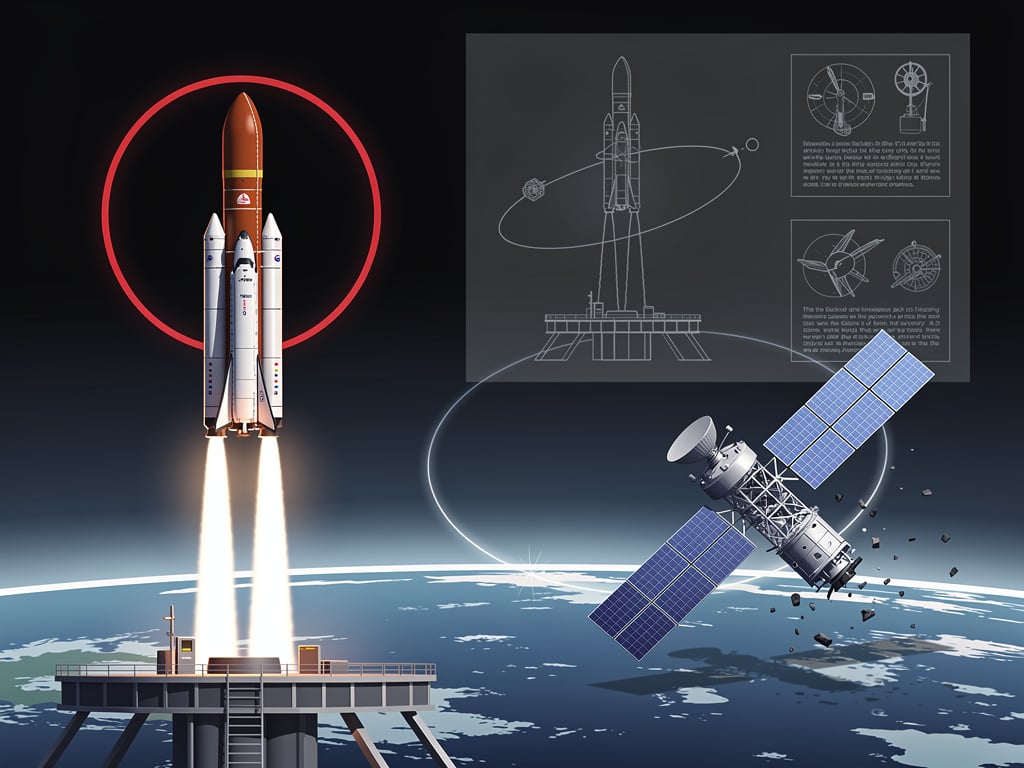
Blue Origin’s New Glenn rocketed skyward Sunday from Cape Canaveral Space Force Station, marking a pivotal moment in the company’s push toward reusable orbital launches. Liftoff came at 7:25 a.m. EDT on April 19, 2026, with the first stage—christened ‘Never Tell Me The Odds’—roaring to life on seven methane-burning BE-4 engines. Three minutes later, it separated cleanly. Less than ten minutes after that, the booster touched down precisely on the Jacklyn recovery ship, 400 miles offshore in the Atlantic. First reuse of an orbital-class booster for Jeff Bezos’s firm. A win.
But the mission’s core goal crumbled higher up. The upper stage, equipped with twin BE-3U hydrogen-oxygen engines, aimed to deliver AST SpaceMobile’s BlueBird 7 satellite—a six-ton behemoth with a 2,400-square-foot antenna for direct-to-smartphone broadband—into a circular 285-mile orbit at 49 degrees inclination. It needed two burns: one to reach orbit, another to circularize. The first worked. The second didn’t. Telemetry showed the payload released into an off-nominal path, perigee scraping just 95 miles above Earth. Too low. Atmospheric drag inevitable.
AST SpaceMobile confirmed separation and power-up, but quickly assessed the damage. “While the satellite separated from the launch vehicle and powered on, the altitude is too low to sustain operations with its on-board thruster technology and will [be] de-orbited,” the company stated, expecting insurance to cover costs (TechRadar). BlueBird 7, the second full-scale unit in a planned swarm, now faces burnout on reentry. AST plans 45 more launches by year-end, with BlueBird 8-10 shipping in 30 days.
Blue Origin posted updates on X: “We have confirmed payload separation. AST SpaceMobile has confirmed the satellite has powered on. The payload was placed into an off-nominal orbit. We are currently assessing and will update when we have more detailed information.” (Blue Origin on X). CEO Dave Limp later elaborated: “Early data suggest that on our second GS2 burn, one of the BE-3U engines didn’t produce sufficient thrust to reach our target orbit. Blue Origin is leading the anomaly investigation with FAA oversight to learn from the data and implement the improvements needed to quickly return to flight operations.” (Dave Limp on X).
The FAA wasted no time. It classified NG-3 as a mishap, grounding New Glenn pending investigation. “The FAA is aware that Blue Origin New Glenn 3 experienced a mishap during the second-stage flight sequence following a successful launch,” the agency said. Return to flight hinges on proving public safety fixes (Engadget). This echoes a prior grounding after the debut flight’s booster landing flop.
New Glenn’s path here reveals hard truths. Flight one in January 2025 nailed orbital insertion, per Limp. NG-2 in November sent NASA’s Mars probes on target, with the booster recovered offshore for the first time (Ars Technica). Now 1-for-3 on perfect missions. Upper stages snag even veterans—SpaceX’s Falcon 9 boasts near-flawless boosters but has lost a handful to second-stage woes. Starship tests last year fared worse.
For Blue Origin, stakes climb. This reuse proves the 320-foot rocket can refurbish and refl y its beefy first stage, outscaling the suborbital New Shepard’s routine hops. Technicians swapped all seven engines for NG-3, testing nozzle thermal shields; future flights will reuse NG-2’s powerplants. Yet payload delivery defines viability. Customers like Amazon’s Kuiper—Bezos’s broadband rival to Starlink—demand reliability. Kuiper has 241 birds up via rivals; direct-to-cell lags SpaceX’s 650+ capable sats serving T-Mobile users.
AST SpaceMobile feels the pinch short-term. Shares dipped below the 50-day moving average post-launch. But multi-launch pacts with Blue Origin and SpaceX buffer the blow. BlueBird 7’s solo ride spared worse carnage.
Limp’s team eyes NG-4 soonish, then Kuiper barrages and Blue Moon Mark 1—a lunar lander demo for NASA’s Artemis. That $3.4 billion program eyes permanent Moon bases; Blue Origin bids against SpaceX’s Starship. Reliability gaps hurt. SpaceX flies Falcon 9s weekly, boosters turning around in days. Blue Origin’s five-month NG-2 to NG-3 gap stemmed from first-time refurb.
Space stays unforgiving. One engine sputters. Satellites tumble. But data from this flight—booster telemetry pristine, upper stage logs rich—fuels fixes. Blue Origin paused New Shepard tourism in January to chase these bigger prizes. NG-3’s split verdict underscores why. Triumph below. Debacle above. Forward.


 WebProNews is an iEntry Publication