
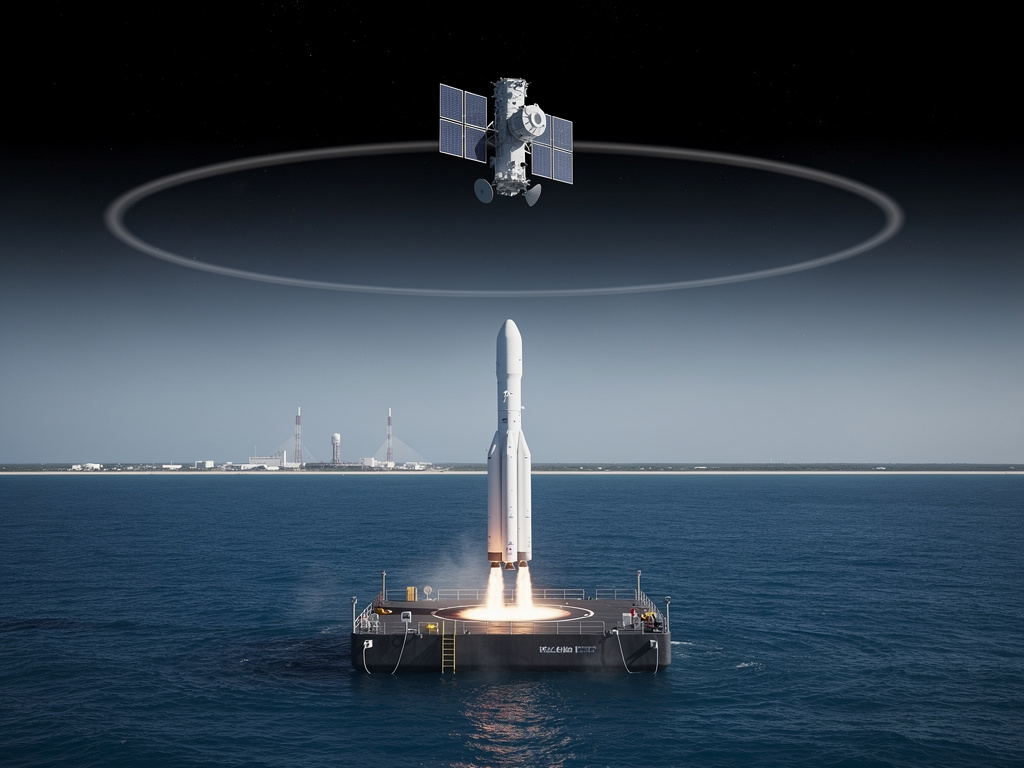
Blue Origin’s New Glenn rocket roared off the pad at Cape Canaveral Space Force Station on April 19, 2026, at 7:25 a.m. EDT. Liftoff marked the third flight for Jeff Bezos’s heavy-lift vehicle—and the first reuse of its first-stage booster. The booster, dubbed “Never Tell Me the Odds,” separated cleanly 3.5 minutes in. Ten minutes after launch, it touched down precisely on the droneship Jacklyn in the Atlantic. Blue Origin engineers erupted in cheers.
Victory for reusability. But not the full mission. The second stage faltered. AST SpaceMobile’s BlueBird 7 satellite deployed about 75 minutes post-liftoff. It powered on successfully. Yet Blue Origin confirmed it reached an off-nominal orbit—lower than the targeted 460 km low Earth orbit. “We have confirmed payload separation. AST SpaceMobile has confirmed the satellite has powered on. The payload was placed into an off-nominal orbit,” the company posted on X. Assessment underway.
Partial triumph amid high stakes. New Glenn stands 321 feet tall, powered by methane and hydrogen. Its seven BE-4 engines on the first stage mimic SpaceX’s Falcon 9 playbook. This reuse—after refurbishing with new engines and thermal upgrades—ends SpaceX’s nine-year monopoly on orbital booster reflights. “NG-3 is a huge flight for us. It’s the first flight of our reflown booster,” said Jordan Charles, Blue Origin’s VP of New Glenn, during commentary. “Definitely super proud of our refurbishment team.” (Space.com)
New Glenn’s Rocky Path to Orbit
First flight came January 16, 2025, reaching orbit with a pathfinder payload. NG-2 in November 2025 nailed the initial booster landing. NG-3 pushed further: reuse. Delays plagued the program since 2016 announcements. Billions spent. NASA contracts helped. Now, eight to 12 launches eyed for 2026. CEO Dave Limp boasted, “We have plenty of hardware to do that,” citing surging demand from satellite internet firms. (Fortune)
But upper stage woes persist. SpaceNews reported a second-stage malfunction on NG-3, likely a BE-3U engine relight failure during its 68-second burn. Previous flights hinted at restart challenges for these vacuum-optimized engines. The satellite, a 6,100 kg Block 2 BlueBird with a 2,400 sq ft solar array, aims to beam cellular broadband direct to phones. AST SpaceMobile plans 45-60 satellites by year-end. BlueBird 7’s ion thrusters might raise its orbit—burning extra fuel, shortening life. Insurance likely covers losses. (SpaceNews)
Countdown hiccups added tension. A hold at T-3:57 for an undisclosed issue. Scrubs marked early days, like the inaugural attempt in 2025. Weather cooperated at 90% favorable odds.
And competition looms large. SpaceX dominates with Falcon 9’s rapid reuse—hundreds of flights. New Glenn’s larger fairing could stack multiple satellites. Blue Origin pitches alternatives: orbital data centers, government connectivity nets. Paused New Shepard tourism to chase lunar landers. Mark 1 Blue Moon has “a very good chance” of moon landing this year, Limp said. Both firms hold NASA Artemis contracts for 2028 human landings.
Payload Dreams Meet Orbital Reality
AST SpaceMobile races Starlink and Amazon’s Project Kuiper. BlueBird 7 expands direct-to-smartphone service, targeting rural gaps. Chairman Abel Avellan said, “We remain on track to achieve our target of deploying 45 to 60 satellites… we expect the New Glenn booster to be reused every 30 days.” (Spaceflight Now)
Off-nominal insertion hurts. Lower orbit means drag, faster decay without correction. Thrusters designed for raising—but fuel margins tight. Florida Today captured the update: satellite healthy, orbit wrong. Jeff Bezos shared booster landing video on X, flames billowing as it settled on Jacklyn. No comment on the glitch.
Industry watches closely. Reusability slashes costs, opens markets. Blue Origin joins the club. Upper stage fixes needed fast. Demand swells—satellite constellations multiply. Limp noted, “demand is going up.” New Glenn’s cadence must accelerate. Booster every 30 days? Ambitious. Engines from NG-2 slated for future reuse.
So where next? Flight 4 eyes March 2026 window, per manifests. Vandenberg prep advances West Coast ops. Lunar missions loom. NASA Mars science launch awarded. But today’s split result tempers hype. Booster flawless. Payload adrift. Space demands perfection across stacks. Blue Origin iterates. SpaceX did too, years back. Catch-up mode persists.
Rivals circle. Amazon eyes Globalstar buy. (Bloomberg) Starlink blankets orbits. Blue Origin diversifies: data centers, moon tech. Reusability win buoys stock—invisible to public markets, but Bezos pours in. Partial success. Forward momentum. Orbit anomaly? Fixable. The race heats.


 WebProNews is an iEntry Publication