
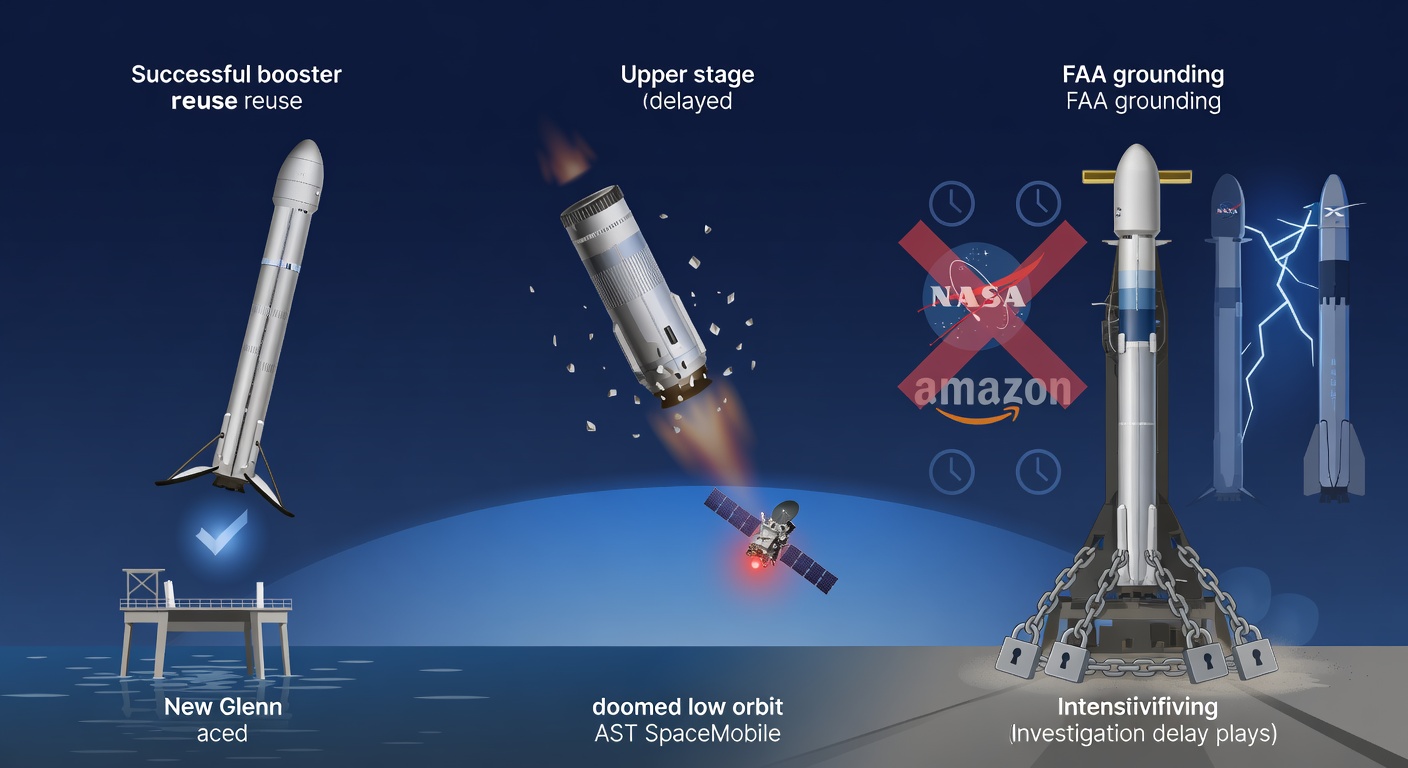
Blue Origin’s ambitious push into orbital launches hit a snag Sunday. The company’s New Glenn rocket, on its third flight dubbed NG-3, lifted off from Cape Canaveral Space Force Station at 7:25 a.m. The reusable first-stage booster—named “Never Tell Me The Odds” and flying for the second time—performed flawlessly. It separated, then touched down 375 miles downrange on the recovery vessel Jacklyn in the Atlantic. A milestone. Reuse works.
But the upper stage faltered. Badly. It deployed AST SpaceMobile’s BlueBird 7 communications satellite into an off-nominal orbit—about 95 miles high instead of the targeted 285 miles. Too low. The satellite powered on briefly after separation. Then it began deorbiting. Reentry destroyed it.
Blue Origin CEO Dave Limp pinned the blame on one of the two BE-3U engines. “One of the BE-3U engines didn’t produce sufficient thrust,” he said in a statement posted on X Monday. That shortfall hit during the critical second burn, which circularizes the orbit. Early data points there. No public injuries. No property damage. Still, a failure.
The Federal Aviation Administration moved fast. It classified the event a mishap and grounded New Glenn pending investigation. Blue Origin leads the probe, under FAA oversight. They must identify the root cause, propose fixes, and get approval before flying again. Past cases dragged on for months—like after New Glenn’s debut in January 2025, when a booster landing flop kept it sidelined until spring.
AST SpaceMobile, building a space-based cellular network to rival Starlink, took the hit. Shares dropped 14% in premarket trading Monday, per Seeking Alpha. The company shrugged it off publicly. “The altitude is too low to sustain operations with its on-board thruster technology and will de-orbited,” they stated Sunday evening. Insurance covers the loss. Plans call for launches every one to two months through 2026, backed by deals with multiple providers. BlueBird 8 waits in the wings.
New Glenn’s Rocky Path to Maturity
This wasn’t Blue Origin’s first brush with New Glenn trouble. The rocket debuted January 16, 2025, reaching orbit but losing its first-stage booster to engine reignition woes during landing. FAA closed that probe in March, clearing seven corrective actions on propellant and engine controls, per SpaceNews. Flight 2 succeeded fully, paving for NG-3’s commercial debut. Now grounded again. Pattern emerging.
Competition looms large. SpaceX dominates with Falcon 9, flying near-daily. Starship scales up. United Launch Alliance’s Vulcan eyes certification. Blue Origin needs New Glenn for NASA contracts—like Blue Moon lander on Artemis IV—and Amazon’s Kuiper broadband, which taps the rocket heavily. Delays here ripple. Space Force certification demands four successful orbital launches; NG-3’s flop clouds that, as SpaceNews notes amid provider shortages.
Engine troubles recur. BE-3U powers the upper stage—hydrogen-oxygen, vacuum-optimized kin to New Shepard’s BE-3. Limp’s statement flags insufficient thrust on one. Reuters reports the FAA zeroed in on second-stage failure, with one engine likely misfiring, per Reuters. Blue Origin stays mum on details beyond that. Teams assess telemetry now.
Wall Street Journal called it a stumble on the first commercial mission. “The payload was placed into an off-nominal orbit,” Blue Origin posted on X, per WSJ. Indeed. CNET detailed the sequence: booster success, upper stage shortfall, satellite doom, as in CNET. Satellite Today echoed: grounded, satellite lost after anomaly, via Satellite Today.
So what next? Investigation timelines vary. FAA cleared prior New Glenn issues in weeks to months. Blue Origin eyes quick return—NG-4 looms with more Kuiper birds. But fixes demand rigor. Upper stage redesign? Engine tweaks? Bezos’ firm, now 14,000 strong under Limp, cut 10% last year to streamline. Pressure mounts.
AST pushes ahead. Multiple launchers in pocket—SpaceX, others. One lost bird won’t ground their constellation. Still, cadence slips. Investors watch.
Blue Origin’s boosters shine. Reuse proven. Upper stage? Not yet. Fix it fast. Or rivals pull further ahead.


 WebProNews is an iEntry Publication