
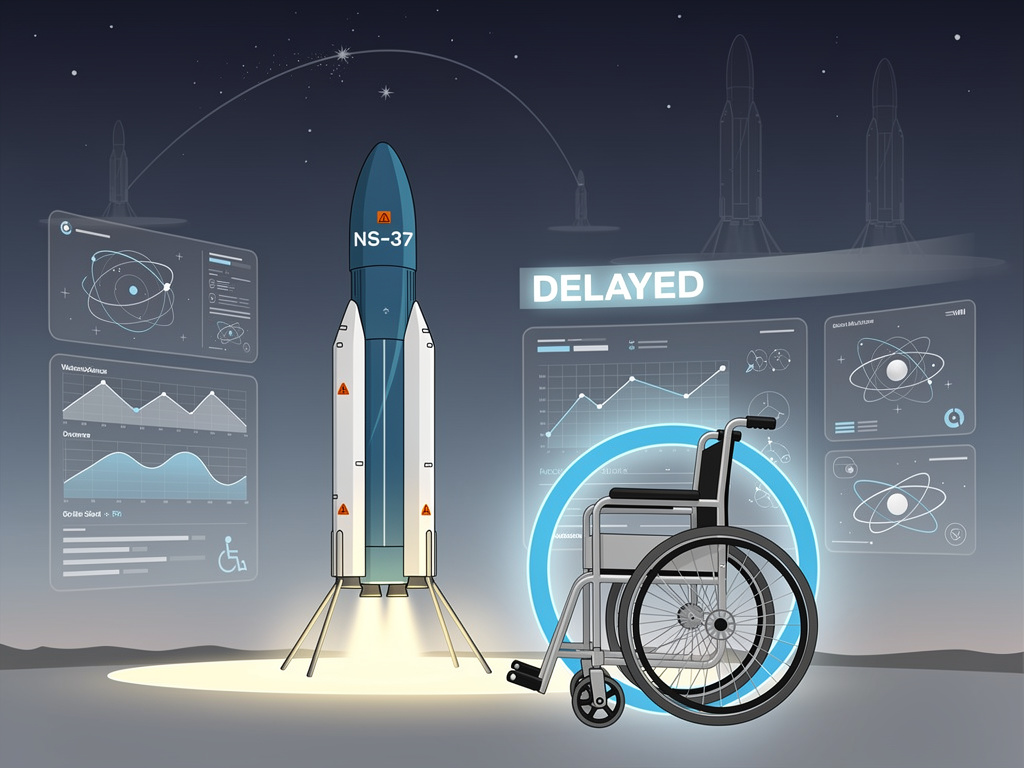
Blue Origin’s New Shepard rocket stood poised on the launch pad in West Texas, ready to etch a new chapter in private spaceflight by sending Michaela Benthaus, the first wheelchair user, beyond Earth’s atmosphere. The mission, designated NS-37, promised not just another tourist jaunt but a milestone in accessibility for space travel. Yet, in a familiar rhythm of the suborbital business, the December 18 liftoff was scrubbed at the eleventh hour due to an unspecified “observation,” delaying Benthaus’s boundary-crossing voyage.
Benthaus, a 34-year-old aerospace engineer at the European Space Agency in Germany, suffered a spinal cord injury from a 2018 mountain biking accident, confining her to a wheelchair. Her inclusion on the six-person crew underscores Blue Origin’s push to broaden who can venture into space. Posts on X from Blue Origin’s official account confirmed the mission was “GO for launch” just a day prior, highlighting Benthaus as the pioneer expanding human spaceflight’s reach.
From Accident to Astronaut Selection
Benthaus’s path to the capsule began with her rigorous career in mechatronics and space systems. After her injury, she channeled resilience into advocacy, clinching a seat through Blue Origin’s competitive auction process. Space.com detailed how the scrub occurred after the crew was cleared and the vehicle was vertical, with liftoff targeted for 10:00 a.m. CST.
The crew also features Kai Koenigsmann, a former SpaceX propulsion vice president who joined Blue Origin this year, adding intrigue to the passenger manifest. CNN noted Koenigsmann’s defection as a coup for founder Jeff Bezos’s venture, blending rival expertise into the flight.
Engineering Accessibility into Orbit
New Shepard’s design emphasizes safety and inclusivity, with modifications ensuring Benthaus could board and endure the 11G ascent and microgravity phase. Blue Origin’s X posts emphasized how astronaut safety permeates every step, from suit pressurization tests to offload systems mimicking zero-G. ABC News reported Blue Origin’s preparations to make history with the first wheelchair user crossing the Kármán line at 100 kilometers.
The vehicle’s reusability—booster landing vertically after separation—has flown 37 missions, carrying over 50 people since 2021. Benthaus’s flight builds on precedents like the all-women crew of NS-31, proving commercial space isn’t just for the able-bodied elite. USA Today outlined viewing options, underscoring public interest in this accessibility leap.
Crew Dynamics and Rival Crossovers
Besides Benthaus and Koenigsmann, the crew includes entrepreneur Rob Ferber, investor Hank Woods, and others bidding through Blue Origin’s platform. Koenigsmann’s shift from SpaceX, where he oversaw Merlin engine development, to Blue Origin’s BE-4 program brings proprietary knowledge to Bezos’s New Glenn ambitions. His presence symbolizes talent wars in the new space economy.
Blue Origin’s X thread on Benthaus revealed her ESA role in interplanetary tech, from 2018 accident recovery to auction win. The company stressed her passion, with posts like one quoting her dedication to scientific collaboration.
Launch Scrub Realities
The abort, per Space.com‘s earlier coverage targeting December 18, stemmed from a last-minute anomaly, halting after pad preparations. Weather, including upper-level winds, had been monitored, but this was technical. Blue Origin’s track record shows scrubs as routine, prioritizing safety over schedules.
Rescheduling eyes December 19 or soon after, with live streams promised on Blue Origin’s site. Times of India profiled Benthaus as a German trailblazer, detailing her engineering feats.
Implications for Commercial Space Access
This mission challenges norms, proving suborbital flights can accommodate disabilities through custom fittings and training. Blue Origin’s auction model, raising millions for spaceflight, democratizes access beyond nation-states. Competitors like Virgin Galactic face similar inclusivity pressures.
Benthaus’s flight aligns with NASA’s Artemis inclusivity goals, where Blue Origin tests suits via ARGOS systems, as noted in recent X updates. Her success could spur standards for paraplegic astronauts on orbital missions.
Business Stakes in Suborbital Tourism
With New Shepard’s cadence resuming post-FAA grounding, Blue Origin eyes 10+ flights yearly, funding orbital pushes. Ticket prices, often $1 million via auction, fund infrastructure. Fox Business highlighted the milestone’s market signal for diverse clientele.
The scrub tests investor patience, but Bezos’s $10 billion commitment buffers delays. Koenigsmann’s hire accelerates BE-4 production for United Launch Alliance, intertwining suborbital with heavy-lift futures.
Broader Industry Ripples
Benthaus embodies space’s evolving demographics, mirroring Ham the chimp to diverse Artemis crews. Her story, amplified on X, boosts Blue Origin’s brand against SpaceX’s dominance. Success vaults accessibility into commercial manifests, pressuring regulators for inclusive protocols.
As West Texas pads hum, NS-37’s delay only heightens anticipation. Benthaus awaits her zero-G moment, poised to redefine who belongs among the stars.


 WebProNews is an iEntry Publication