
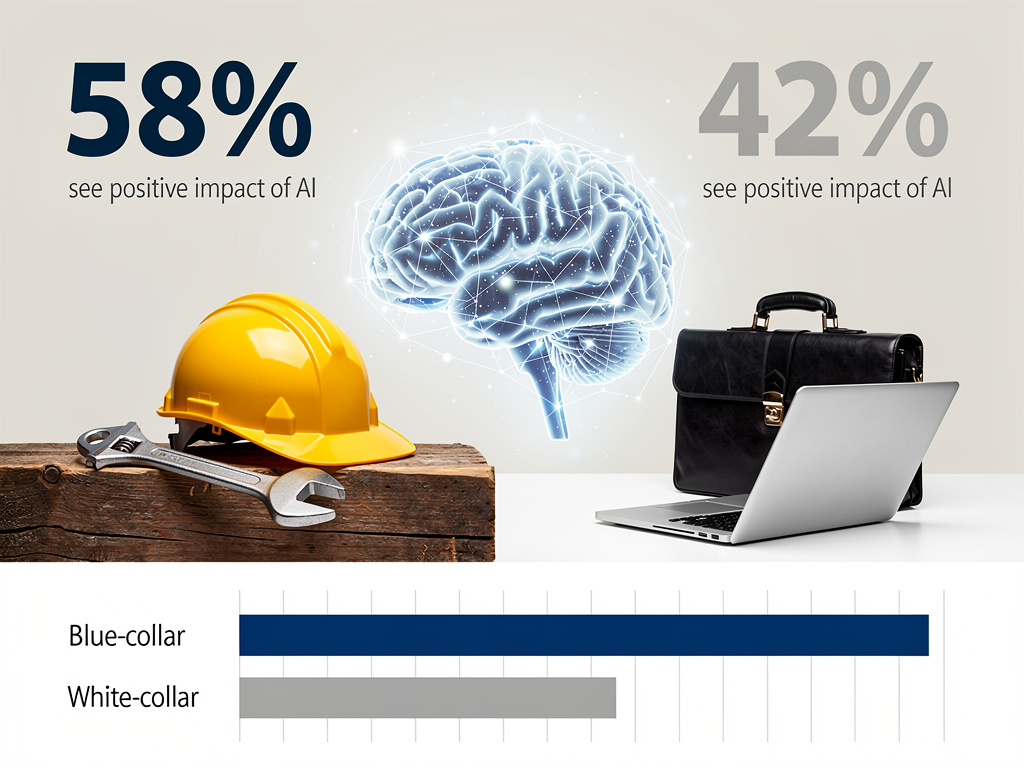
In a striking reversal of conventional expectations about artificial intelligence’s impact on the workforce, a new survey reveals that blue-collar workers are significantly more optimistic about AI technology than their white-collar counterparts, challenging long-held assumptions about which sectors of the economy face the greatest disruption from automation and machine learning.
According to a comprehensive poll conducted by Business Insider, blue-collar workers demonstrate remarkable confidence in AI’s potential to enhance their careers rather than eliminate them. The survey, which examined attitudes across different employment sectors, found that 58% of blue-collar workers believe AI will positively impact their jobs, compared to just 42% of white-collar professionals who share similar optimism. This 16-percentage-point gap represents a fundamental shift in how different segments of the workforce perceive technological transformation.
The findings contradict decades of economic theory suggesting that manual labor jobs would be the first casualties of automation. Instead, the data indicates that workers in trades, manufacturing, and service industries see AI as a tool that augments their capabilities rather than replaces them entirely. Construction workers, electricians, plumbers, and mechanics report that AI-powered diagnostic tools, predictive maintenance systems, and augmented reality applications are making their work more efficient without threatening their core expertise.
White-Collar Anxiety Reaches New Heights
The survey’s most surprising revelation centers on the anxiety permeating office environments and professional services sectors. Knowledge workers—including those in finance, marketing, legal services, and administrative roles—express mounting concerns about AI’s ability to replicate cognitive tasks that once seemed uniquely human. The fear is not unfounded: generative AI tools like ChatGPT, Claude, and specialized industry applications have demonstrated remarkable proficiency in drafting documents, analyzing data, creating marketing content, and even generating computer code.
White-collar professionals cite specific concerns about AI systems performing tasks that constitute significant portions of their daily responsibilities. Junior attorneys worry about AI conducting legal research and drafting briefs, while marketing professionals observe AI generating campaign concepts and advertising copy in seconds. Financial analysts note that machine learning algorithms can process vast datasets and identify patterns far more quickly than human counterparts, raising questions about the future value of traditional analytical skills.
The Practical Reality of Physical Work
Blue-collar workers’ optimism stems from a pragmatic understanding of their roles’ physical and contextual complexity. Unlike many white-collar tasks that can be reduced to information processing, skilled trades require spatial reasoning, fine motor skills, real-time problem-solving in unpredictable environments, and the ability to adapt to unique situations that resist standardization. A plumber responding to a burst pipe in a century-old building faces variables that no AI system can fully anticipate or address remotely.
The Business Insider survey reveals that 67% of blue-collar workers believe their jobs require human judgment and physical presence that AI cannot replicate. This confidence reflects the reality that while AI can assist with diagnostics, planning, and optimization, the actual execution of physical work remains firmly in human hands. An electrician might use an AI-powered app to troubleshoot a complex wiring issue, but the task of safely implementing the solution requires years of training, certification, and hands-on experience.
Economic Implications and Wage Dynamics
The divergent attitudes toward AI carry significant implications for labor markets and wage structures. Historically, white-collar positions commanded premium compensation partly due to educational requirements and specialized knowledge. However, as AI democratizes access to information and analytical capabilities, the economic value proposition of certain professional roles faces scrutiny. Meanwhile, skilled trades—already experiencing severe labor shortages in many regions—may see their market position strengthen as the irreplaceable nature of physical expertise becomes more apparent.
Industry analysts note that this dynamic could accelerate existing trends toward wage compression between traditional blue-collar and white-collar roles. Construction managers, master electricians, and experienced HVAC technicians already command salaries competitive with many office-based professionals. As AI tools become standard equipment for trades workers, enhancing their productivity and service quality, their economic value may increase while certain professional services face commoditization pressures.
Training and Adaptation Strategies
The survey also examined how different worker categories approach AI skill development. Blue-collar workers report higher rates of engagement with AI-enhanced tools and training programs, viewing technological proficiency as a competitive advantage rather than an existential threat. Trade schools and vocational programs increasingly incorporate AI-assisted technologies into their curricula, teaching students to leverage diagnostic software, robotic assistance, and data analytics alongside traditional craft skills.
In contrast, many white-collar professionals express uncertainty about how to position themselves in an AI-augmented workplace. The survey found that 51% of office workers feel their employers have not provided adequate guidance or training regarding AI integration. This preparation gap creates anxiety and resistance, as workers struggle to understand whether they should view AI as a collaborative tool or a replacement technology. Human resources departments face mounting pressure to develop clear frameworks for AI adoption that emphasize augmentation over automation.
Sector-Specific Variations and Nuances
The broad blue-collar versus white-collar distinction masks important variations within each category. Among blue-collar workers, those in highly repetitive manufacturing roles express more concern about automation than skilled tradespeople. Assembly line workers and warehouse staff recognize that robotic systems can perform certain standardized tasks more efficiently than humans. However, even in these sectors, workers note that supervision, maintenance, quality control, and exception handling require human oversight.
Within white-collar professions, software developers and engineers demonstrate relatively high confidence in their AI-era prospects, viewing themselves as creators and managers of AI systems rather than potential victims. Creative professionals in fields like graphic design and content creation show mixed reactions, with some embracing AI as a productivity multiplier while others worry about commoditization of their craft. The most acute anxiety appears among workers in roles heavily dependent on routine information processing—data entry, basic bookkeeping, customer service scripting, and junior-level research tasks.
Organizational Response and Leadership Challenges
Corporate leaders face the delicate challenge of implementing AI technologies while managing workforce morale and retention. The survey suggests that transparent communication about AI’s role proves crucial for employee confidence. Companies that frame AI as a tool to eliminate tedious tasks and enhance human capabilities report better acceptance than those that remain vague about their automation strategies or emphasize cost reduction through headcount optimization.
Forward-thinking organizations are developing hybrid models that combine AI efficiency with human expertise and judgment. In customer service, for example, AI chatbots handle routine inquiries while human representatives focus on complex problem-solving and relationship building. In financial services, AI systems process standard transactions and flag anomalies, while human advisors concentrate on strategic planning and client relationships. This division of labor allows companies to capture AI’s productivity benefits while preserving roles for skilled workers.
The Path Forward for Workforce Development
The survey’s findings underscore the urgent need for workforce development strategies that acknowledge AI’s differential impact across job categories. Policymakers and educational institutions must recognize that retraining initiatives should target specific vulnerabilities rather than assume uniform disruption across all sectors. White-collar workers in at-risk roles may benefit from programs emphasizing uniquely human skills—emotional intelligence, creative problem-solving, ethical reasoning, and complex stakeholder management—that complement rather than compete with AI capabilities.
For blue-collar workers, the priority involves ensuring broad access to AI-enhanced tools and training that amplify their existing expertise. Trade associations and unions have opportunities to lead this integration, establishing standards for AI proficiency alongside traditional certifications. The goal is not to replace craft knowledge but to equip skilled workers with technological capabilities that increase their productivity, service quality, and earning potential. As one survey respondent noted, AI might tell you what’s wrong with a system, but it takes a trained professional to fix it safely and effectively.
The Business Insider survey captures a pivotal moment in the ongoing technological transformation of work. The confidence gap between blue-collar and white-collar workers reflects fundamentally different relationships with AI—one seeing enhancement of irreplaceable physical skills, the other confronting potential substitution of cognitive tasks. As organizations navigate this transition, success will depend on strategies that leverage AI’s capabilities while recognizing and developing the distinctly human contributions that no algorithm can replicate. The workers who once seemed most vulnerable to technological displacement may instead find their expertise more valued than ever, while those who considered their positions secure face unexpected pressures to adapt and differentiate themselves in an AI-augmented economy.


 WebProNews is an iEntry Publication