
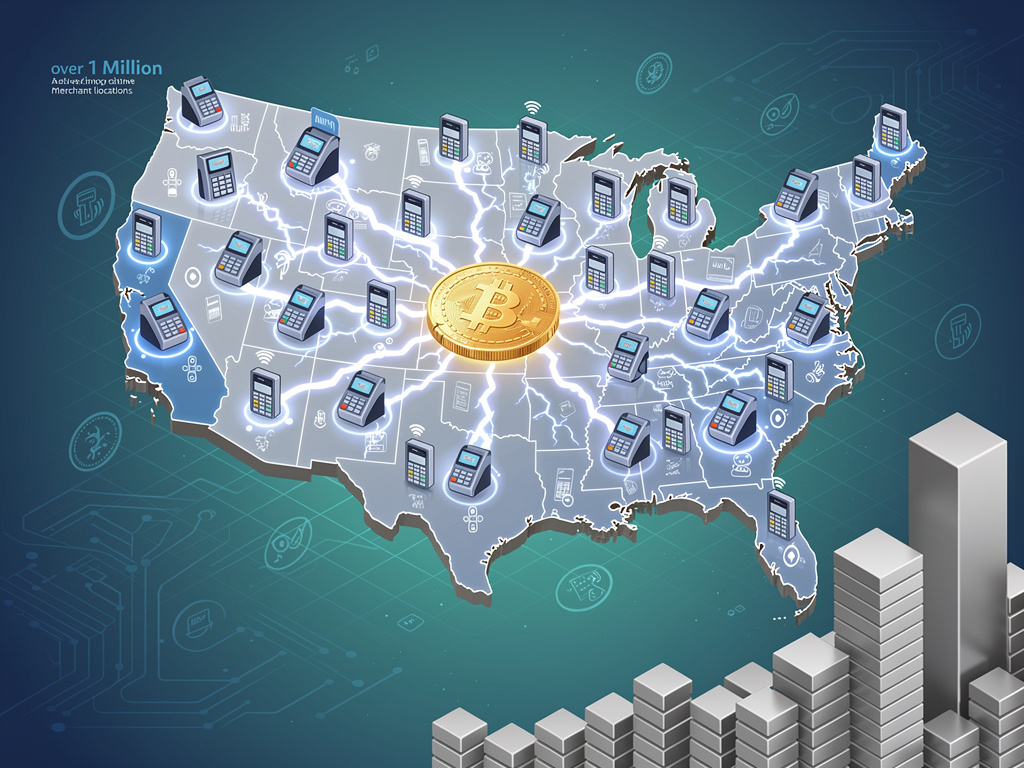
Block Inc. has flipped a switch. Its Square payments arm now counts more than 1 million U.S. merchants able to accept bitcoin at the point of sale. The milestone arrived after an automatic rollout began March 30. New businesses activated the feature at a peak rate of one every eight seconds.
This isn’t hype. It’s infrastructure. Customers pay in bitcoin over the Lightning Network. Merchants receive dollars by default. Volatility stays hidden from the checkout line. The setup removes barriers that once kept small businesses from touching crypto. No custom wallet integrations. No balance sheet risk on every sale. Just another payment type in the Square dashboard.
And yet the implications run deeper. Block, the company formerly known as Square and still led by Jack Dorsey, has spent years moving bitcoin from an investment to a working tool. It holds bitcoin on its own balance sheet. It lets merchants convert portions of daily revenue into bitcoin automatically. It even offers zero processing fees on these transactions through the end of 2026. The strategy bets that circulation matters more than hoarding.
“BTC must circulate if it is going to function as peer-to-peer cash,” said Miles Suter, Block’s bitcoin product lead. The quote, reported by Yahoo Finance, captures the company’s stance. Passive holding alone won’t build a usable network. Real utility at the register does.
Block outlined the payments push at the Bitcoin 2025 conference in Las Vegas. Hardware integration followed. Square’s point-of-sale devices now handle Lightning payments directly. Tap-to-pay functionality via NFC eliminates QR codes for many transactions. Speed arrives in seconds. Fees stay near zero. Traditional card networks charge 2 to 3 percent. Square’s bitcoin option undercuts that for the next several months.
Merchants see the transaction logged as a standard dollar sale in their reports. They can choose to settle in bitcoin instead. Up to 50 percent of eligible daily sales can convert to bitcoin through the dashboard. The company has layered these options without forcing complexity on users who don’t want it.
But adoption velocity tells its own story. Six weeks after the default activation, the million-merchant mark appeared. One in roughly every 20 U.S. small businesses now has the technical ability to accept bitcoin. Not all will see volume. Many may never notice the option. Still, the door stands open at scale for the first time.
Block’s own treasury activity adds weight. The company disclosed 28,355 bitcoin in its Q1 2026 proof-of-reserves report, according to Bitcoin Magazine. That total includes about 19,357 bitcoin held for customers through Cash App and roughly 9,000 bitcoin on the corporate balance sheet. The firm added 114 bitcoin to its treasury in the first quarter. Independent auditors verified the holdings on-chain.
Block continues a disciplined purchase plan. It invests 10 percent of gross profit from bitcoin-related products into additional bitcoin each month. The approach echoes its earlier public blueprint for corporate treasuries. Other companies have studied the document. Some have copied elements. Block’s position among public bitcoin holders remains notable though smaller than leaders like MicroStrategy.
Cash App ties the loop. Users there can receive peer-to-peer payments in bitcoin by default. They earn bitcoin back on certain Square purchases. Withdrawal limits reach thousands of dollars per day in bitcoin. The consumer wallet feeds the merchant side. Merchants gain customers inclined to spend bitcoin. The flywheel turns.
Observers point to broader patterns. Bitcoin payments have struggled for years with volatility, slow confirmations and technical friction. Lightning Network changes the equation for small transactions. Block’s default rollout tests whether removing merchant risk unlocks demand that standalone crypto apps never captured.
Results remain early. No data yet shows explosive consumer spending in bitcoin at these merchants. Conversion happens behind the scenes through partners. Liquidity on Lightning must hold. Yet the experiment now runs at a size previous pilots never touched.
Competitors watch closely. Payment processors from Stripe to PayPal have added crypto options. None match the default activation across a million locations. Shopify and others support stablecoins. Block’s bet sits on bitcoin itself, with dollar settlement as the bridge.
Stock reaction stayed muted. Block shares traded near $70 in the days after the news, per the Yahoo Finance report. Investors appear to price in the long-term optionality rather than short-term revenue lift. Bitcoin’s price environment matters. So does regulatory clarity around Lightning and self-custody tools.
Block has layered additional bitcoin products. It offers the Bitkey hardware wallet. It operates a mining hardware division called Proto. These moves signal commitment beyond payments or treasury. Dorsey has long advocated for bitcoin as fundamental infrastructure for the internet age. His company’s actions align.
The million-merchant threshold arrives at a moment when corporate bitcoin treasuries draw fresh attention. Public companies collectively hold more than 1 million bitcoin in some counts, though exact figures shift with markets and new adopters. Block’s piece of that total stays modest. Its integration of bitcoin into daily commerce stands apart.
Small businesses operate on thin margins. A reduction in payment fees from 2.6 percent to zero can matter. If enough merchants steer customers toward bitcoin to capture that savings, habits may form. Consumers already hold bitcoin in Cash App. The path from wallet to coffee purchase just shortened.
Challenges persist. Lightning liquidity can constrain large purchases. On-chain settlement costs rise during network congestion. Consumer education still needed. Tax treatment of bitcoin payments complicates accounting for some sellers. Block’s design mitigates several of these for the merchant. It cannot remove them entirely.
Even so. The rollout demonstrates what focused product work can achieve. Automatic enrollment. Frictionless conversion. Zero fees as incentive. Clear reporting. These choices compound. One million merchants represent real distribution. Not every location will process bitcoin volume. The option now exists where it didn’t before. Scale creates data. Data informs iteration.
Block has released its proof-of-reserves reports with third-party verification to build trust. The Q1 2026 update showed both customer and corporate holdings clearly separated. Transparency addresses past concerns in crypto custody. It also lets outsiders verify balances directly on the blockchain.
Future updates will matter. Transaction volume figures. Merchant retention of the feature. Actual bitcoin settlement rates versus dollar defaults. Consumer uptake through Cash App. Each data point will test whether bitcoin can function as working money at the counter or remains mostly a store of value.
For now the company presses forward. It keeps buying bitcoin with profits from its own products. It expands hardware support. It promotes circulation. The million-merchant milestone marks progress on that path. Not the finish. Just visible evidence that the infrastructure bet has reached a new stage.
Industry watchers will track what happens next. Other processors may accelerate their own offerings to match. Merchants may experiment and report results. Consumers may discover the option and use it. Or the entire effort could plateau if underlying economics or user experience falter. Block has removed many excuses. Execution now sits with the market.


 WebProNews is an iEntry Publication