
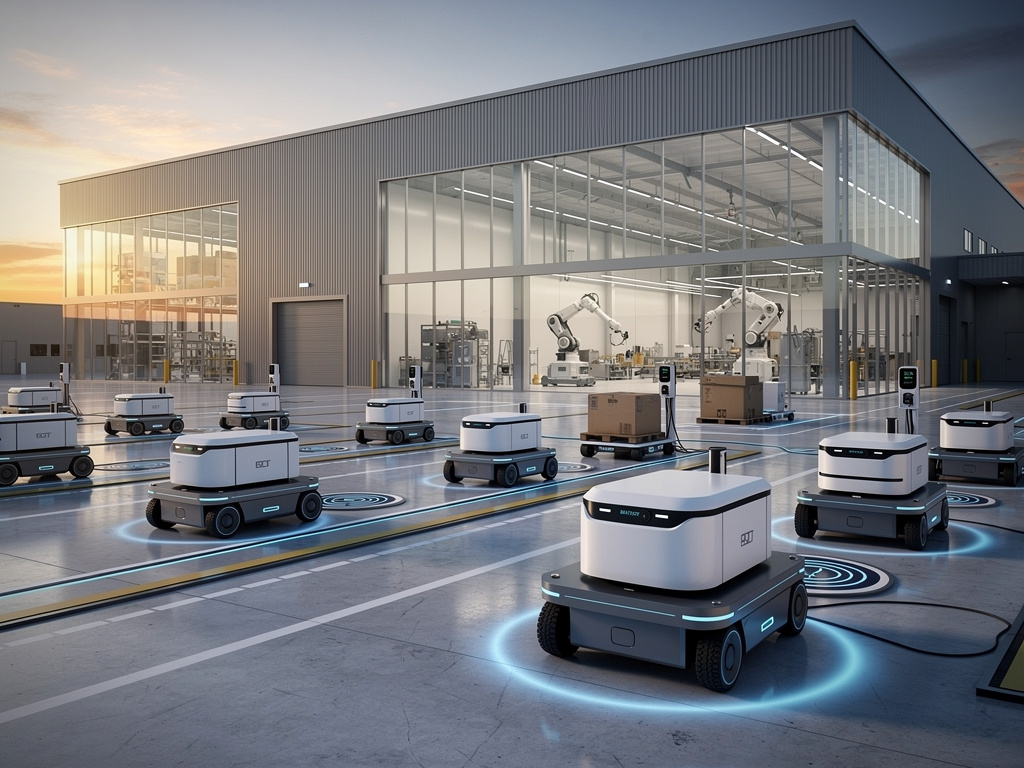
MELBOURNE—Applied Electric Vehicles, a Melbourne-based innovator in autonomous transport, has secured a $30.7 million investment from the National Reconstruction Fund, propelling its Series B round past A$57 million and marking the fund’s inaugural foray into transport manufacturing. The capital, comprising more than half of the latest raise, will accelerate production of the company’s signature Blanc Robot—a cabinless, electric platform devoid of seats, doors, steering wheels, or windows, tailored for industrial logistics in hazardous environments.
Founded in 2015 by Julian Broadbent, a former Holden engineer and designer, and co-founder Shane Ambry, ex-Telstra executive, Applied EV emerged from a Melbourne garage amid bold predictions of widespread self-driving cars by 2020. Instead of chasing passenger vehicles, the firm zeroed in on commercial applications, developing the Digital Backbone—a proprietary, safety-rated control system enabling Level 4 autonomy. The Blanc Robot, built on a Suzuki Jimny chassis with Australian-made electronics and software, allows operators to attach custom pods for tasks like mining haulage or last-mile delivery.
Roots in Australia’s Auto Decline
Broadbent’s vision crystallized after Holden’s closure, leveraging local engineering talent for software-defined vehicles. “When traditional automotive manufacturing left Australia, we saw an opportunity, tapping into the wealth of local engineering talent and building something truly innovative from the ground up,” Broadbent stated, as reported by The Driven. Early partnerships, including with the University of Sydney’s Australian Centre for Field Robotics, honed the platform for off-road autonomy.
By 2019, prototypes debuted at CES in Las Vegas, drawing global interest. Victoria’s government backed a $2 million facility in Bayswater North, creating over 20 jobs. The Digital Backbone powers bi-directional, four-wheel-steering operations, reducing hardware complexity while meeting Automotive Safety Integrity Level standards.
Global Partnerships Fuel Scale
Suzuki Motor Corporation invested $21 million in 2022 via its venture arm, co-developing the Generation 6 Blanc Robot on the Jimny ladder frame. “Suzuki will continue to build relationships with companies like Applied EV that possess unique technologies,” the firm announced on its global news site. Japan Post Capital and Barrenjoey joined the Series B, alongside prior backers like St Baker, supporting plans for 100 initial units and thousands more.
Trials spanned continents: Oxa (formerly Oxbotica) integrated its software for driverless runs in Oxford, UK, in 2022, calling the Blanc Robot “exactly the new-type vehicle that will form the mainstay of the transportation industry.” Deployments in Western Australia mining sites demonstrated dust suppression, while CES 2021 previews highlighted solar-charging pods generating 30-50% of energy needs.
NRF Backs Manufacturing Revival
National Reconstruction Fund CEO David Gall hailed the deal as a foothold in Melbourne’s southeastern suburbs, a former manufacturing hub. “It does speed up the building of Australia’s industrial capability in this area,” Gall told AAP, per The Canberra Times. “The fact that these have been designed and built from the ground up with a view of having zero-emission operations will be key to their success.” The funding adds 25 jobs to Applied EV’s 113-strong workforce, post a 40% cut, targeting production within the year.
This aligns with Australia’s push amid CEFC’s $70 million for Volvo trucks and New Energy Transport’s electric prime-movers. Applied EV’s prior $40.5 million raise underscores momentum, as noted by Startup Daily.
Tech Edge in Hazardous Ops
The Blanc Robot’s all-wheel-drive, configurable design suits remote sites where human drivers face risks. “Its proprietary digital control system… allows autonomous electric vehicles to be operated to the highest global safety standards in conditions that are remote and hazardous,” explained CarExpert. Partnerships with four autonomy firms, soon five, enable plug-and-play integration, sidestepping passenger AV regulatory hurdles.
Generation 6, set for mid-2025 deployment, targets driver shortages in logistics. CISSOID’s SiC inverter enhances motor efficiency. On X, users like @SamCuteri noted: “Local capital → Local manufacturing → Autonomous systems replacing high-risk work.”
Series B Signals Export Ambition
The round closes at A$57 million, blending NRF’s $30.7 million with private capital. Broadbent emphasized global scaling: “This support not only accelerates our mission to scale the Blanc Robot… but also validates the vision.” Gall added emissions focus aids exports, per The Driven.
Applied EV’s Lang Lang proving grounds residency and ITS Hamburg debut position it against rivals like EasyMile. As Broadbent told Forbes Australia in 2025, post-dotcom parallels yield resilient models. With Suzuki chassis from Japan and Aussie software, production ramps signal Australia’s deep-tech resurgence.
Challenges and Road Ahead
Workforce trimming reflects AV sector volatility, yet contracts and OEM ties provide stability. Public road ops loom, building on UK trials. X buzz from @TheDriven_io amplified the news, underscoring sector excitement. For industry insiders, Applied EV exemplifies modular autonomy’s commercial viability, potentially slashing logistics emissions while reclaiming manufacturing prowess.


 WebProNews is an iEntry Publication