
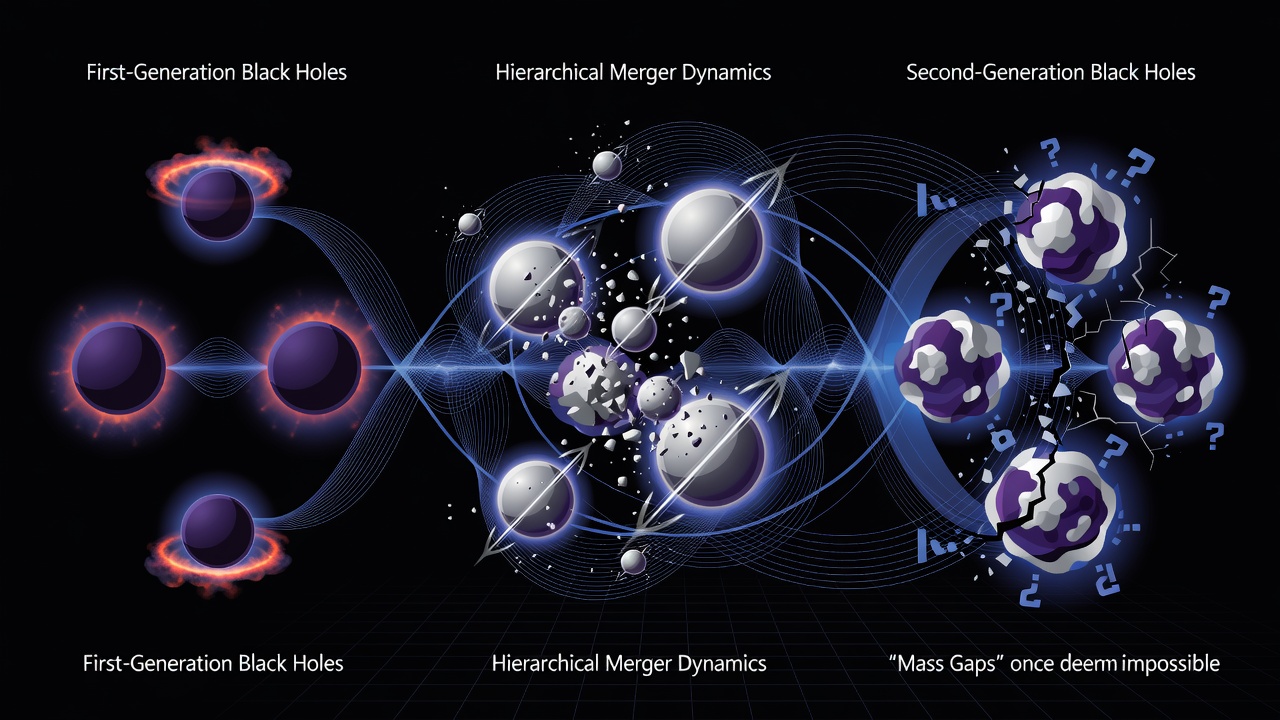
Black holes have long stood as the universe’s most extreme objects. They swallow light. They warp spacetime. Yet their birth stories remain only partly told. For decades the standard account held that they arise when massive stars exhaust their fuel, collapse under gravity and explode as supernovae. Simple enough. But fresh gravitational-wave data tells a different tale. Some black holes are not born from stars at all. They are forged from the remnants of earlier black holes.
The evidence comes in waves. Literally. Since the Laser Interferometer Gravitational-Wave Observatory, or LIGO, first detected ripples in spacetime a decade ago, its network with Virgo and KAGRA has recorded hundreds of black-hole collisions. A Gizmodo report published just yesterday highlights one analysis of 155 such pairs. Roughly 14 percent show signs of second-generation black holes. These are objects assembled through repeated mergers rather than direct stellar collapse. The finding, detailed in Physical Review Letters, adds weight to a picture that has been building for years.
Cailin Plunkett, a graduate student at the Massachusetts Institute of Technology and lead author of the study, put it plainly. “Overall in the universe, black holes are merging all the time.” She continued, “Now we’re seeing a relatively consistent picture where there’s a decent percentage of black holes that are coming from this repeated pathway.” The pathway is known as hierarchical merging. One black hole forms from a star. It finds another. They collide. The result can produce a heavier black hole with distinctive spin and mass traits. That heavier one may then merge again. And again.
Short. Clean. And increasingly supported by data.
But why does this matter? The mass spectrum of observed black holes has long contained puzzles. Theory predicts a gap, sometimes called the pair-instability mass gap, between about 50 and 120 times the mass of the sun. Stars in that range should be torn apart by explosive nuclear reactions before they can collapse into black holes. Yet detectors keep finding objects that seem to sit right in or near forbidden zones. The most colossal merger detected last summer featured black holes whose combined traits strained conventional models. Something else must be at work. Hierarchical mergers offer one explanation. Each collision can build mass while imprinting chaotic spin. The resulting objects don’t obey the same rules as pristine stellar remnants.
A June 2026 catalog update from the LIGO-Virgo-KAGRA collaboration drove the point home. ScienceDaily covered the release of nearly 400 gravitational-wave detections, including 161 new ones from April 2024 through January 2025. Among them sat two striking events detected just a month apart in late 2024. GW241011, some 700 million light-years away, and GW241110, more than three times farther, both carried signatures of lopsided masses and unusually high or misaligned spins. Storm Colloms, part of the analysis team, noted that these observations trace an underlying trend for hierarchical black holes. The larger partner in each pair likely formed not from a star but from a previous black-hole union.
Daniel Williams, another researcher on the project, captured the scale. “This bumper update has once again broadened and deepened our knowledge. We’re now detecting so many it’s the astronomical equivalent of uncovering an ancient civilisation.” The catalog also delivered the clearest signal yet, GW250114, with a signal-to-noise ratio of nearly 77. That event let scientists measure three distinct vibrational modes of the final black hole, offering fresh tests of general relativity and Stephen Hawking’s area theorem. The theorem holds. Merged black holes never shrink. Their event horizons only grow.
And. The data keeps coming.
These second-generation black holes tend to appear in dense stellar environments. Globular clusters. The cores of galaxies. Places where black holes born from different stars can sink toward the center through dynamical friction, pair up and collide. In such crowds the process can cascade. A first merger yields a black hole of 20 or 40 solar masses or more. That object retains some of the orbital angular momentum from its parents, often in a spin direction that doesn’t align neatly with a new partner. Precession follows. The orbital plane wobbles like a top. Detectors on Earth pick up the modulated waveform. Models that include this precession match the observed 14 percent fraction better than those that assume all mergers are first-generation.
Yet questions linger. How often does the chain continue beyond two generations? Can it reach hundreds of solar masses and help seed the supermassive black holes that sit at galactic centers? Earlier work from the 2000s, revisited in a Science News Explores article updated in May 2026, suggested giant seeds might grow stepwise through repeated collisions or steady gas accretion. JWST observations of early-universe quasars have only sharpened the puzzle. Some supermassive black holes appear to have formed sooner than models allow if they relied solely on stellar remnants and slow feeding. Hierarchical mergers in dense clusters could accelerate the process. So could direct collapse of massive gas clouds, a mechanism spotlighted in a July 2025 Phys.org report on the Infinity galaxy. There, Yale astronomer Pieter van Dokkum’s team found what looks like a newborn supermassive black hole embedded in colliding galaxies. The object sits in a cloud of gas at the center of an infinity-symbol-shaped merger remnant. It may represent a different birth channel altogether.
But. The gravitational-wave route offers something unique. Direct observation. Not inference from light. Each detection carries information about masses, spins, distances and even the binary’s formation history. Population studies now show clear correlations. Black holes in different mass ranges carry different spin distributions. Lower-mass ones tend to have spins aligned with their orbits, consistent with isolated binary evolution from massive stars. Heavier ones show more chaos. That split points to multiple formation channels operating across the cosmos.
The implications stretch beyond astrophysics. If a meaningful fraction of black holes carries this hierarchical heritage, then estimates of merger rates, the stochastic gravitational-wave background and even cosmological parameters could shift. One analysis within the latest catalog used 236 signals to refine measurements of the Hubble constant. Small adjustments now. Larger ones may follow as detector sensitivity improves.
Researchers emphasize caution. Fourteen percent is a statistical inference, not a head count. Individual events can be explained in multiple ways. Yet the trend holds across independent studies. An earlier 2022 paper in Astronomy & Astrophysics already constrained hierarchical merger rates using LIGO-Virgo data. The newest catalogs only reinforce the signal. Dense environments matter. Dynamical interactions matter. And black holes that eat their predecessors are not rare outliers. They are part of the ordinary churn of the universe.
So what comes next? Upgrades to LIGO, Virgo and KAGRA promise dozens more detections per year. Space-based detectors like LISA will one day capture mergers of supermassive black holes themselves, perhaps revealing whether those giants grew through countless small bites or a few giant ones. Meanwhile theorists continue to model cluster dynamics, supernova fallback and the recoil kicks that can eject merged black holes from their birthplaces. Only those that remain can merge again.
The universe, it turns out, recycles its most extreme creations. Stars die. Black holes form. Some of those black holes find each other, collide and spawn heavier offspring. The cycle repeats. Each generation carries a little more mass, a little more spin memory from its violent past. And with every new detection, the story of how black holes are born grows richer, stranger and far less solitary than astronomers once believed.


 WebProNews is an iEntry Publication