
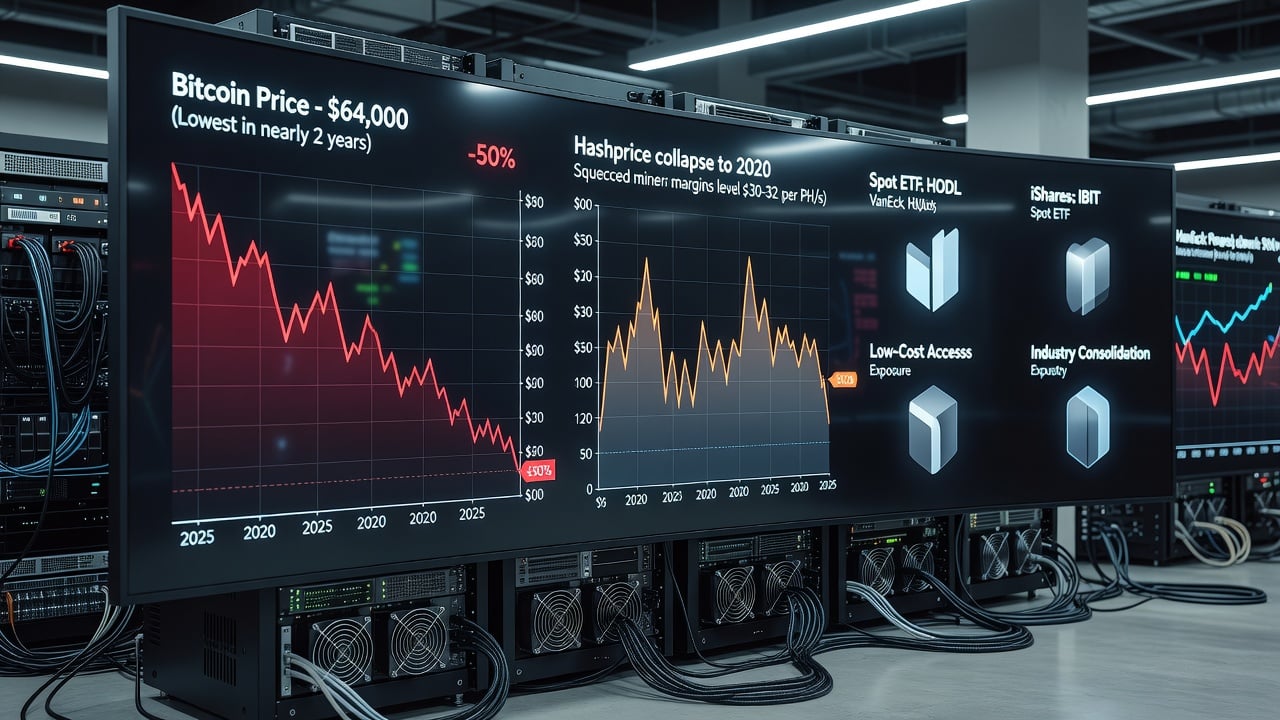
Bitcoin trades near $64,000. That’s its cheapest level in nearly two years. The drop from last October’s peak above $126,000 has wiped out more than half its value. Yet for some, this marks a rare entry point.
ETFs Offer Easy Access Amid the Slump
Spot Bitcoin ETFs have drawn billions since their 2024 debut. The iShares Bitcoin Trust, known as IBIT, boasts $47.6 billion in assets under management. Its shares fetched $36.39 on July 16. VanEck’s HODL fund, smaller at $1.1 billion, traded at $18.16 the same day. Yahoo Finance breaks down the choice. HODL carries a 0.20% expense ratio. IBIT charges 0.25%. For buy-and-hold investors, the lower fee adds up. Active traders may favor IBIT’s tighter spreads and scale.
Both funds simply hold Bitcoin. No wallets. No private keys. They track the spot price after fees. One-year returns through mid-July sit at roughly negative 46% for each. Max drawdowns over two years reached 50% for HODL and 53.3% for IBIT. Beta figures tell different risk stories. HODL’s 0.89 suggests less volatility than the broader market. IBIT’s 2.13 points to amplified swings.
Cathie Wood weighed in early this month. She sees Bitcoin entering recovery mode. The path ahead stays volatile, she cautioned. A Motley Fool columnist echoed the sentiment. Bitcoin’s slide to two-year lows could signal opportunity for believers. The Motley Fool highlights predictions that it could double by end of 2027.
But the real pressure lands on miners. Hashprice, the daily revenue per unit of computing power, has sunk to levels last common in 2020. Recent figures put it around $30 to $32 per petahash per second. That’s down sharply from peaks above $60 last year. Hashrate Index shows spot hashprice at $31.86 per PH/s as of mid-July, with network hashrate near 895 EH/s and Bitcoin at $64,015.
Such thin margins force tough calls. Older equipment struggles. Antminer S19 models need electricity below $0.055 per kilowatt-hour to break even at current hashprice. Newer S21 XP units tolerate up to $0.088 per kWh. Hydro-cooled S23 models push that to $0.124. These thresholds come from efficiency ratings under 15 joules per terahash. Start Mining details the math. At July 2026 hashprice of about $29 per PH/s/day, only the best hardware survives standard industrial power rates.
Profitability has tightened all year. CoinShares reported hashprice falling to $28-30 per PH/s in early 2026. That followed a slide from $63 the prior summer. Many operators hit breakeven or worse. Some shut down rigs. Others switched to more efficient fleets or secured cheaper power deals. Global hashrate dipped at times but rebounded. Difficulty adjustments offered temporary relief. One April drop in difficulty lifted hashprice back toward $35-$36 briefly. Bitcoin Foundation noted the rebound then.
Energy costs decide everything. Efficient miners lock in rates below $0.06 per kWh. Those paying $0.08 or more often run at a loss unless they bet on price gains. A few cents per kilowatt-hour swings the balance from red to black. Yahoo Finance explains the dynamic in a July 7 update. Hashprice reflects Bitcoin’s price, network difficulty, fees and subsidy. When all align poorly, machines go offline. The network self-corrects. Yet prolonged low prices test even public miners’ balance sheets.
Transaction fees have stayed subdued. The April halving cut the block reward to 3.125 BTC. That reduced baseline revenue. Fees need to rise to offset. So far they haven’t delivered enough. Network hashrate hovered near 900 EH/s in July. Earlier peaks exceeded 1,000 EH/s. Lower hashrate eases competition. But new machines keep coming online. Manufacturers push the latest ASICs. Demand for them falls when returns disappoint.
Public companies face extra scrutiny. Their stock prices often move with Bitcoin. Some hold large treasuries. Others hedge or diversify. The slump has hurt valuations across the board. Still, survivors emerge stronger. They buy discounted hardware. They negotiate better energy contracts. They optimize operations. History shows Bitcoin’s price cycles reward patience. The 2020 hashprice lows preceded a massive rally.
Recent market data adds nuance. Bitcoin dipped below $60,000 in early July before recovering. It closed some days above trendlines, eyeing $67,000 resistance. ETF flows turned negative at times. Macro factors weigh in. Federal Reserve decisions later this month could sway sentiment. Cooler inflation might help. Hawkish signals might not. Crypto.news outlines the July setup, with support near $58,000 and resistance at $63,800.
Analysts offer varied forecasts. Some see Bitcoin holding $56,000 to $62,000 range near term. Others predict climbs toward $100,000 later in 2026 if conditions improve. Long-term calls reach far higher. Michael Saylor has floated extreme targets. Bernstein analysts stay bullish despite the 50% drawdown from peak. Yahoo Finance rounded up the most optimistic views on July 10.
Mining and artificial intelligence compete for power and chips. Some speculate hyperscalers could pivot back to mining if inference costs collapse. Yet the economics differ. Mining can flex with power prices. AI workloads run constantly. The overlap stays limited. Discussions on X highlight these tensions. One user noted inference becoming so cheap that outdated hardware might not resell well. Another stressed Bitcoin’s value in its slow, expensive production model.
Bitcoin’s current affordability cuts two ways. Investors gain cheaper exposure via ETFs or direct buys. Miners confront survival tests. The industry consolidates. Weak hands exit. Efficient operators gain share. Hashprice at 2020-comparable levels doesn’t guarantee a repeat of that bull run. Different market structure now. Spot ETFs. Corporate treasuries. Greater institutional involvement. Still. The setup invites comparison.
Fees, halvings, difficulty. They interact in complex ways. A single difficulty drop can restore margins. Sustained price recovery does more. For now, Bitcoin hovers. Miners adapt. Investors watch. The coming weeks may clarify if this low holds or gives way to further pressure. Or if recovery talk gains traction. Either way, the numbers don’t lie. Bitcoin hasn’t been this affordable in two years. The question is who steps in.


 WebProNews is an iEntry Publication