
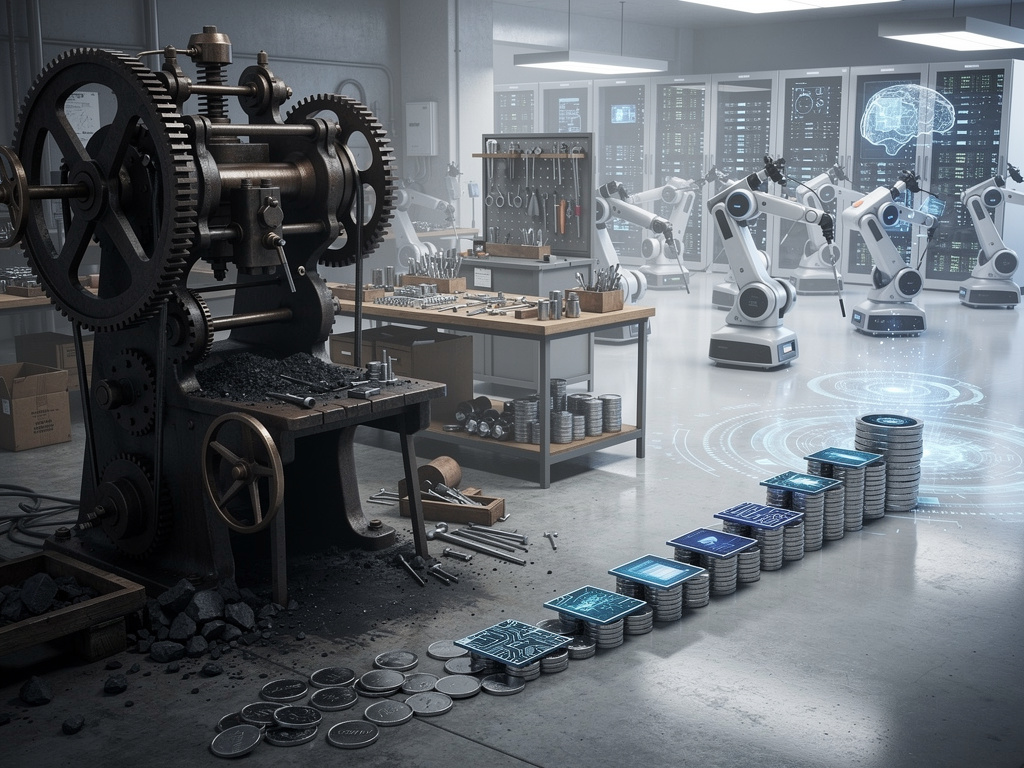
Bill Gurley has seen technology upend industries before. The Benchmark Capital partner backed Uber early, watched the internet boom and bust, and now watches AI spark familiar panic. On a recent episode of the All-In Podcast, he cut through the noise. Warnings that artificial intelligence will wipe out jobs, he said, mirror complaints raised during the Industrial Revolution.
Gurley Points to the Vatican’s Own History
Pope Leo XIII issued an encyclical in 1891 called Rerum Novarum. It expressed deep worry that factories, machines and industrial capitalism would exploit workers, widen inequality and harm society. Gurley quoted the concerns directly. “Leo the 13th encyclical warned that the industrial revolution was going to be bad for people,” he told the podcast hosts. Then he delivered the verdict. The century that followed brought the opposite. Workweeks dropped from over 60 hours to 34 hours globally. Real wages rose eight to 10 times after inflation. Life expectancy climbed. Workplace deaths fell. Global poverty dropped from roughly 75 percent of humanity to under 10 percent. “All those things happened because of technology, innovation, and capitalism, which is exactly what Leo the 13th was warning against,” Gurley said. “So he got it dead wrong.”
The parallel feels pointed today. Pope Leo XIV, in his first major encyclical, just warned that mass AI-driven unemployment could become a “true social calamity.” Gurley sees repetition. He spent time reviewing the data himself. The trends after 1891 delivered prosperity on a scale few predicted. And history, he argues, offers no sign that AI will break the pattern.
His view lands at a moment when the conversation has shifted. For months, prominent AI leaders predicted sweeping job losses. Dario Amodei of Anthropic spoke of half of entry-level white-collar roles disappearing within five years. Mustafa Suleyman of Microsoft AI suggested most white-collar work could automate inside 12 to 18 months. Sam Altman and others echoed similar tones. Yet recent weeks show softening. Both Amodei and Altman have dialed back apocalyptic language. Goldman Sachs CEO David Solomon told the New York Times that AI will more likely change tasks than eliminate entire jobs. Apollo chief economist Torsten Sløk went further in May. He saw “zero evidence” that AI has caused net job losses so far.
Reality on the ground looks mixed. Companies including Block, Cloudflare, Cisco, IBM, Coinbase and Snap have cited AI in recent layoffs. Challenger, Gray & Christmas reported in early May 2026 that AI accounted for 26 percent of announced job cuts that month, the second straight month it led the list. Yet economists note other forces at work. Many firms overhired during the pandemic. Higher interest rates, inflation, budget tightening and tariff uncertainty also squeezed payrolls. Some executives may overstate AI’s role to mask broader pressures. The U.S. labor market still churns 25 to 35 million jobs a year through normal hiring, firing and shifts. Automating 25 percent of certain work hours barely registers against that volume.
Gurley refuses to dismiss the changes. Automation will reshape roles. Some tasks will vanish. Workers who treat AI as a tool rather than a threat will pull ahead. “The best way to protect yourself from AI is to be the most AI-enabled version of yourself you can be,” he said. That means learning fast, experimenting constantly, staying curious. Those who resist or wait for instructions risk falling behind. He draws from his own career advice. In interviews and his book Runnin’ Down a Dream, Gurley urges people to run toward the edge of their fields. Passionate obsession with new frontiers beats rote competence. AI rewards the former.
Look further back and the pattern repeats. The New York Times noted in May that fears of technological unemployment date to the Luddites smashing machines in 1811. Every major wave since — steam power, electricity, computers, the internet — displaced workers in specific trades while creating far more opportunities elsewhere. The majority of jobs that exist today did not exist in 1940. Forbes highlighted the same historical resilience in April. Innovations create new demands, new industries, new skills. AI appears poised to follow suit, though the speed and white-collar focus feel different this time.
Recent data adds texture. GitHub recorded 1 billion code commits for all of 2025. The past 30 days alone produced 1.1 billion, a 14-fold jump year-over-year. Software engineer job listings sit at a three-year high, up 15 percent. The “AI eats coders” narrative does not match the numbers. Yale researchers observed that recent graduates struggle more to land first jobs, suggesting disruption hits entry points hardest. Yet overall U.S. unemployment remains near historic lows. A Quinnipiac poll in March found 70 percent of Americans believe AI will reduce job opportunities, up from 56 percent a year earlier. Fear runs high. Evidence of mass displacement does not — yet.
Some voices push harder warnings. A New York City comptroller report in May projected the city could lose over 110,000 private-sector jobs in 2027 under certain AI scenarios, with heavy hits to office-using industries. Wall Street profits could slip for three straight years. A Yale School of Management analysis in May argued the real damage appears before careers even start. Entry-level roles shrink. Young workers miss the foundational experience that builds expertise. That concern resonates. If AI compresses the bottom of the ladder, how do future leaders gain the judgment machines cannot replicate?
Gurley’s optimism rests on productivity gains. Past technologies made humans more valuable, not less. Real wages rose dramatically over the long run despite short-term pain. He sees AI doing the same. Innovation has consistently lifted living standards. “Historically, innovation has led to more prosperity for humans,” he said. “I see no reason why that won’t happen here.” Others agree the net effect will prove positive. The World Economic Forum has projected a net gain of 78 million new jobs by 2030. BCG estimates 10 to 15 percent of existing roles could disappear by 2031, but new ones will emerge.
Still, transition matters. Not every worker will surf the wave smoothly. Those in routine cognitive tasks face pressure. Professionals in legal discovery, basic coding, customer support and data entry already see tools handling chunks of their days. Companies test AI for everything from contract review to financial analysis. Success depends on integration. The most effective teams pair human judgment with machine speed. Pure replacement remains rare. Augmentation delivers the gains.
Gurley also flagged risks beyond jobs. On the same podcast he discussed Anthropic’s ambitions, regulation and open-source models. He spent weeks reading the company’s constitution and related materials. He senses some leaders view themselves as creating something superior to humans, almost a digital deity. That philosophical bent could shape policy fights. Calls for heavy regulation often come from the frontier labs themselves, he noted, raising questions of motive. A U.S. crackdown on open-weight models could leave the country isolated while China and others advance faster. Intelligence sovereignty — controlling the AI that influences thought and information — may become a defining battle.
Executives already feel the tension. One Fortune 20 company reportedly spent $500 million on a single AI provider in one month with limited results. Another CEO sought $1 billion in savings but saw $200 million spent in six months with little to show. Enthusiasm collides with execution challenges. Meanwhile, regulated industries pour money into on-premise models to avoid depending on outside labs that could change terms or face political pressure.
The debate will not settle soon. Polls show rising anxiety. Layoff announcements cite AI more often. Yet labor markets demonstrate remarkable churn and recovery. Gurley bets on the long view. Technology has lifted billions before. It demands adaptation, not fear. Workers who embrace tools, build irreplaceable skills and stay at the frontier will thrive. Those who cling to old routines may not. The data from 1891 to now supports him. Pope Leo XIII got the Industrial Revolution wrong. Current worries could prove equally misplaced. The test lies ahead. But the historical record tilts toward optimism, provided society responds with curiosity instead of resistance.
Business Insider first reported Gurley’s comments from the All-In Podcast. Read the full story here. The New York Times explored why the AI job apocalypse probably won’t arrive as predicted. See their analysis. Forbes examined the long history that suggests we will adapt. Their take appears here. CBS News covered the rising share of layoffs tied to AI. Details are available. And TechCrunch captured Gurley’s earlier advice that playing it safe may be the riskiest career move in the AI era. Read that interview.


 WebProNews is an iEntry Publication