
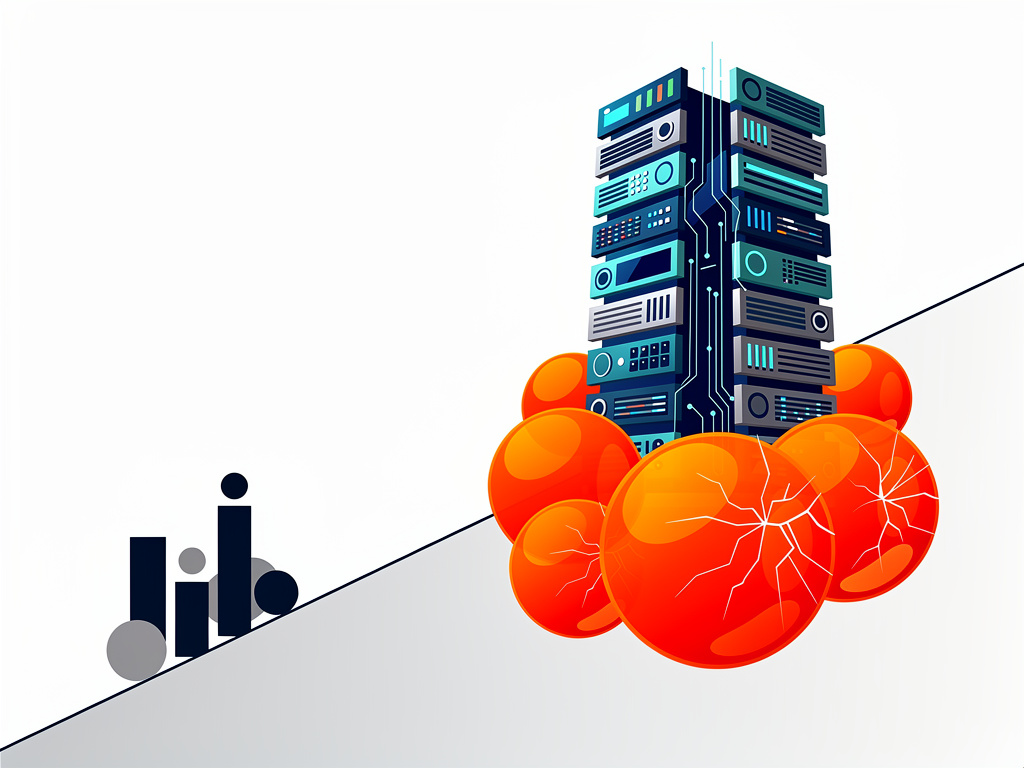
Bill Gurley has seen this movie before. The legendary venture capitalist — a general partner at Benchmark and one of Silicon Valley’s sharpest voices on market cycles — is warning that the massive capital spending fueling today’s AI infrastructure buildout could slam into a wall as early as next year. His argument isn’t that AI is overhyped in the long run. It’s that the short-term economics don’t add up.
Speaking at a recent event and elaborating in posts on X, Gurley drew explicit parallels between the current AI investment frenzy and the telecom bubble of the late 1990s, as Business Insider reported. Back then, companies like WorldCom and Global Crossing poured billions into fiber-optic networks based on demand projections that never materialized on schedule. The infrastructure eventually got used — but not before a brutal shakeout destroyed capital and careers. Gurley sees a disturbingly similar pattern forming around AI data centers, GPU procurement, and the hyperscaler spending arms race.
The numbers are staggering. Microsoft, Google, Amazon, and Meta have collectively committed hundreds of billions of dollars to AI-related capital expenditure. Microsoft alone signaled plans to spend $80 billion on AI data centers in fiscal year 2025. Meta has raised its capex guidance repeatedly. And these figures keep climbing, driven by a conviction that whoever builds the most compute capacity fastest wins.
Gurley’s concern is straightforward: what happens when revenue doesn’t catch up to spending?
He pointed out that much of the current AI revenue is concentrated in a handful of companies — primarily Nvidia, which sells the GPUs, and the cloud providers reselling compute. But the downstream applications generating actual end-user revenue remain thin relative to the infrastructure investment. Enterprise AI adoption is growing, sure. But it’s growing at a pace that doesn’t justify the scale of capital being deployed. The gap between infrastructure supply and monetizable demand is widening, not narrowing.
This isn’t a fringe take. Sequoia Capital’s David Cahn published an analysis in 2024 estimating that AI companies would need to generate $600 billion in annual revenue just to cover the cost of the infrastructure being built — a figure that dwarfed actual AI revenue at the time. Gurley’s warning echoes that math and extends it, suggesting that 2026 could be the year the bill comes due, when companies are forced to write down investments or dramatically cut spending.
The telecom analogy is pointed. In the late ’90s, bandwidth demand was real. The internet was real. But the timeline was wrong, and the capital structure was fragile. Companies built for a demand curve that was five to ten years away, funded by debt and equity markets that assumed the future had already arrived. When reality intervened, the correction was savage.
Gurley sees the same structural risk now. Not because AI won’t transform industries — he believes it will — but because markets are pricing in a deployment timeline that’s wildly optimistic. And the companies doing the spending are, in some cases, building redundant capacity that will sit underutilized.
There are counterarguments. Jensen Huang, Nvidia’s CEO, has repeatedly insisted that demand for AI compute is outstripping supply and will continue to do so. Satya Nadella has framed Microsoft’s AI spending as a generational investment with decades-long returns. And some analysts argue that the hyperscalers have balance sheets strong enough to absorb years of heavy capex without existential risk — unlike the debt-laden telecoms of 2000.
Fair points. But Gurley’s argument isn’t about bankruptcy. It’s about stock prices.
If capital spending gets cut or even levels off, the ripple effects hit Nvidia’s revenue growth, semiconductor supply chains, construction firms building data centers, and the energy companies powering them. The entire AI trade — which has driven a disproportionate share of S&P 500 gains over the past two years — could reverse sharply. You don’t need a corporate collapse to trigger a market correction. You just need a change in expectations.
On X, Gurley has been characteristically blunt, sharing charts comparing telecom capex curves from 1996–2002 with current AI infrastructure spending. The visual rhyme is uncomfortable. He’s also flagged the risk of “capital cycle” dynamics, where overinvestment leads to overcapacity, which crushes pricing power, which forces pullbacks. It’s a classic boom-bust pattern that repeats across industries.
So what should industry professionals watch? A few signals matter. First, cloud AI utilization rates. If hyperscalers start reporting that GPU clusters are sitting idle or that enterprise customers are slower to migrate workloads than expected, that’s an early warning. Second, Nvidia’s data center revenue growth rate. Any deceleration — even from extraordinary levels — will spook markets. Third, the tone of earnings calls. When CFOs start hedging language around “return on AI investment” or “optimizing capex efficiency,” the cycle may already be turning.
There’s also the question of what happens to the startups. Hundreds of AI companies have raised at valuations predicated on continued cheap access to compute and an ever-expanding market. If hyperscaler spending contracts, compute prices could actually rise for smaller players, or capacity could become harder to access on favorable terms. The downstream effects on the startup economy could be significant.
Gurley isn’t saying sell everything. He’s saying pay attention to history. The telecom bust didn’t mean the internet was fake. It meant the market got ahead of itself. The infrastructure eventually became essential — just not on the timeline investors were betting on. The same logic applies to AI. The technology is real. The applications are coming. But the gap between what’s being built and what’s being used is growing, and that gap has consequences.
For anyone making capital allocation decisions — whether you’re a fund manager, a startup founder planning your compute budget, or a corporate strategist evaluating AI initiatives — Gurley’s framework deserves serious consideration. The best time to think about cycle risk is before the cycle turns. Not after.


 WebProNews is an iEntry Publication