
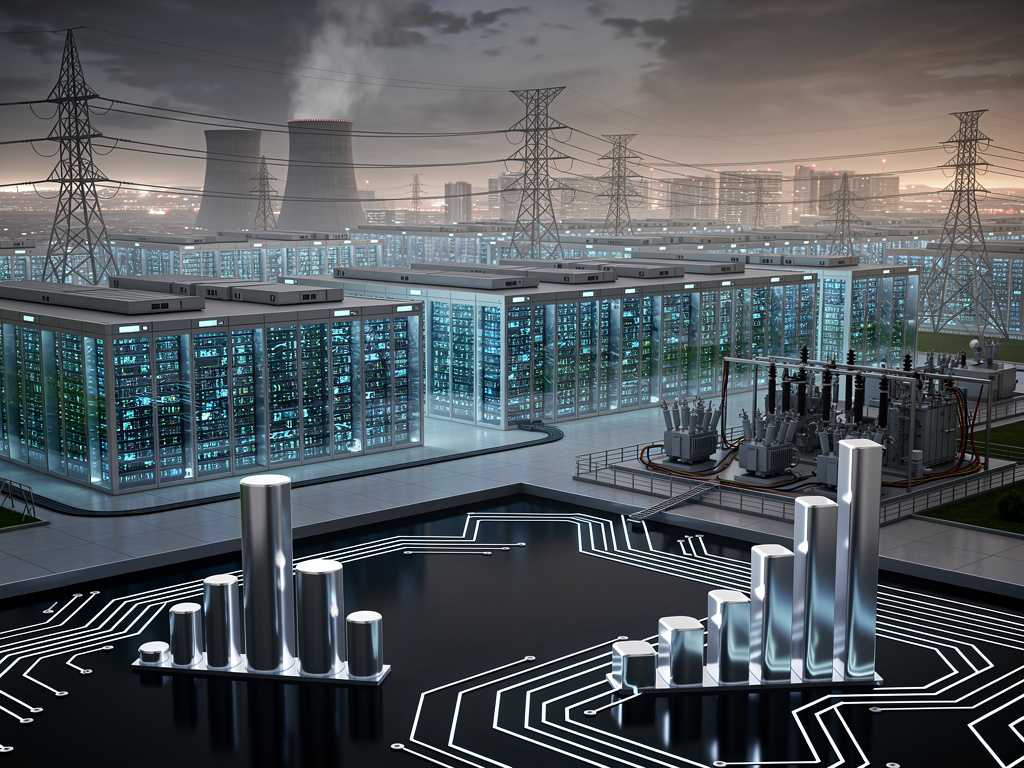
Big Tech just dropped another jaw-dropping number. The four largest hyperscalers — Amazon, Alphabet, Meta and Microsoft — plowed $130.65 billion into capital expenditures in the first three months of 2026. That record haul, revealed in their latest earnings, dwarfs the entire cost of the Manhattan Project. It also runs 71% higher than the same period a year earlier.
Scale of the Buildout
Analysts now project the group will approach or exceed $700 billion in total capital spending for the full year. Some forecasts push the combined figure for the top five hyperscalers, including Oracle, toward $800 billion or even $900 billion. Amazon alone guides toward $200 billion. Alphabet lifted its range to $175 billion-$190 billion. Meta raised its outlook to $125 billion-$145 billion. Microsoft tracks above $120 billion. And the pace shows no sign of slowing.
But here’s the tension. Revenue from AI products and services grows fast. Yet it does not grow fast enough to match the cash pouring into chips, data centers, power systems and networking gear. The gap widens. Markets have started to notice. Stock prices for some suppliers and even the hyperscalers themselves reflect fresh caution.
The original Yahoo Finance analysis laid out the stakes early. Massive outlays today could either cement long-term dominance or create years of disappointing returns if monetization lags. That warning looks more relevant than ever in mid-2026. Executives acknowledge compute constraints in the near term. Demand outruns supply. Still, they keep raising guidance.
Sundar Pichai, Alphabet’s chief executive, told investors his teams cannot build AI infrastructure quickly enough. Google Cloud backlog swelled past $460 billion. Revenue there jumped 63% in the first quarter. Those figures impress. They also underscore how much more capacity the industry needs before the full economic payoff arrives.
And the spending does not stop at silicon. Power represents the new bottleneck. Data centers already consume about 1.5% of global electricity. Projections show that share doubling or tripling by 2030. The International Energy Agency estimates data center electricity use could reach 945 terawatt-hours by then in a base case. Accelerated AI servers drive much of the growth at 30% annual rates. In the United States, data centers could claim 9% to 17% of total electricity generation by 2030, according to the Electric Power Research Institute.
Some regions feel the strain already. Virginia’s data center cluster accounts for nearly 40% of state electricity consumption. New York placed a moratorium on new facilities in certain areas. Grid operators in Texas and elsewhere warn of delays for projects that once seemed certain. Companies respond by signing direct power purchase agreements, restarting old plants or even exploring nuclear options. The infrastructure race now includes the electric grid itself.
But power is only one constraint. Memory chips, networking equipment and specialized cooling systems all face tight supply. Prices for some components climbed. Lead times stretched. The surge funnels billions to Nvidia, Broadcom, TSMC and a handful of other suppliers. Their order books look enviable. Yet analysts question whether the entire chain can scale without creating overcapacity that eventually depresses margins.
A New York Times report captured the mood after those first-quarter earnings. All four companies signaled even higher spending ahead. Meta lifted its forecast again. Google pointed to “significantly” higher outlays in 2027. No one offered a clear ceiling. The article noted the absence of any visible summit to the climb.
Investors once cheered the aggression. Now they probe for returns. Free cash flow at some hyperscalers sits near decade lows as a percentage of sales. Debt issuance picked up. Dividend growth and share buybacks face pressure in certain cases. A recent Forbes analysis highlighted how capital expenditures surge far faster than revenue. Roughly 75% of the 2026 spend ties directly to AI infrastructure. The piece documented CreditSights estimates placing the top five hyperscalers between $700 billion and $900 billion this year, up 36% from 2025.
Comparisons to past technology cycles surface often. Goldman Sachs noted that AI hyperscaler capital expenditure would need to hit $700 billion in 2026 to match the peak intensity of the late-1990s telecom boom as a share of GDP. Current levels already equal about 0.8% of U.S. GDP. That remains below historic highs. Yet the absolute dollars dwarf anything seen before in the private sector.
Enterprise adoption offers some comfort. Gartner and others project worldwide AI spending to reach $2.52 trillion in 2026, with infrastructure making up more than half. Generative AI software grows at 80% rates in certain forecasts. Companies outside the hyperscalers begin to deploy models at scale. That should eventually translate into higher cloud usage and software licensing revenue for the big spenders.
Still, timing matters. Training frontier models requires enormous clusters today. Inference, the day-to-day work of running those models for users, could prove even more expensive at global scale. A single AI query can consume orders of magnitude more electricity than a traditional search. Multiply that across billions of daily interactions and the math becomes daunting.
So far the market rewards patience. Stock prices for the hyperscalers largely held up through the spending announcements. Some even rose on strong cloud results. Yet volatility increased. Suppliers tied closely to the capex wave saw sharper swings. Broadcom’s cautious tone in recent commentary triggered fresh questions about potential slowdowns in GPU orders.
Executives insist the bet makes sense. They point to internal productivity gains, new product categories and defensibility against rivals. OpenAI, Anthropic and other model developers consume vast capacity on these clouds. Their success feeds directly back to the infrastructure owners. Microsoft, Amazon and Google each hold significant stakes or partnerships in the leading AI labs.
The competitive dynamic leaves little room for restraint. Slow down and risk falling behind in the race for the best models, the largest clusters and the most attractive developer platform. Speed up and accept years of negative or muted returns on the massive invested capital. That dilemma defines the current moment.
Longer term, efficiency improvements could ease some pressure. New chip architectures promise better performance per watt. Software optimizations reduce inference costs. Liquid cooling and advanced power management trim energy needs. Yet history shows that efficiency gains in computing often lead to higher overall consumption as applications expand. The Jevons paradox looms large.
Policy makers watch closely. Energy security, national competitiveness and environmental targets all intersect with these buildouts. Some governments offer incentives for domestic data center construction. Others worry about grid reliability and carbon emissions. The U.S. leads in absolute terms but faces competition from China and Gulf states pouring money into their own AI infrastructure.
Wall Street’s stance evolved. Early enthusiasm gave way to detailed modeling of payback periods. Analysts now demand clearer signals that AI revenue will inflect sharply higher in 2027 and beyond. Consensus estimates for hyperscaler capital expenditure in 2027 already top $1 trillion in some forecasts from Bank of America and Evercore.
The spending appears locked in for the near future. Contracts for chips and equipment span multiple years. Construction projects cannot stop midway without huge write-offs. The industry committed itself. Now it must deliver applications compelling enough for customers to pay premium prices at scale.
Those applications emerge. Coding assistants boost developer productivity. Customer service agents handle more complex queries. Drug discovery pipelines accelerate. Creative tools reshape media production. Each use case chips away at the skepticism. Yet converting those gains into measurable financial returns at hyperscaler margins takes time.
So the machines keep multiplying. The wires keep lengthening. The power plants keep spinning up. And the question lingers. Will today’s enormous bets look prescient in five years? Or will they stand as another chapter in technology history where ambition outran immediate economics?
One thing seems certain. The AI infrastructure buildout ranks among the largest concentrated capital campaigns in modern business. Its outcome will shape not only technology profits but also energy markets, industrial supply chains and even macroeconomic growth for years to come.


 WebProNews is an iEntry Publication