
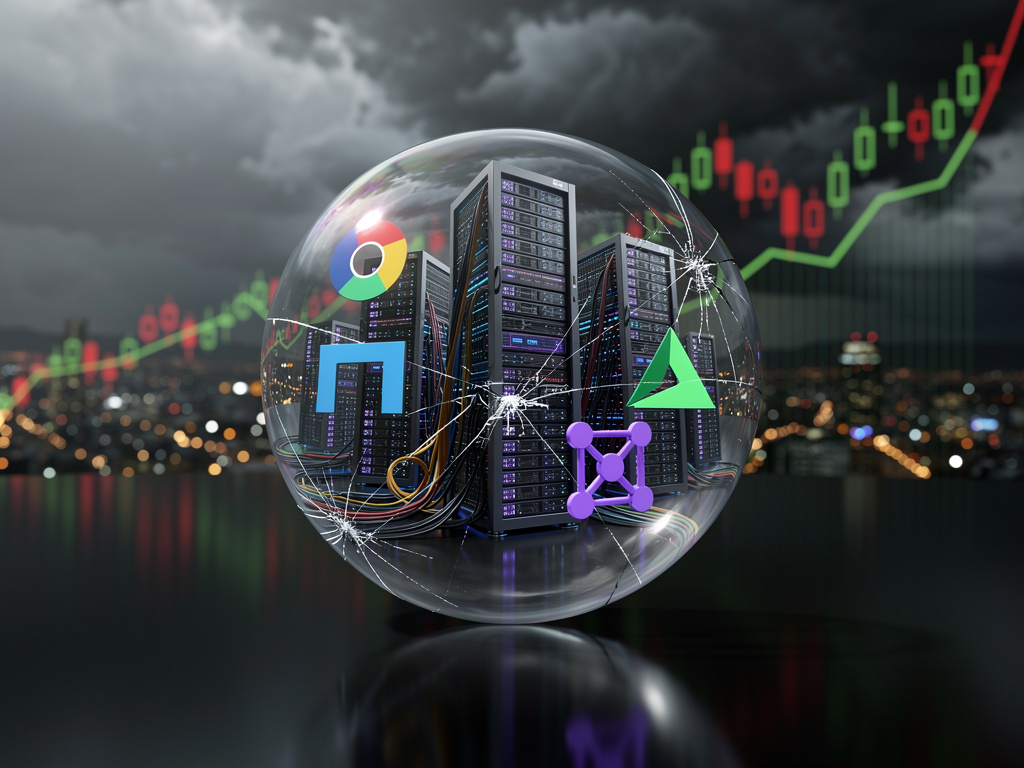
The AI Mirage: Big Tech’s High-Stakes Gamble on a Fickle Future
In the high-octane world of technology investing, few voices carry the weight of Danny Moses, the investor immortalized in “The Big Short” for his prescient bets against the housing market. Now, Moses is sounding alarms about another potential catastrophe: the artificial intelligence frenzy gripping Big Tech giants like Alphabet Inc.’s Google, Amazon.com Inc., Microsoft Corp., and Meta Platforms Inc. According to a recent interview, Moses warns that the massive capital expenditures pouring into AI infrastructure could lead to a bubble burst reminiscent of the dot-com crash, where hype outpaced real-world returns.
Moses, speaking to Business Insider, highlighted the staggering sums these companies are committing to data centers, chips, and other AI enablers. He argues that while AI holds transformative potential, the current valuation multiples assume flawless execution and immediate profitability—assumptions that history shows are often flawed. “It’s like the internet in the late ’90s,” Moses said, drawing parallels to a time when companies burned cash on unproven tech only to see markets implode.
This cautionary tale comes at a pivotal moment. As of late 2025, these four behemoths have collectively ramped up spending to unprecedented levels, with projections suggesting hundreds of billions in AI-related outlays. Investors, buoyed by soaring stock prices, seem undeterred, but cracks are appearing in the narrative as questions mount about when—and if—these investments will yield sustainable profits.
Echoes of Past Manias
The parallels to previous market excesses are hard to ignore. During the dot-com era, companies like Pets.com symbolized irrational exuberance, pouring funds into online ventures with scant revenue models. Today, AI’s promise of revolutionizing everything from search to e-commerce has similarly intoxicated Wall Street. Google, for instance, has seen its stock surge over 60% this year, outpacing rivals, as reported in a Fortune analysis, thanks to perceived leads in models like Gemini.
Yet, Moses isn’t alone in his skepticism. Posts on X, the platform formerly known as Twitter, reflect a growing chorus of analysts drawing comparisons to the late 1990s, where internet stocks soared before plummeting. One recurring theme in these discussions is the rapid upward revisions in capital expenditure forecasts, with estimates for 2026 now topping $500 billion across major players—a figure that dwarfs many national economies.
Microsoft, a key AI proponent through its partnership with OpenAI, has guided for around $80 billion in fiscal 2025 capex, much of it funneled into cloud infrastructure. Amazon isn’t far behind, with projections exceeding $125 billion, as noted in various X posts tracking these developments. Meta and Google round out the group, each committing sums that could fund entire industries elsewhere.
Spending Spree Under Scrutiny
This expenditure bonanza is fueling economic growth in unexpected ways. A Washington Post report detailed how these investments are propping up U.S. GDP, creating jobs in construction and energy sectors tied to new data centers. However, the sustainability of this boom is questionable. Moses points out that unlike the housing bubble, where leverage amplified risks, AI’s dangers lie in overcapacity—if demand for AI services doesn’t match the built infrastructure, writedowns could follow.
Bloomberg has explored similar concerns, noting in a piece that investors have funneled trillions into AI without clear paths to monetization. OpenAI’s own fundraising rounds underscore this: vast sums raised on promises of breakthroughs, yet profitability remains elusive. For Big Tech, the bet is that AI will enhance core businesses—think Amazon’s logistics optimization or Meta’s ad targeting—but Moses warns that competitive pressures could erode margins.
Recent earnings seasons have amplified these debates. Microsoft and Amazon reported record profits alongside ballooning capex, but whispers of AI-driven layoffs are emerging. A CNBC article revealed how these firms are citing AI efficiencies as reasons for workforce reductions, a double-edged sword that boosts short-term earnings but signals underlying uncertainties about human-AI integration.
Insider Perspectives and Market Sentiment
Industry insiders at events like the NeurIPS conference, as covered in The Atlantic, paint a picture of lavish optimism mixed with existential dread. Discussions there ranged from AI’s potential to achieve general intelligence to fears of an impending correction. This duality mirrors broader market sentiment, where enthusiasm for tools like Meta’s Llama models coexists with doubts about their long-term viability.
Harvard’s Gazette, in a recent analysis, consulted expert Andy Wu, who suggests that while Big Tech is insulated by diversified revenues, smaller vendors and investors bear the brunt of risks. Wu’s view aligns with Moses’ thesis: the bubble’s impact depends on how evenly risks are distributed. If AI fails to deliver exponential returns, cascading effects could hit suppliers like Nvidia Corp., whose chips power much of this infrastructure.
On X, sentiment is mixed but increasingly cautious. Posts highlight Meta’s open-source strategy as a potential edge, with Llama models reportedly boosting ad efficiency by 10-12%. Yet, others warn of a “reckoning” in late 2025, when proof of revenue generation becomes imperative. One thread compared the situation to 2008’s financial crisis but emphasized AI’s tangible value—unlike subprime loans, AI has real applications, though overhyped.
Valuation Realities and Future Risks
Stock valuations tell a stark story. Google’s outperformance, as per the Fortune report, stems from investor confidence in its AI integrations across search and cloud services. Meta, however, has seen some pullback due to heavy spending on Reality Labs and AI, compressing free cash flow despite robust ad revenues. Microsoft and Amazon face similar scrutiny, with capex now rivaling their operating incomes in scale.
The New York Times has chronicled this acceleration, noting in an October piece that despite bubble risks, these firms plan even more billions. This persistence raises questions: Are executives chasing a genuine revolution or succumbing to FOMO? Moses argues the latter, predicting that as interest rates stabilize and economic headwinds mount, the cost of capital will force a reevaluation.
Wired’s coverage of earnings, in a report, fueled speculation by highlighting record infrastructure outlays amid profit highs. Yet, the article also nods to bubble fears, echoing Moses’ concerns that without corresponding revenue growth, stocks could tumble 30-50%.
Strategic Divergences Among Giants
Diving deeper, each company’s AI approach reveals unique vulnerabilities. Google’s closed-loop ecosystem, integrating AI into Android and YouTube, positions it as a frontrunner, but antitrust pressures could disrupt this. Amazon leverages AWS to monetize AI via cloud services, yet competition from Microsoft’s Azure intensifies. Meta’s bet on open-source, as discussed in X posts, aims to set industry standards, potentially yielding partnerships but risking commoditization.
Microsoft’s OpenAI ties provide cutting-edge models, but dependency on a startup introduces risks, as Bloomberg’s analysis suggests. Across the board, energy demands from data centers pose another hurdle—environmental regulations and power shortages could inflate costs unexpectedly.
Moses’ warning extends to broader implications: a burst could ripple through supply chains, affecting everything from semiconductor makers to renewable energy providers. Still, optimists point to AI’s role in driving efficiency gains, like Meta’s reported revenue boosts.
Navigating the Uncertainty
As 2025 winds down, the debate intensifies. A Motley Fool article dissected earnings for clues, concluding that while hype abounds, underlying metrics show progress. For instance, Alphabet’s capex jumped to $92 billion, per X discussions, all self-funded without debt reliance.
Platformer’s forward-looking predictions for 2026 dismiss an immediate bubble burst, citing resilient demand. Yet, Moses urges vigilance, reminding that bubbles often pop when least expected.
Investors must weigh these views against tangible advancements. AI is already embedding in daily operations—Google’s search enhancements, Amazon’s predictive logistics, Microsoft’s productivity tools, Meta’s content moderation. The question is timing: Will returns materialize before patience wears thin?
Lessons from History Applied
Reflecting on Moses’ track record, his housing bet netted fortunes by spotting overvaluation. Applying that lens to AI, he sees similar red flags: exponential spending without proportional output. CNBC’s earlier reporting quantified this, with combined outlays surging.
X posts underscore a divide: some hail AI as the next industrial revolution, others foresee a correction akin to crypto winters. TechStock²’s week-ahead outlook captures this jitter, predicting volatility around year-end.
Ultimately, Big Tech’s AI pivot represents a high-wire act. Moses’ caution serves as a sobering counterpoint to the euphoria, urging stakeholders to demand evidence over promises. As markets evolve, the true test will be whether these investments forge a new era or merely echo past follies.


 WebProNews is an iEntry Publication