
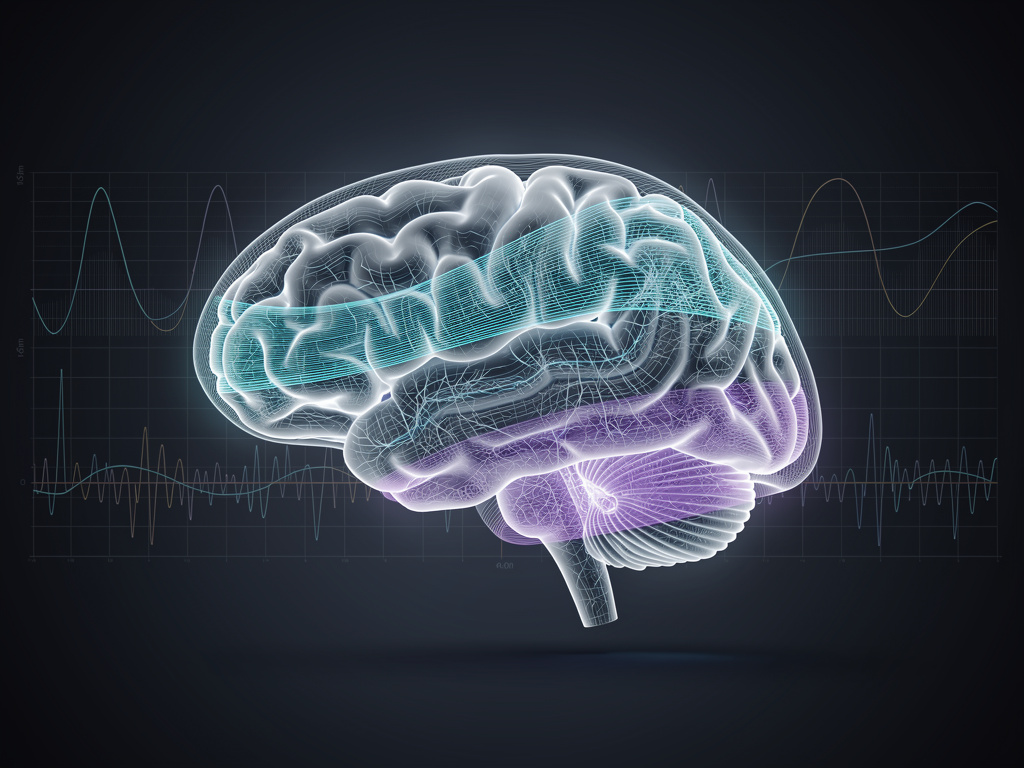
For decades, the prevailing model of brain function resembled a complex digital circuit board, with distinct regions firing in precise, synchronized bursts to process information. This view held that when we see a car, hear its engine, and feel the vibration, separate neural areas light up in unison to create a unified experience. But a growing body of evidence suggests this picture is incomplete. The brain, it appears, operates less like a digital computer and more like a fluid, dynamic system governed by rhythmic, propagating waves of electrical activity.
This emerging paradigm is centered on cortical traveling waves—organized patterns of neural oscillations that sweep across the brain’s surface like ripples on a pond. New research from the Salk Institute is providing the most detailed look yet at how these waves function, arguing that they are not just background noise but a fundamental mechanism for binding information together. These waves, scientists now propose, are what physically stitch together our perception of the world, defining the very boundaries of a moment of conscious thought.
A New Framework for Perception
In a landmark study, researchers at the Salk Institute for Biological Studies analyzed an immense dataset of brain activity recorded from a primate model, offering an unprecedented window into these elusive waves. The findings, published in Science Advances, detail how these waves are not random but are highly organized, coordinating the timing of neuron firing across vast stretches of the cortex. “The brain is a spatiotemporal organ,” Terrence Sejnowski, a Salk professor and senior author of the study, explained in a press release. This means that the spatial pattern of brain activity is just as critical as its timing, a dimension largely overlooked by models focused solely on synchronized firing in isolated regions.
The team discovered that these traveling waves are modulated by attention. When the subject was focused on a task, the waves became more prominent and organized, suggesting they play an active role in perception and cognition. According to a report from ScienceAlert, this finding directly challenges the idea of the brain as a collection of discrete processing centers. Instead, it paints a picture of a more holistic system where information is integrated across both space and time by these continuous, flowing patterns.
Solving the Brain’s Binding Problem
This research offers a compelling potential solution to one of neuroscience’s most persistent puzzles: the “binding problem.” This problem asks how the brain integrates disparate sensory inputs—the color, shape, motion, and sound of a bouncing ball, for example—into a single, coherent object of perception. If different attributes are processed in different cortical areas, what mechanism binds them together into one seamless experience? The classic model of synchronized oscillations, where different brain areas fire at the same frequency, has struggled to fully explain how this happens with such speed and flexibility.
Traveling waves provide a more elegant explanation. As a wave propagates across the cortex, it sequentially activates different groups of neurons, creating a structured, time-delayed framework for communication. This allows information from one area to be integrated with another in a precise, ordered sequence. This process, as detailed in the Salk Institute’s own announcement, could be the physical basis for our unified sense of reality. The “limits of you” in any given moment, the researchers suggest, may be defined by the physical extent and duration of a single, overarching traveling wave as it moves through the brain.
The Rhythmic Pulse of Consciousness
The concept of brain waves guiding information is not entirely new, but the resolution and scale of the Salk study have pushed the idea to the forefront. Previous work, highlighted in a Quanta Magazine report, has shown how different frequencies of brain waves, or oscillations, can route information between different neural circuits. Alpha waves, for instance, have been observed acting as a form of gatekeeper, suppressing irrelevant neural activity, while gamma waves are associated with active processing. The traveling wave model builds on this, showing that these oscillations are not just static pulses but have a direction and a velocity, creating a dynamic scaffold for complex computation.
This spatiotemporal framework suggests that our subjective experience of a continuous present is an illusion, constructed from discrete packets of information bound together by these waves. Each wave represents a single “frame” of perception. “We have a new appreciation for how the cortex is organized,” said Sejnowski, as noted by the Salk Institute. “The fact that brain waves are organized and travel across the surface of the cortex is a big surprise.” This organization is what allows the brain to manage the immense complexity of sensory input and generate a stable, coherent internal model of the outside world.
Implications for Neurological and Psychiatric Disorders
This refined understanding of the brain’s operating system has profound implications for clinical neuroscience. Many neurological and psychiatric conditions, including schizophrenia, autism, and ADHD, are characterized by disorganized or fragmented perception. If traveling waves are the mechanism responsible for binding our experiences together, then disruptions to these wave patterns could be a core pathological feature of these disorders. A fragmented sense of self or a disjointed perception of reality, common in schizophrenia, might be the direct result of aberrant or poorly coordinated cortical waves.
This hypothesis is already gaining traction. A separate study published in PNAS found evidence of disorganized traveling waves in individuals with schizophrenia, suggesting a breakdown in the large-scale coordination of neural activity. By identifying wave patterns as a potential biomarker, clinicians could one day develop new diagnostic tools or therapeutic interventions. Treatments could be designed to modulate or restore healthy wave dynamics, potentially using non-invasive techniques like transcranial magnetic stimulation (TMS) or focused ultrasound to nudge the brain’s rhythms back into a coherent state.
A New Frontier in Brain Science
The shift from a purely temporal, region-based model of brain function to a spatiotemporal, wave-based one represents a significant evolution in neuroscience. It forces researchers to think about the brain not as a static network but as a continuously active medium, where information flows and integrates in ways far more complex than previously imagined. This perspective opens up new avenues of inquiry, from understanding the fundamental nature of consciousness to developing more sophisticated brain-computer interfaces that can interpret and even influence these intricate patterns.
The immediate challenge lies in decoding the “language” of these waves. If different wave patterns—varying in speed, direction, and frequency—correspond to different cognitive states or perceptual experiences, then mapping these correlations could unlock a new level of understanding of the mind. While the technical hurdles are immense, the work at the Salk Institute and elsewhere provides a crucial foundation. By observing the rhythmic tide that sweeps across the cortex, we are no longer just looking at the brain’s individual components, but beginning to grasp the elegant, flowing process that gives rise to the self.


 WebProNews is an iEntry Publication