
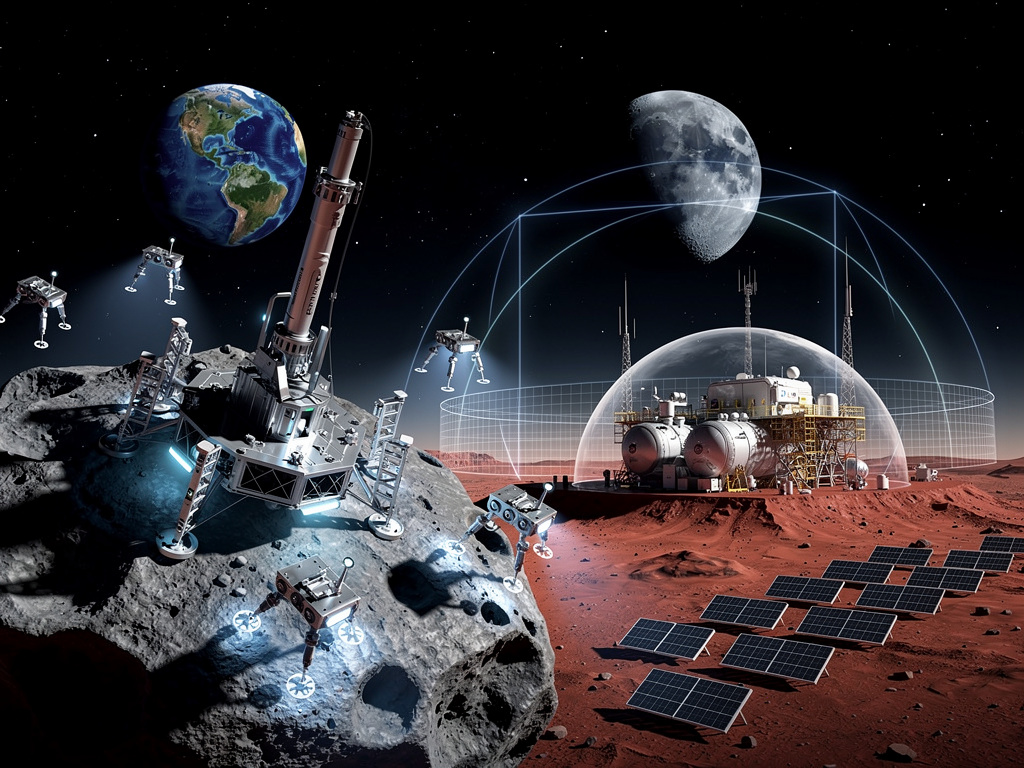
The United States House of Representatives has taken a landmark step toward establishing the regulatory framework necessary for commercial ventures beyond cislunar space, signaling a new era in which private enterprise could operate mining facilities on asteroids, construct habitats on Mars, and establish permanent infrastructure throughout the solar system. The legislative initiative represents the most significant expansion of commercial space law since the passage of the Commercial Space Launch Competitiveness Act nearly a decade ago.
According to Ars Technica, the House Science, Space, and Technology Committee advanced a bipartisan bill that would create a comprehensive regulatory structure for deep space commercial activities, extending beyond the Earth-Moon system to encompass asteroids, Mars, and potentially the outer planets. The legislation addresses a critical gap in existing space law, which has largely focused on activities in low Earth orbit and, more recently, lunar operations. This new framework would establish property rights mechanisms, safety standards, and licensing procedures for companies venturing into previously uncharted regulatory territory.
The timing of this legislative push reflects the rapid maturation of commercial space capabilities and the growing recognition among policymakers that the United States must establish clear rules of engagement before international competitors do. China has announced ambitious plans for deep space resource extraction, while the European Space Agency has partnered with commercial entities to explore asteroid mining feasibility. Without clear American leadership in establishing international norms, industry experts warn that the United States could find itself operating under frameworks developed by rival powers.
The Economic Imperative Behind Deep Space Commerce
The potential economic value of deep space resources has transformed from science fiction speculation into serious policy consideration. A single metallic asteroid could contain more platinum group metals than have been mined in all of human history, while water ice deposits on asteroids and Mars could provide propellant for spacecraft, dramatically reducing the cost of deep space operations. The proposed legislation recognizes these economic realities by establishing mechanisms for companies to claim rights to extracted resources while maintaining compliance with the Outer Space Treaty’s prohibition on territorial sovereignty.
Industry stakeholders have pressed Congress for regulatory clarity for years, arguing that the absence of clear property rights and operational frameworks has deterred investment in deep space ventures. SpaceX, Blue Origin, and several specialized asteroid mining startups have collectively invested billions in technologies that would enable commercial deep space operations, but the regulatory uncertainty has made it difficult to secure additional venture capital or plan long-term business models. The new legislation attempts to balance the need for regulatory certainty with flexibility to accommodate technologies and business models that don’t yet exist.
Navigating International Treaty Obligations
The proposed framework must navigate complex international legal terrain, particularly the Outer Space Treaty of 1967, which established that celestial bodies cannot be subject to national appropriation. The legislation addresses this constraint by focusing on resource extraction rights rather than territorial claims, similar to the approach taken with deep-sea mining under the Law of the Sea Convention. Legal experts note that this distinction, while subtle, could prove crucial in maintaining international support for American commercial activities while still providing companies with sufficient property rights to justify massive capital investments.
The bill also proposes the creation of a new office within the Department of Commerce specifically dedicated to deep space commercial activities, separate from existing offices that handle launch licensing and Earth observation. This organizational structure acknowledges that deep space operations present fundamentally different challenges than near-Earth activities, including communication delays, extreme distances, and the need for greater operational autonomy. The office would be responsible for issuing licenses, monitoring compliance with safety and environmental standards, and coordinating with international partners on shared deep space initiatives.
Technical Standards and Safety Protocols
One of the most challenging aspects of the legislation involves establishing technical standards for operations that will occur millions of miles from Earth, where real-time oversight is impossible and rescue missions may be infeasible. The bill mandates the development of autonomous safety systems and requires companies to demonstrate technological readiness before receiving licenses for crewed missions beyond Mars orbit. These provisions reflect lessons learned from the commercial crew program, where NASA’s partnership with private companies has successfully transported astronauts to the International Space Station while maintaining rigorous safety standards.
The legislation also addresses environmental considerations, requiring environmental impact assessments for activities that could significantly alter celestial bodies or create debris fields that might interfere with future operations. While some space advocates have criticized these provisions as potentially burdensome, supporters argue that establishing sustainable practices from the outset will prevent the kind of orbital debris problems that currently plague low Earth orbit. The bill includes provisions for international coordination on debris mitigation and planetary protection, recognizing that deep space operations will require unprecedented levels of cooperation among spacefaring nations.
Financing Mechanisms and Public-Private Partnerships
The proposed legislation includes novel financing mechanisms designed to bridge the gap between current commercial space capabilities and the massive investments required for deep space infrastructure. The bill authorizes the creation of a Deep Space Development Corporation, modeled loosely on the Tennessee Valley Authority, which could issue bonds to finance shared infrastructure such as propellant depots, communication relays, and emergency response capabilities. Private companies would lease access to this infrastructure, creating a sustainable revenue model while reducing the capital requirements for individual ventures.
This public-private partnership approach represents a significant evolution in space policy, moving beyond the traditional model of government-led exploration followed by commercial exploitation. Instead, the legislation envisions government and private sector developing deep space capabilities simultaneously, with each sector focusing on its comparative advantages. NASA would continue to lead scientific exploration and technology development, while commercial entities would focus on resource extraction, manufacturing, and permanent infrastructure development.
Workforce Development and Educational Initiatives
Recognizing that a successful deep space commerce sector will require a dramatically expanded workforce with specialized skills, the legislation includes substantial provisions for education and training programs. The bill authorizes grants to universities for developing curricula in deep space engineering, autonomous systems, and space resource utilization. It also creates apprenticeship programs that would allow students to gain practical experience with companies developing deep space technologies, addressing industry concerns about the shortage of qualified personnel.
These workforce provisions have garnered bipartisan support, with lawmakers from both parties recognizing the potential for high-skilled job creation in their districts. The bill includes geographic diversity requirements for educational grants, ensuring that opportunities extend beyond traditional aerospace hubs to communities across the country. Industry representatives have praised these provisions, noting that the success of deep space commerce will ultimately depend on developing a robust talent pipeline.
The Path Forward and Political Challenges
Despite the bipartisan support in committee, the legislation faces significant hurdles before becoming law. Budget hawks have expressed concerns about the costs of establishing new regulatory infrastructure and the potential for taxpayer-funded bailouts if deep space ventures fail. The bill’s supporters counter that the minimal government investment required pales in comparison to the potential economic returns and that clear regulations will actually reduce the likelihood of costly failures by establishing safety standards and operational best practices from the outset.
The legislation must also navigate competing visions within the space community about the appropriate role of government in commercial space activities. Some libertarian-leaning advocates argue that the proposed regulatory framework is too extensive and could stifle innovation, while others contend that more stringent environmental protections are necessary to prevent irreversible damage to pristine celestial environments. The bill’s sponsors have attempted to chart a middle course, establishing clear rules while preserving flexibility for innovation and maintaining environmental stewardship.
As the legislation moves to the full House for consideration, its fate will likely depend on broader political dynamics and competing budget priorities. However, the strong bipartisan support in committee and endorsements from major aerospace companies suggest that some version of the bill has a reasonable chance of passage. If enacted, this legislation would position the United States as the leader in establishing the legal and regulatory framework for humanity’s expansion into the solar system, with profound implications for economic development, scientific discovery, and international relations for decades to come.
The proposed framework represents more than just regulatory housekeeping; it embodies a fundamental shift in how humanity approaches space exploration and development. By establishing clear rules for commercial deep space activities, Congress is acknowledging that the future of space lies not just in government-led missions but in the dynamic interplay between public exploration and private enterprise. Whether this vision becomes reality will depend on the legislation’s passage and implementation, but the House committee’s action marks a significant milestone in the ongoing evolution of space policy and the opening of the final frontier to commercial development.


 WebProNews is an iEntry Publication