
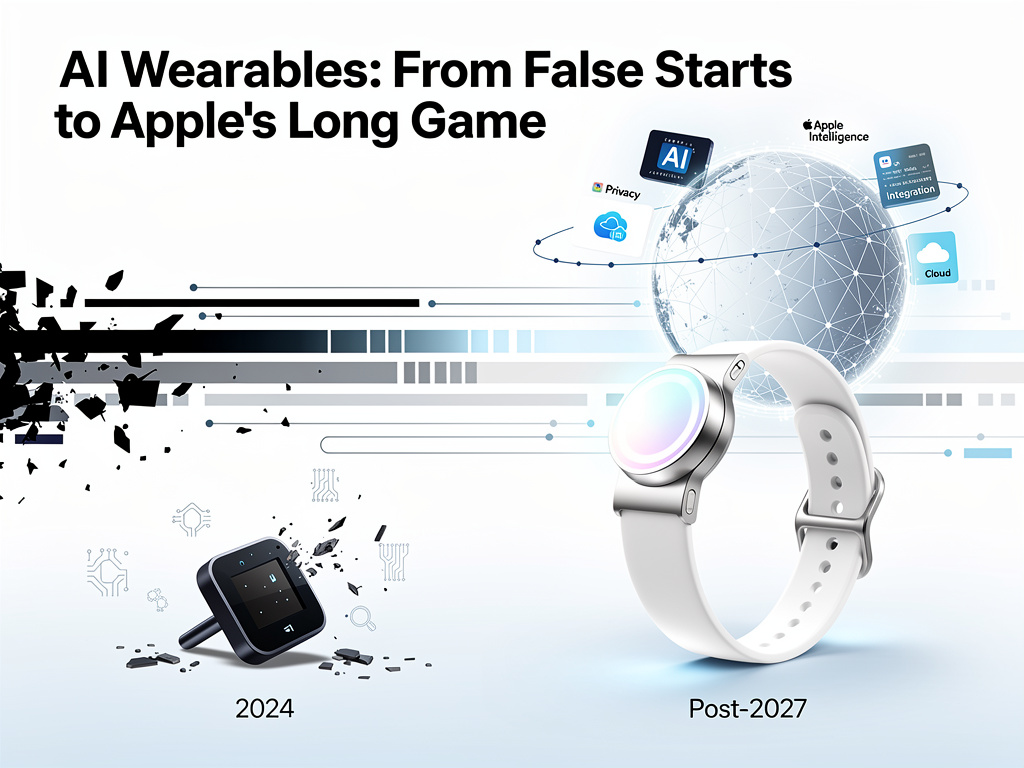
The nascent market for standalone artificial intelligence hardware is already littered with high-profile wreckage. Humane’s Ai Pin, a device that promised to liberate users from their screens, was met with scorching reviews for its poor performance and fundamental usability flaws. The Rabbit R1, another hopeful, quickly faced scrutiny over its software and long-term viability. For many in Silicon Valley, these early failures have served as a cautionary tale, suggesting the world is not yet ready—and the technology not yet mature—for a post-smartphone, ambient computing future.
Yet in the meticulously planned, long-range corridors of Cupertino, a different conclusion is being drawn. Apple Inc. is reportedly exploring its own entry into the category, envisioning a wearable AI device that could one day supplement, or even succeed, the iPhone. According to a detailed report from The Information, the company’s industrial design group is in the early stages of investigating devices, including one that could function like a pin-on wearable equipped with cameras. Crucially, however, Apple is in no rush. Unlike the venture-backed startups that raced to market, the technology giant is said to be eyeing a potential release no earlier than 2027, a timeline that underscores its methodical and patient approach to new product categories.
This extended timeline is classic Apple strategy. It allows the company to observe the market, learn from the very public missteps of its predecessors, and wait for key enabling technologies to mature. The company is not interested in launching a minimum viable product; it is focused on creating a polished, integrated experience that solves real user problems from day one. This approach was central to the development of the Apple Watch and, more recently, the Vision Pro, both of which spent years in secretive R&D labs before being unveiled. For a potential AI wearable, the challenges of battery life, processor efficiency, and the sheer utility of the software demand nothing less than a long-term, deliberate development cycle.
A Market Defined by High-Profile Failures
To understand Apple’s potential path forward, one must first dissect the failures of those who came before. The Humane Ai Pin, which began shipping in April 2024, was intended to be a seamless, voice-driven interface to AI models. Instead, it became a case study in over-promising and under-delivering. In a widely circulated and damning review, technology analyst Marques Brownlee labeled it “the worst product I’ve ever reviewed… for now,” citing its excruciatingly slow response times, constant overheating, and unreliable core functions. As detailed by The Verge, the device’s reliance on a cloud connection for nearly every task created a frustrating latency that defeated its purpose as a quick, ambient tool.
The Rabbit R1 faced a different, though equally problematic, set of issues. While its hardware was more whimsical and its price point more accessible, critics quickly questioned its fundamental value proposition. The device struggled to perform tasks that are trivial on a smartphone and, in some cases, its software was found to be running on a relatively simple Android application, undermining its claim as a revolutionary new operating system. These early entrants failed to answer the most critical question for any new hardware category: what can this device do that my existing, incredibly powerful smartphone cannot do better, faster, and more reliably?
These failures provide Apple with an invaluable playbook of pitfalls to avoid. The technical hurdles are immense, from creating a miniaturized chipset that is both powerful and thermally efficient to engineering a battery that can sustain all-day use for a device that is always on and always sensing. More importantly, the user experience must be flawless. Consumers will not tolerate a product that is slower or less reliable than pulling out an iPhone. Apple’s deep expertise in custom silicon, power management, and software-hardware integration gives it a structural advantage that startups like Humane, which relied on a Qualcomm Snapdragon processor, simply cannot match.
The ‘Apple Intelligence’ Ecosystem Advantage
The timing of these hardware rumors is not coincidental. They arrive just as Apple has unveiled its overarching AI strategy, branded “Apple Intelligence.” Announced at its 2024 Worldwide Developers Conference, this system is designed to weave generative AI deeply into the operating systems of the iPhone, iPad, and Mac. Crucially, Apple’s approach prioritizes on-device processing for privacy and speed, with a sophisticated ability to tap into a user’s personal context—their emails, calendars, photos, and messages—to provide truly helpful assistance. This software foundation is the missing piece that eluded early AI gadgets.
An Apple-designed wearable would not be a standalone product in a vacuum; it would be the ultimate edge device for the Apple Intelligence ecosystem. While the Humane Ai Pin had to build its contextual understanding from scratch, an “Apple Pin” would instantly and securely tap into the user’s established personal data graph. As Apple’s own announcement makes clear, its system is built to understand a user’s world to simplify and accelerate everyday tasks. Imagine asking a wearable device to “summarize the email my boss sent about the Q3 projections” or “show me photos from my trip to Italy last spring.” Only Apple, with its control over the entire hardware and software stack, can deliver this level of seamless, private, and context-aware interaction.
This integration also addresses the business model challenge. Humane required a $24 monthly subscription for cellular and AI services, a steep price for a device with questionable utility. An Apple wearable would likely integrate into existing service bundles like Apple One or function as an accessory to the iPhone, much like the Apple Watch. This lowers the barrier to entry and frames the device not as a risky bet on a new platform, but as a natural and powerful extension of an ecosystem in which hundreds of millions of users are already deeply invested.
Navigating Consumer Skepticism and Defining a Purpose
Despite Apple’s formidable advantages, significant skepticism remains, and for good reason. The central question of purpose—the “why”—has yet to be convincingly answered by anyone in the field. As noted in an analysis by TechRadar, convincing users they need another device to carry, charge, and potentially pay a subscription for is an immense hurdle. The smartphone is the apex predator of consumer electronics; it is a camera, a communication hub, a payment device, and a portal to infinite information. A successful new device cannot merely replicate these functions poorly; it must offer a fundamentally new and compelling capability.
Apple is likely exploring use cases that thrive in a hands-free, screen-free context. A key area is a more proactive and intelligent Siri. A camera-equipped device could offer real-time visual search, identifying landmarks, translating text, or providing product information. It could serve as a more discreet and immediate way to capture moments or dictate notes without the friction of pulling out a phone. The goal is not to replace the iPhone for tasks like browsing the web or watching video, but to handle the quick, in-the-moment interactions that currently interrupt a user’s presence in the physical world.
The journey to this future is fraught with technical and social challenges. The inclusion of an always-on camera, for instance, immediately raises privacy concerns, an issue Google learned the hard way with its Glass project. Apple will need to leverage its hard-won reputation for user privacy to convince the public to adopt such a device. This is where its on-device processing strategy becomes not just a technical feature, but a critical marketing and ethical pillar.
A Long Road Paved with Patience and Capital
The exploration of an AI wearable fits perfectly into Apple’s long-term vision of creating more personal and less intrusive technology. It is a direct descendant of the thinking that produced the iPod, the Apple Watch, and the Vision Pro—devices that aimed to embed technology more seamlessly into a user’s life. According to Bloomberg, Apple’s rollout of its Apple Intelligence software will itself be a gradual, multi-year process, with many advanced features not arriving until 2025 or later. This pace shows the company is more concerned with getting the experience right than with winning a short-term marketing cycle.
Ultimately, the rumors of a 2027 AI device are less about a specific product and more about Apple’s direction. The company is methodically laying the groundwork—in silicon, in software with Apple Intelligence, and in its supply chain—to build the next generation of personal computing devices. The first wave of AI gadgets may have crashed on the shores of poor execution and a lack of purpose, but the tide of technological progress is still coming in.
While the rest of the industry chases the hype cycle, Apple is playing a different game. It is using its immense resources to solve the hard engineering problems and, most importantly, to wait until the technology is ready to deliver an experience that feels not like a science experiment, but like magic. Whether this future takes the form of a pin, a pair of glasses, or something else entirely remains to be seen. But for competitors and industry observers, the message from Cupertino is clear: the era of ambient AI is coming, and Apple plans to define it on its own terms and on its own timeline.


 WebProNews is an iEntry Publication