
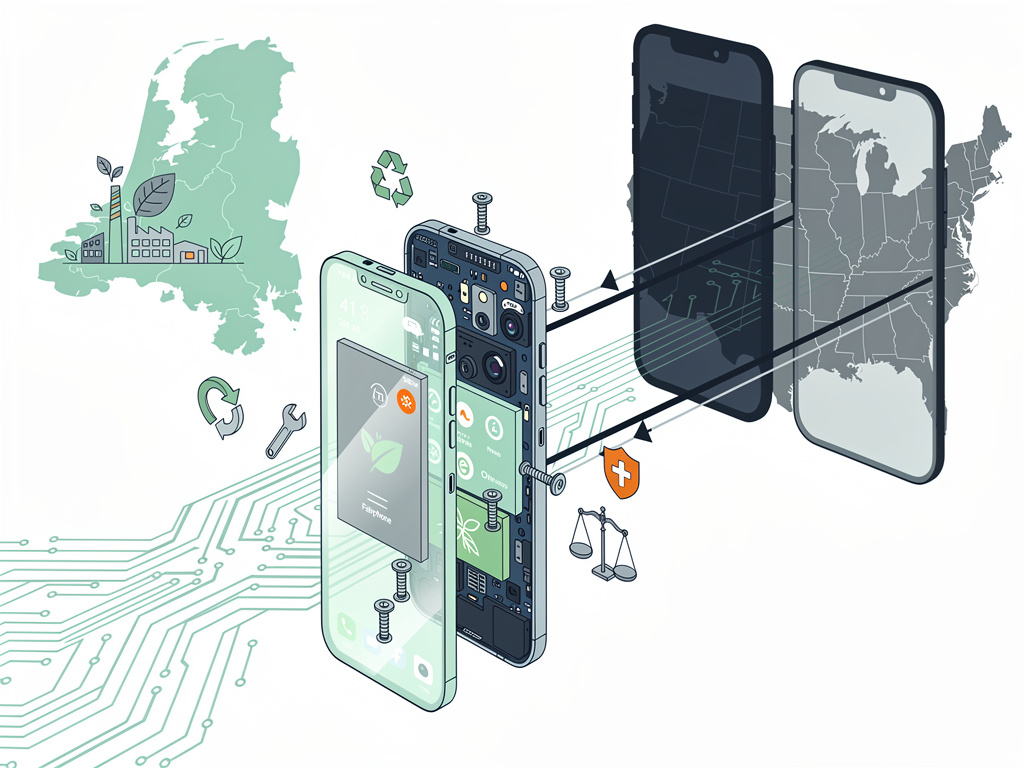
AMSTERDAM—In an industry defined by sealed glass-and-metal slabs designed for a two-year lifespan, Fairphone BV has carved out a niche by doing the unthinkable: building a phone meant to be taken apart. The Dutch social enterprise has spent a decade cultivating a loyal following in Europe with devices that champion ethical material sourcing, worker welfare, and, most radically, user repairability. Now, the company is looking west, contemplating its most audacious move yet: an entry into the formidable, carrier-dominated smartphone market of the United States.
The U.S. represents a tantalizing prize and a near-insurmountable challenge. It’s a market where two giants, Apple Inc. and Samsung Electronics Co., command the vast majority of sales, distributed through a powerful oligopoly of wireless carriers. For an outsider like Fairphone, breaking in is a high-stakes gamble. Yet, a confluence of regulatory tailwinds from the burgeoning “right-to-repair” movement and a growing consumer unease with disposable technology may be cracking the door open just enough for a company whose entire ethos is built on longevity. The question insiders are asking is whether a hypothetical “Fairphone 6” could be the device to finally make the transatlantic leap.
Fairphone’s current strategy in the U.S. is a cautious one, executed through a partnership with Murena, a company that sells de-Googled smartphones running its privacy-focused /e/OS. This collaboration allows a version of the Fairphone 4 to be sold directly to American consumers, bypassing the carriers entirely. While a clever way to test the waters, it relegates the device to a hyper-niche audience of privacy advocates and tech tinkerers. As a market-entry strategy, it is more of a quiet reconnaissance mission than a full-scale assault, gathering data on a small but dedicated user base.
This softly-softly approach underscores the central barrier that has kept Fairphone and other smaller manufacturers out of America. “The U.S. is a completely different market than Europe, mainly because of the carriers,” Fairphone CEO Eva Gouwens has stated. The process of getting a device certified for use on networks like Verizon or AT&T is both technically arduous and financially punishing, involving extensive testing to ensure network compatibility and compliance. For a small company, the cost and complexity of navigating this gauntlet for a device that might sell in the low thousands is a prohibitive risk.
A Market Ripe for Disruption
Despite the structural challenges, the timing for a more ambitious American play has never been better. A powerful legislative movement is reshaping the electronics industry’s relationship with its customers. Landmark Right to Repair laws have recently been enacted in states like California and New York, compelling manufacturers to make parts, tools, and repair manuals available to consumers and independent shops. This regulatory shift directly validates Fairphone’s core business model, potentially creating a new class of consumers who value and demand repairability in their devices.
This legislative momentum reflects a deeper cultural shift. The narrative of needing a new thousand-dollar phone every two years is facing pushback from consumers tired of expensive screen repairs and batteries that can’t be easily replaced. Fairphone’s central value proposition—a modular phone where a cracked screen or a failing battery can be replaced by the user in minutes with a simple screwdriver—is a direct answer to these frustrations. The market for a sustainable, long-lasting device may be small, but it is vocal and growing, a segment that currently has no viable option in the mainstream U.S. market.
To succeed, however, a potential Fairphone 6 would need to be more than just a moral statement; it must be a competitive product. The company’s past devices have often been criticized for lagging behind on key specifications, particularly camera performance and processing power—a necessary trade-off for prioritizing modularity and ethical sourcing. As noted by industry publication Android Authority, for a U.S. launch to be viable, the device would need to close this gap significantly, likely requiring a capable mid-range processor like a Qualcomm Snapdragon 7-series chip and a camera system that can hold its own against similarly priced rivals.
Furthermore, the technical requirements for the U.S. market are non-negotiable. Comprehensive 5G band support, including the crucial C-band and mmWave frequencies, would be essential for ensuring compatibility and performance across all major carriers. This is a significant engineering and licensing hurdle that requires deep collaboration with chipset manufacturers and a substantial financial investment. Without it, even an unlocked model sold directly to consumers would offer a subpar experience, dooming it from the start.
Navigating the Carrier Labyrinth
Assuming Fairphone can engineer a technically competitive device, the ultimate challenge remains distribution. Cracking the carrier channel is the holy grail for any phone maker in the U.S. It would require a strategic pivot from the company’s direct-to-consumer European model. One potential path is to partner with a smaller Mobile Virtual Network Operator (MVNO) to build a track record and demonstrate demand before approaching one of the major players. This would be a gradual, trust-building exercise in a market that values volume and reliability above all else.
Another, more direct route would be to focus initially on a powerful unlocked model, marketed heavily to the tech-savvy and environmentally conscious consumers who are already seeking alternatives. The success of brands like Framework with its repairable laptops shows that a direct-to-consumer model for complex, sustainable electronics can work in the U.S. This approach would allow Fairphone to build brand recognition and a loyal customer base, creating a demand that carriers would eventually find difficult to ignore. Recent company moves, including hiring a general manager for North America, suggest Fairphone is, as a spokesperson told The Verge, “seriously exploring” this very path.
The journey will not be easy. The U.S. smartphone market is a graveyard of ambitious brands, from LG to HTC, that failed to compete with the marketing budgets and supply chain dominance of Apple and Samsung. Fairphone operates on a completely different scale and with a fundamentally different objective. Its goal isn’t to ship tens of millions of units, but to prove that a different kind of electronics industry is possible—one that is more sustainable, ethical, and respectful of the consumer.
Fairphone’s potential U.S. entry is less a story about market share and more about market influence. Success would not be measured by dethroning the incumbents, but by establishing a durable beachhead for sustainable technology in the world’s most influential consumer market. It’s a bet that a growing number of Americans are ready to vote with their wallets for a phone that lasts, a principle that, until now, has been all but impossible to find.


 WebProNews is an iEntry Publication