
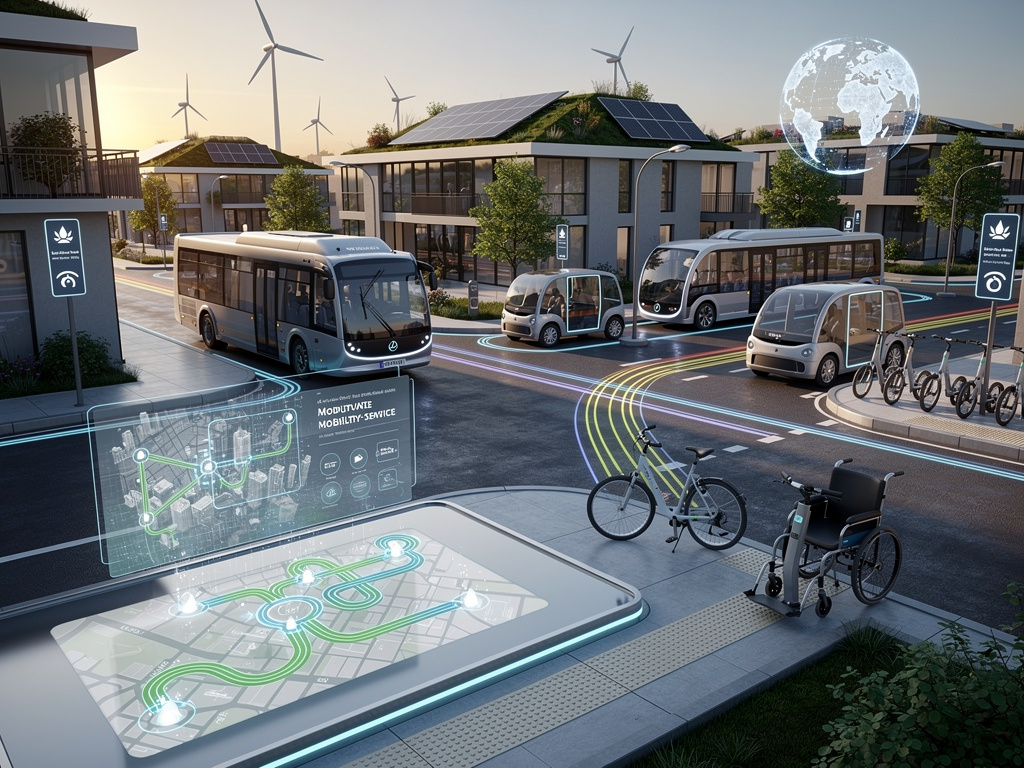
In the evolving world of urban movement, mobility transcends the basic mechanics of shuttling people and goods from one spot to another. It centers on seamless access, affordability, and integration across options like walking, cycling, rideshares, and public transit. This holistic approach prioritizes diverse users, from low-income residents to the elderly and those with disabilities, fostering economic opportunity and quality-of-life gains. Studies link robust mobility networks to upward socioeconomic progress, underscoring its role in equitable city-building.
Mobility as a Service (MaaS) exemplifies this shift, bundling transport modes into unified apps for trip planning, booking, and payment. Helsinki’s Whim app, aiming to eliminate private car needs by 2025, integrates public transit, bikeshares, and taxis via real-time data. Deloitte Netherlands highlights how such platforms pivot from ownership to on-demand access, optimizing flows amid rising urbanization.
The MaaS market, valued at $195.2 billion in 2024, eyes $4,013.2 billion by 2033, per Grand View Research. Projections vary—Research Nester forecasts $754.5 billion by 2037 at 20.1% CAGR—driven by 5G, IoT, and AI for real-time routing. Bengaluru’s 2025 launch of Tummoc and Namma Yatri apps via Mercedes-Benz’s challenge signals Asia’s surge, as noted by Precedence Research.
Equity at the Core of Modern Systems
Accessibility defines true mobility success. Systems must serve low-income groups, seniors, and disabled individuals, who face barriers in traditional setups. The U.S. Federal Transit Administration’s Section 5310 funds targeted services, blending 55% for traditional needs with 45% for ADA enhancements or fixed-route access, per FTA. Programs like NADTC promote options for these demographics, emphasizing coordination.
Social equity ties mobility to well-being: healthcare, jobs, education access correlates with transport availability. MTC’s Bay Area blueprint aids older adults, disabled persons, and low earners via county assistance and underserved community targeting, as detailed on MTC. Contra Costa’s Mobility Matters deploys 100+ volunteers for thousands of rides yearly.
Challenges persist for vulnerable users. Transportation disadvantage bars vital services, per a ScienceDirect study, urging user-centered designs and stable funding to curb exclusion.
Sustainability Drives Mode Integration
Active modes like walking and cycling offer health perks and low emissions but limited range. Public options—buses, trains—excel in mass efficiency, forming sustainable urban backbones. Shared services like Uber, Lyft complement for last-mile gaps, though regulation shapes their green impact.
Freight adds complexity, vying for space with passengers. UN-Habitat warns passenger demand could quadruple by 2050, freight triple, demanding climate-resilient integration. Shared micromobility and cargo bikes emerge for urban goods, tackling congestion and pollution, as explored in PMC.
Sustainability hinges on reducing single-occupancy vehicles. EU targets cut vehicle emissions 55% by 2030; AI aids via infrastructural tweaks, optimized parking, per Isarsoft.
Technology’s Precision Edge
Smart mobility harnesses AI for traffic optimization. Juniper Research predicts $277 billion savings by 2025 from such systems. New York’s 2025 congestion pricing slashed Manhattan vehicles by a million monthly, boosting emergency responses and air quality, via Omnisight.
Helsinki’s program uses AI for signals, congestion prediction, multimodal data. Singapore’s Smart Mobility 2030 employs speed algorithms, cutting rush-hour jams, per ACM. ITMS market hits $30.7 billion by 2034 at 13.5% CAGR, fueled by AI-IoT, notes GlobeNewswire.
Reinforcement learning refines signals; UC Berkeley’s HumanLight prioritizes people over vehicles. Waymo’s San Francisco expansion outpaces Lyft rides, per X posts.
Pioneering Global Deployments
Europe leads: Berlin’s Jelbi, city-owned with Trafi, integrates modes. umob’s €3.5 million raise scales Whim across Europe, per Grand View Research. China’s smart city push eyes $114.96 billion MaaS by 2025.
Denver’s OpenPayments enables contactless fares with capping. Toyota-Jasmy integrates blockchain in ridesharing, X highlights. SMBC Card pilots regional MaaS payments.
U.S. fragmentation hampers scaling; state rules inflate costs, per Mordor Intelligence. Yet pilots proliferate: Vienna’s Upstream, Netherlands’ Rivier open platforms.
Freight’s Urban Squeeze
Goods movement fuels economies but congests roads. Strategies like off-hour deliveries, rail shifts mitigate. Carrier data sharing aids planning, per ScienceDirect.
MaaS extends to freight: on-demand ferries, diversified options. Micromobility for parcels cuts emissions 108-120g/km, via Frontiers. Shared resources promise efficiency.
Passenger-freight integration curbs impacts; OECD’s curb management key.
Regulatory and Tech Hurdles Ahead
Incumbents resist; taxi unions lobby against ride-hailing. EU’s MDMS pushes data access. Data privacy, interoperability challenge MaaS, per GlobeNewswire.
G2C models rise over B2C; public operators lead. AI ethics, V2X integration loom. X buzzes on Tesla’s TAAS, Cybercab production.
Success demands collaboration: governments, firms, planners. Pilots prove gains; scaling via policy unlocks potential.


 WebProNews is an iEntry Publication