
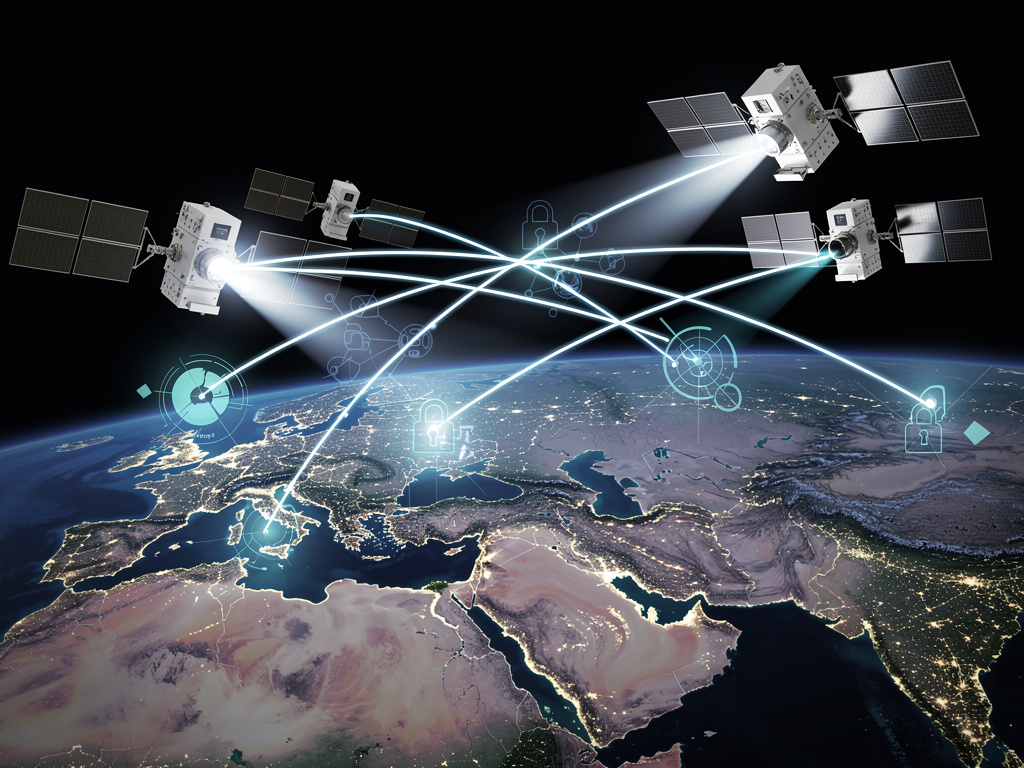
In an increasingly crowded sky, where constellations of satellites promise to blanket the globe with internet access, a new heavyweight contender is emerging with a fundamentally different strategy. TeraWave, a joint venture backed by the formidable financial power of Saudi Arabia’s Public Investment Fund (PIF) and the technical vision of Rivada Space Networks, is not aiming to bring Netflix to the world’s remote cabins. Instead, it is building a highly secure, high-speed communications backbone in low-Earth orbit (LEO) designed exclusively for governments and large enterprises, a move that could redefine secure global connectivity.
The partnership, announced in late 2023, establishes TeraWave as the exclusive provider of Rivada’s LEO satellite capacity in the Middle East, Europe, Africa, and parts of Asia and Latin America. Headquartered in Germany, the venture represents a significant strategic investment for the PIF, which is aggressively diversifying the Saudi economy beyond oil as part of its Vision 2030 plan. By backing TeraWave, the sovereign wealth fund is making a calculated bet on the future of secure data transit, a market driven by escalating geopolitical tensions and the ever-present threat of cyberattacks on terrestrial infrastructure.
A New Architecture for a Network in the Sky
At the heart of TeraWave’s offering is Rivada’s “Outer-NET,” a planned 600-satellite constellation that operates more like a secure data network in space than a simple internet service. Unlike first-generation LEO systems that often act as “bent pipes”—relaying signals from a user on the ground up to a satellite and back down to a terrestrial gateway—the Outer-NET is designed as a dynamic optical mesh network. Each satellite will be interconnected with four others via laser links, creating a web of light that routes data entirely in space. This architecture, as detailed by TechRepublic, allows data to travel from one point on Earth to another without ever touching the terrestrial internet, significantly reducing latency and exposure to ground-based threats.
This is made possible by two key technologies: inter-satellite laser links (ISLs) and advanced on-board processing. The ISLs enable data to hop from satellite to satellite at the speed of light, while the on-board routers and processors manage traffic flow dynamically, choosing the most efficient path through the orbital network. “We are creating a new form of connectivity which is a secure, private network for governments and enterprises, which has not existed before,” said Declan Ganley, Chairman and CEO of Rivada, in an interview. This approach effectively creates a single, unified global network in orbit, offering unparalleled security and route diversity for mission-critical communications.
Carving a Niche in the Enterprise and Government Sectors
TeraWave’s decision to bypass the direct-to-consumer market is a deliberate strategic choice that sets it apart from competitors like SpaceX’s Starlink. While Starlink has successfully demonstrated the vast potential of LEO-based consumer broadband, TeraWave is targeting a different class of customer with distinct needs. Its potential clients include telecommunications companies seeking to extend their 5G networks, energy firms needing reliable connectivity for remote operations, maritime and aviation industries requiring global coverage, and, most critically, government and defense agencies demanding ultra-secure communication channels.
The business model is wholesale, positioning TeraWave as a capacity provider for these large organizations. By selling secure, private network access, the company can command premium pricing for guaranteed service-level agreements (SLAs), a crucial requirement for enterprise customers that consumer-focused services often cannot provide. This strategy avoids the high customer acquisition and support costs of the consumer market, focusing instead on high-value, long-term contracts. A press release from the PIF highlighted the venture’s goal to “empower businesses and governments” with a network designed for the modern data economy, emphasizing security, latency, and reach.
Fortifying Communications with Quantum-Level Security
For its target clientele, security is not just a feature; it is the primary value proposition. The Outer-NET’s inherent architecture, which keeps data traffic off the terrestrial internet, provides a foundational layer of security. By minimizing the number of ground-based touchpoints, it dramatically reduces the attack surface available to malicious actors. A data packet could, for example, travel from a corporate office in London to a remote facility in the South Pacific by traversing the space-based optical network, only touching the ground at its final destination.
TeraWave and Rivada are pushing the security envelope even further. In a move to future-proof the network against emerging threats, Rivada announced a partnership with SpeQtral, a specialist in quantum communications, to integrate Quantum Key Distribution (QKD) technology into the Outer-NET. QKD uses the principles of quantum mechanics to create cryptographic keys that are theoretically un-hackable. Any attempt to intercept the key would disturb its quantum state, immediately alerting the parties involved. This level of security is aimed squarely at national security agencies and financial institutions for whom data integrity is paramount.
Navigating a Field of Established Titans
Despite its innovative approach, TeraWave enters a market where giants are already in play. SpaceX’s Starlink has a significant first-mover advantage with thousands of satellites already in orbit. Eutelsat OneWeb is operational and serving enterprise and government customers, while Amazon’s Project Kuiper is beginning its deployment phase. However, TeraWave’s backers believe its unique architecture and business focus provide a clear path to success. Rivada has also secured priority ITU spectrum rights for Ka- and V-band frequencies, a critical and finite resource that provides a significant regulatory moat against future competitors.
The venture’s financial foundation is also robust. According to SpaceNews, Rivada has already secured over $2.4 billion in debt financing to fund the constellation’s construction, a strong vote of confidence from the financial community. The satellite manufacturing is well underway, with Terran Orbital contracted to build the initial 300 satellite buses, with an option for 300 more. This combination of secured funding, priority spectrum, and a clear manufacturing plan positions TeraWave as a credible and formidable new player.
The Path to Launch and Beyond
The timeline remains ambitious, with initial services slated to begin in 2025 and global coverage expected by 2026. The space industry is notoriously challenging, and executing a plan to deploy hundreds of highly sophisticated satellites on schedule will be a monumental task. Success will depend on the seamless integration of technologies from multiple partners, including Safran for the advanced optical laser terminals, and a flawless launch campaign.
Should TeraWave and Rivada succeed, the implications will extend far beyond corporate balance sheets. The Outer-NET could provide a new layer of resilient global infrastructure, offering a secure communications backbone for a world increasingly dependent on data but wary of its vulnerabilities. For Saudi Arabia, it marks another major step in its transformation into a global technology and investment power, leveraging its capital to build the infrastructure of the future. For governments and multinational corporations, it promises a new era of secure, sovereign control over their most sensitive communications, high above the fray of terrestrial geopolitics.


 WebProNews is an iEntry Publication