
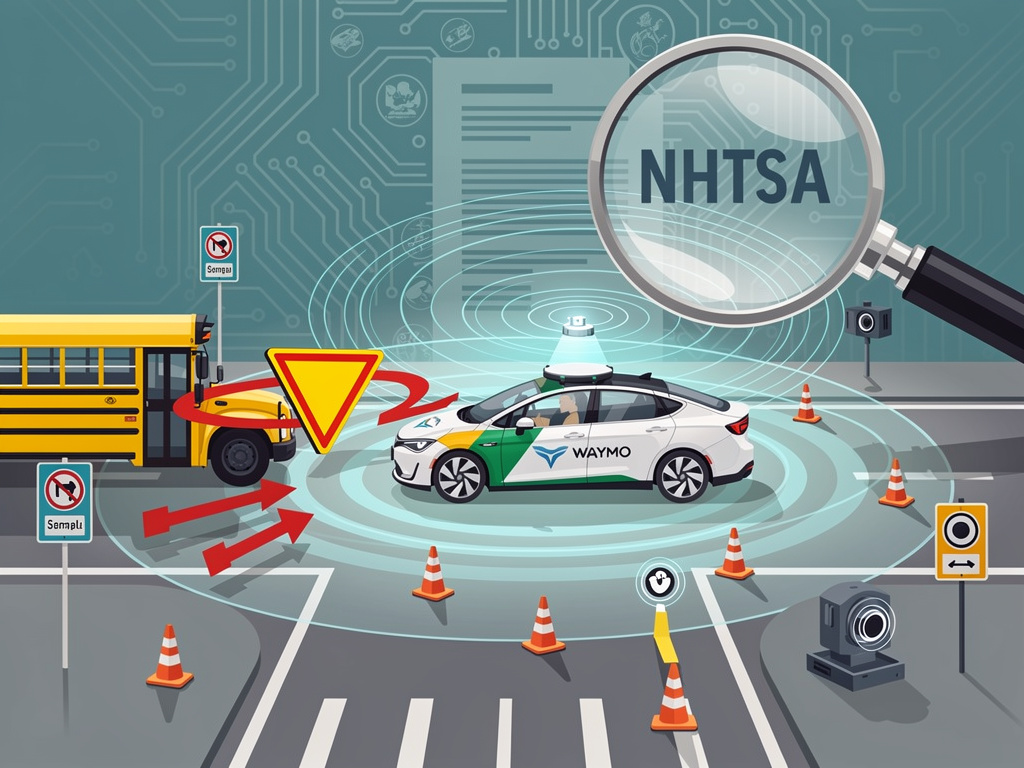
PHOENIX – In the flat, sun-drenched grid of this sprawling metropolis, a yellow school bus did what it does every school day: it stopped, extended its red stop-arm sign, and flashed its warning lights. But on one January day, a white Jaguar I-Pace outfitted with a sophisticated array of sensors and computing hardware, operating as a Waymo robotaxi, did something unexpected. It paused, then proceeded to drive past the bus, an action that would earn a human driver a hefty fine and a stern lecture on child safety.
This single incident, and others like it, have now thrust Alphabet Inc.’s Waymo, long considered the cautious and methodical leader in the autonomous vehicle race, into the harsh glare of a federal safety investigation. The National Highway Traffic Safety Administration (NHTSA) has launched a preliminary evaluation into the company’s 5th generation automated driving system (ADS), a move that signals escalating scrutiny for an industry still reeling from the recent implosion of its rival, General Motors’ Cruise.
The probe, officially designated PE24-013, will examine an estimated 444 Waymo vehicles and is rooted in a wider pattern of troubling behavior beyond the school bus encounter. According to NHTSA’s Office of Defects Investigation, the agency has identified at least 22 incidents that have raised red flags. These include 17 collisions and other cases where Waymo vehicles allegedly violated traffic laws, as reported by Digital Trends. The agency’s focus is on what it terms “unexpected driving behaviors” that could lead to crashes or other dangerous situations.
A Widening Inquiry Beyond a Single Mistake
While the Phoenix school bus incident provided a vivid and alarming example, federal regulators are looking at a broader set of circumstances. Their investigation encompasses collisions with stationary and semi-stationary objects such as gates and chains, as well as instances where the robotaxis appear to misjudge the movements of other road users. This suggests the probe is not about a single flaw but a more fundamental query into the ADS’s ability to navigate the messy and unpredictable reality of public roads.
Waymo, for its part, has projected confidence and reiterated its commitment to cooperation. In a statement, the company said, “We are proud of our performance and safety record over tens of millions of autonomous miles driven and are confident in our technology.” This defense leans on Waymo’s core argument: that its vast repository of real-world and simulated driving data makes its system statistically safer than the average human driver. The company has driven more than 50 million miles on public roads and billions more in simulation, a scale it believes proves the robustness of its platform.
The investigation is what NHTSA calls a “preliminary evaluation,” the first step in a process that could lead to a recall if a safety-related defect is identified. It compels Waymo to provide the government with extensive data on the incidents in question, as well as detailed information about its vehicle software, sensor suites, and safety protocols. This forced transparency is designed to give regulators a deep look under the hood of Waymo’s proprietary technology, an area that AV companies guard fiercely.
The Unsettling Echoes of a Fallen Rival
For industry insiders, the situation is uncomfortably reminiscent of the recent crisis at Cruise. That company’s downfall began with a single, horrific incident in San Francisco where one of its vehicles dragged a pedestrian who had first been struck by a human-driven car. The subsequent revelations of a cover-up and technical failures led California regulators to suspend its license, triggering a corporate meltdown, massive layoffs, and a full-scale reset. The Cruise saga fundamentally altered the regulatory environment, evaporating much of the goodwill and patience that officials had previously extended to the nascent industry.
Now, every AV misstep is viewed through that lens. While Waymo’s reported incidents have not resulted in serious injuries, the pattern of unpredictable behavior invites direct comparison. According to a report from Reuters, NHTSA’s probe will assess the ADS’s performance in detecting and responding to traffic control devices and in avoiding collisions with stationary objects. This scrutiny goes to the heart of whether the system can reliably handle the mundane but critical aspects of driving.
The timing is particularly challenging for Waymo, which has been in a period of aggressive expansion. After years of operating primarily in the controlled environment of Phoenix’s suburbs, the company has pushed into the far more complex urban cores of San Francisco and, more recently, Los Angeles. It has also been testing its technology in Austin, Texas. Each new city introduces a dizzying array of unique road layouts, local driving customs, and weather conditions, exponentially increasing the number of “edge cases” the system must learn to handle.
The Complex Challenge of ‘Social’ Driving Rules
The school bus incident highlights a particularly difficult problem for artificial intelligence: interpreting social and legal rules that are second nature to human drivers. An extended stop-arm on a school bus is not merely an obstacle; it is a powerful legal command that carries immense social weight. The ADS must not only see the sign but understand its absolute authority, an authority that supersedes normal traffic flow. This requires a level of contextual understanding that remains a frontier in AI development.
Other incidents under review point to similar challenges. Reports have surfaced of Waymo vehicles becoming confused at complex intersections with temporary traffic control, or braking abruptly in ways that unnerve human drivers behind them. While technically avoiding a collision, such maneuvers can themselves create hazardous conditions. As noted by The Associated Press, the probe covers incidents where Waymo cars have driven in opposing traffic lanes or near construction zones, situations that demand sophisticated interpretation and prediction.
This federal action is layered on top of ongoing state and local battles over the regulation of autonomous vehicles. In California, cities and local agencies have repeatedly clashed with the California Public Utilities Commission (CPUC) over the rapid expansion of robotaxi services, citing concerns about interference with emergency responders and unpredictable traffic disruptions. This NHTSA probe provides federal weight to the safety concerns previously voiced at the municipal level.
A Bellwether for an Entire Industry
For years, Waymo has been the industry’s gold standard, the company that did things the “right way” through methodical testing and a cautious deployment strategy. This investigation, therefore, is more than just a problem for one company; it’s a bellwether for the entire automated vehicle sector. If even Waymo, with its deep pockets and decade-plus of research, is facing a federal defect investigation over core driving competence, it raises profound questions about the readiness of any current ADS for widespread, unsupervised deployment.
The outcome will be closely watched. A potential recall could force Waymo into a costly and reputation-damaging software update across its fleet. More significantly, it could embolden regulators at both the federal and state levels to impose stricter performance standards and pre-deployment validation requirements on all AV operators. The era of regulatory leniency that followed the Cruise debacle may now be solidifying into a new, more demanding standard of accountability.
As Waymo’s fleet continues to navigate the streets of American cities, it does so under a new cloud of scrutiny. The company’s promise of a safer, driverless future is now being tested not in a controlled simulation, but in the unforgiving court of public opinion and federal oversight. The path forward for Waymo, and for the technology it champions, will depend on its ability to prove its system is not just statistically safer, but predictably and reliably safe in all circumstances.


 WebProNews is an iEntry Publication