
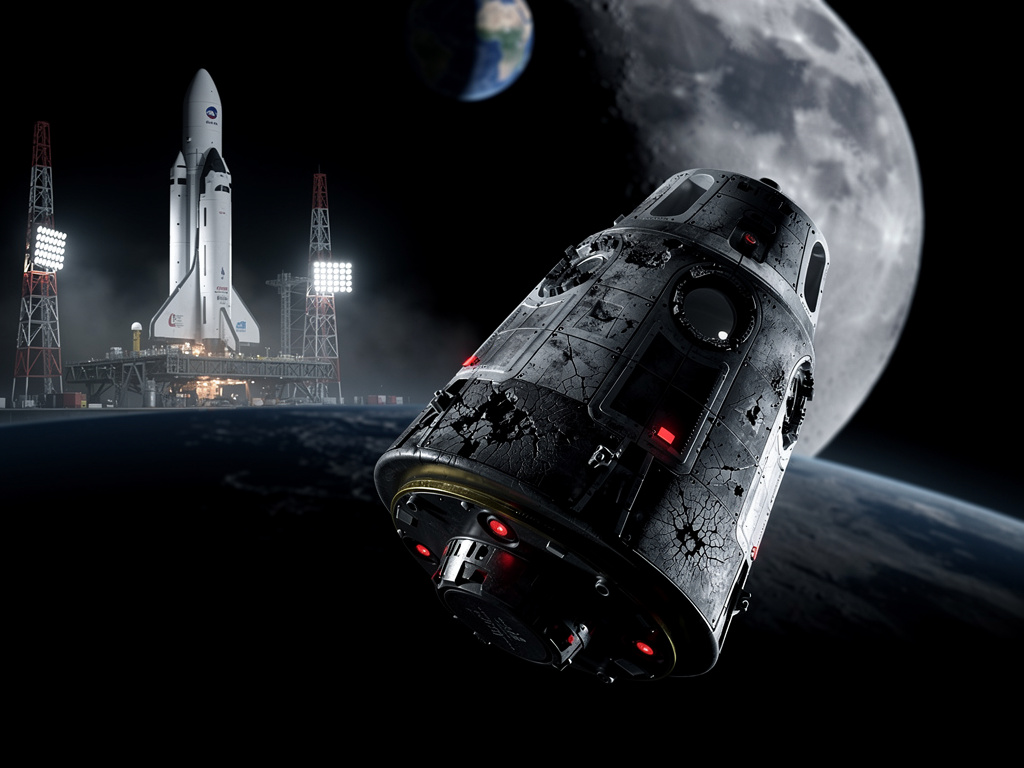
WASHINGTON—In the carefully managed narrative of America’s return to the Moon, NASA projects an aura of methodical confidence. The agency recently pushed the schedule for its next two crewed lunar missions, framing the delays as a prudent measure to ensure astronaut safety. But behind the public assurances, a far more urgent and uncertain engineering drama is unfolding, centered on the flagship Orion spacecraft and a series of critical flaws that have some of the agency’s own watchdogs questioning if the capsule is truly ready to fly with humans aboard.
The Artemis program, with its multi-billion-dollar price tag, is NASA’s grand endeavor to establish a permanent human presence on the Moon and serve as a stepping stone to Mars. Yet, the linchpin of this strategy, the Lockheed Martin-built Orion capsule, returned from its uncrewed maiden voyage in 2022 with a deeply troubling scar. Its heat shield, designed to protect the capsule from the 5,000-degree Fahrenheit inferno of reentry, wore away in a manner that engineers neither predicted nor fully understand, a problem that now casts a long shadow over the entire enterprise.
An Unknown and Unacceptable Risk
The core of the concern lies with the “unexpected liberation of char” from Orion’s heat shield during the Artemis I mission. Post-flight analysis revealed that pieces of the ablative material, designed to burn away and carry heat from the spacecraft, flaked off in chunks rather than eroding evenly. While the capsule and its test dummies returned safely, the phenomenon represents a critical failure in engineering models. For the upcoming Artemis II mission, which will carry four astronauts on a flyby of the Moon, such an anomaly could have catastrophic consequences, potentially damaging vital components or compromising the shield’s integrity.
This is not a minor discrepancy. The issue was severe enough to be a primary driver in NASA’s decision to delay Artemis II from late 2024 to no earlier than September 2025, as detailed in a recent agency update. The problem’s gravity was underscored in a stark report by NASA’s own Aerospace Safety Advisory Panel (ASAP), an independent body of experts tasked with evaluating the agency’s safety protocols. The panel expressed pointed concern that NASA had not yet identified the root cause of the heat shield issue, labeling it a significant risk to the crew.
A Methodical Investigation Under Pressure
Publicly, NASA officials maintain that the process is under control. Amit Kshatriya, deputy associate administrator for the Moon to Mars Program, stated that teams are taking a “methodical” approach, involving extensive sampling of the heat shield, destructive testing of components, and sophisticated modeling to replicate the reentry conditions. “We are working through a methodical and deliberate process to understand the system, understand the problem, and get to a flight rationale,” Kshatriya told reporters, a sentiment echoed by The Guardian in its coverage of the safety concerns.
This investigation is a painstaking process of elimination. Engineers are meticulously analyzing over 100 locations on the heat shield, building a fault tree to trace every possible cause, from the manufacturing process of the Avcoat material to its application on the capsule’s structure. However, the inability to definitively pinpoint the cause more than a year after the mission’s completion is a source of mounting anxiety within the aerospace community. The delay of Artemis II has a cascading effect, pushing the first lunar landing in over 50 years, Artemis III, to at least September 2026.
Concerns Beyond the Heat Shield
The heat shield, while the most prominent issue, is not the only source of worry for safety experts. The 2023 ASAP annual report reads as a caution against organizational complacency, warning that NASA may be “experiencing a waning of its vigilance.” The panel’s findings highlight other technical challenges that could pose a risk to the crew, including issues with bolts in the launch abort system and unexpected electrical vulnerabilities in the life support system’s circuitry that could affect its valve controls.
These compounding problems paint a picture of a highly complex system where small, unforeseen issues can create significant threats. The ASAP report suggests a cultural challenge as much as an engineering one, urging a “restoration of a sense of vulnerability to the unforgiving environment of space.” For an agency whose history is marked by the tragedies of Apollo 1, Challenger, and Columbia—disasters rooted in technical flaws and organizational failures—such a warning from its own advisory board carries immense weight.
The Contractor and the Clock
At the center of the hardware challenges is Lockheed Martin, the prime contractor for the Orion spacecraft. The company is now under intense pressure to assist NASA in resolving the heat shield and other subsystem issues. The performance of the Avcoat material is particularly complex, as its behavior during the extreme physics of hypersonic reentry is notoriously difficult to model perfectly. Every delay adds to the program’s already staggering cost and puts contractor performance under a microscope.
The schedule itself has become a source of risk. While the recent delays were presented as a safety-driven decision, the pressure to meet ambitious timelines set by previous administrations remains a powerful undercurrent. As noted by industry publication Ars Technica, the revised schedule is still considered “aggressive,” leaving little room for further setbacks. This creates tension between the engineering imperative to solve a problem completely and the programmatic desire to keep the mission moving forward.
Weighing Risk in a New Space Race
The entire Artemis program is unfolding against the backdrop of renewed geopolitical competition in space, particularly with China’s rapidly advancing lunar ambitions. This external pressure adds a layer of complexity to NASA’s risk calculus. The agency must balance the absolute necessity of crew safety with the national imperative to demonstrate leadership in deep space exploration. A failure on Artemis II would not only be a human tragedy but also a devastating blow to American prestige and its multi-decade vision for space.
The delays also have a significant ripple effect across the commercial space industry. The Artemis III landing is dependent not only on a flight-ready Orion but also on SpaceX delivering a human-rated lunar lander version of its Starship rocket and Axiom Space providing new spacesuits. According to SpaceNews, the interconnected nature of these programs means a problem in one area creates a bottleneck for all, further complicating an already intricate and expensive timeline.
The Path Forward
Before the four astronauts of Artemis II can strap into their seats, NASA must prove to itself and its watchdogs that it has unequivocally solved the heat shield mystery. This will require more than just a plausible theory; it will demand a fix that can be verified through testing and analysis, leaving no room for doubt. The agency’s commitment to transparency in this process will be crucial in rebuilding confidence that may have been eroded by the disconnect between public statements and the stark warnings from its safety panel.
For now, America’s return to the Moon remains in a holding pattern, contingent not on grand vision but on the granular, high-stakes work of engineers trying to understand why a shield designed to withstand fire did not behave as planned. The path to the lunar surface is paved with immense technical challenges, and for the Orion spacecraft, the journey through Earth’s atmosphere has proven to be as formidable as the void of deep space itself.


 WebProNews is an iEntry Publication