
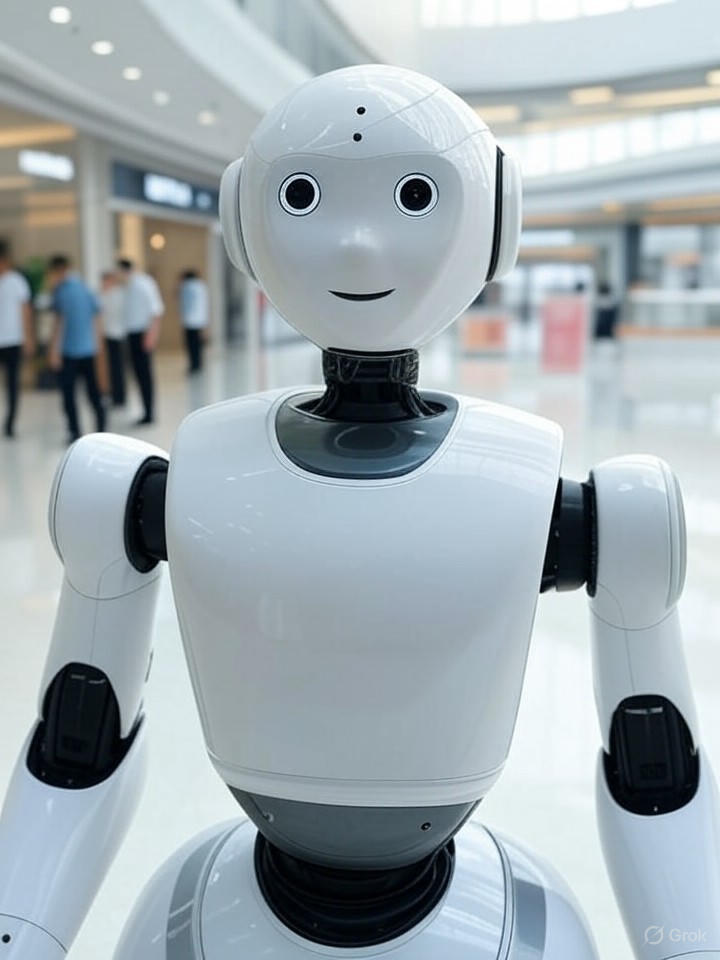
In the heart of Beijing’s E-Town, a sprawling economic zone pulsing with technological ambition, a new retail experiment is unfolding that could redefine how China positions itself in the global robotics race. The Robot Mall, touted as the world’s first “4S store” for humanoid robots—offering sales, service, spare parts, and surveys—opened its doors this summer, showcasing an array of home-grown machines from over 40 domestic brands. Visitors can interact with robots like Unitree’s agile G1, which performs backflips and dances, or UBTech’s Walker S, designed for industrial tasks such as welding and assembly. This isn’t just a showroom; it’s a bold statement of China’s push to dominate humanoid robotics, backed by aggressive government subsidies and a national strategy to foster innovation.
The mall’s launch coincides with Beijing’s municipal government offering up to 100,000 yuan ($14,000) in subsidies for companies purchasing these robots, part of a broader initiative to integrate them into factories, warehouses, and even homes. As reported in the South China Morning Post, this move aims to accelerate adoption amid a slowing economy, with E-Town positioning itself as a “robot valley” akin to Silicon Valley for AI and automation. Industry insiders note that such incentives are crucial, given the high costs—some models exceed several million yuan—yet they signal China’s determination to build a self-reliant ecosystem, reducing dependence on foreign tech amid U.S.-China tensions.
Government Fueling the Robotics Surge
China’s humanoid robot sector has seen explosive growth, propelled by state-led investments and policy frameworks. According to a recent Xinhua report on pooled efforts in humanoid robotics innovation, the government has set ambitious goals to establish a secure supply chain by 2025, with plans to lead globally by 2027. This includes heavy funding for AI, sensors, and actuators, as evidenced at the 2025 World Artificial Intelligence Conference, where Beijing Galbot’s flexible robot dazzled attendees with its dexterity in tasks like folding clothes and manipulating objects.
Recent developments underscore this momentum. Reuters highlighted in May how AI-powered humanoids are transforming manufacturing in Shanghai warehouses, where robots tirelessly fold T-shirts, make sandwiches, and open doors, honing skills through repetitive training. Meanwhile, MIT Technology Review noted in February that China’s electric vehicle giants, leveraging existing supply chains, are pivoting to robotics, giving them a head start over Western competitors. Elon Musk has voiced concerns, as detailed in a Bloomberg feature, about China’s startups harnessing AI for complex roles, potentially outpacing Tesla’s Optimus.
From Factories to Everyday Life
The integration of humanoids into daily operations is already visible. Posts on X from sources like People’s Daily describe collaborative training programs in 5G factories, where swarms of home-grown robots, powered by AI models like DeepSeek-R1, perform tasks with swarm intelligence—a leap from isolated autonomy. One notable example is Tiangong, a 94-pound robot that ran a half-marathon in under three hours, now deployed in warehouses for sorting fruit and managing hospital corridors, as shared in viral X updates from tech influencers.
Innovation extends to household applications. Chinese researchers have developed reinforcement learning frameworks enabling robots to stand up from falls and recover in real-world scenarios, with emergent behaviors like precise object manipulation, according to posts on X from China Science. State media visions, such as CCTV montages, project humanoids cooking, babysitting, and assisting elders by 2050, normalizing their role in society.
Challenges Amid Rapid Advancements
Yet, hurdles remain. The Associated Press captured photos from the Robot Mall, illustrating both progress—like robots plucking pharmacy boxes—and limitations, such as the need for more refined human-like interactions. Industry analyses, including a Qviro Blog post, emphasize China’s focus on self-sufficiency, but global competition is fierce. The BBC pondered in April whether China will dominate, citing massive investments, while a recent OpenPR market analysis projects the global humanoid robot market surging from $2.24 billion in 2024 to $41.02 billion by 2032, with China at the forefront.
JD.com’s announcement at the 2025 World Robot Conference, as covered by IndexBox, outlines strategic plans to advance robotics, including a potential 1 trillion yuan fund for AI startups. X posts from the China Chamber of Commerce to the EU highlight Beijing’s leadership, with new shops offering multimillion-yuan models.
Innovation Hubs and Future Trajectories
Beijing’s E-Town is emerging as a nexus, with subsidies encouraging adoption, per South China Morning Post coverage. Recent X updates reveal unveils like a 167 cm robot with a “brain” processing 275 trillion operations per second, enabling seamless navigation in dynamic environments. Another breakthrough: a “single brain” architecture controlling multiple robot forms, unveiled in Hefei, standing 1.66 meters and weighing 40 kg, as noted in China Science posts.
This ecosystem thrives on collaboration. MK News reported sentiments from the World Robot Conference, where attendees felt China leads the industry, driven by government support for home-grown products. From Unitree to emerging startups, the focus is on scalable, affordable humanoids.
Global Implications and Competitive Edge
China’s strategy could reshape global labor markets. With electric vehicle expertise fueling robotics, as per MIT Technology Review, firms like those in Shanghai are training humanoids for precision tasks. Bloomberg warns of a “China robots boom,” worrying figures like Musk.
As the Robot Mall draws crowds, it symbolizes a shift: from novelty to necessity. Insiders predict that by 2027, China’s self-reliant supply chains will produce humanoids rivaling any worldwide, backed by innovations in AI and hardware. While challenges like ethical integration persist, the trajectory is clear—China is not just participating in the humanoid revolution; it’s steering it.


 WebProNews is an iEntry Publication