
China isn’t just talking about going to the Moon anymore. It’s picking out real estate.
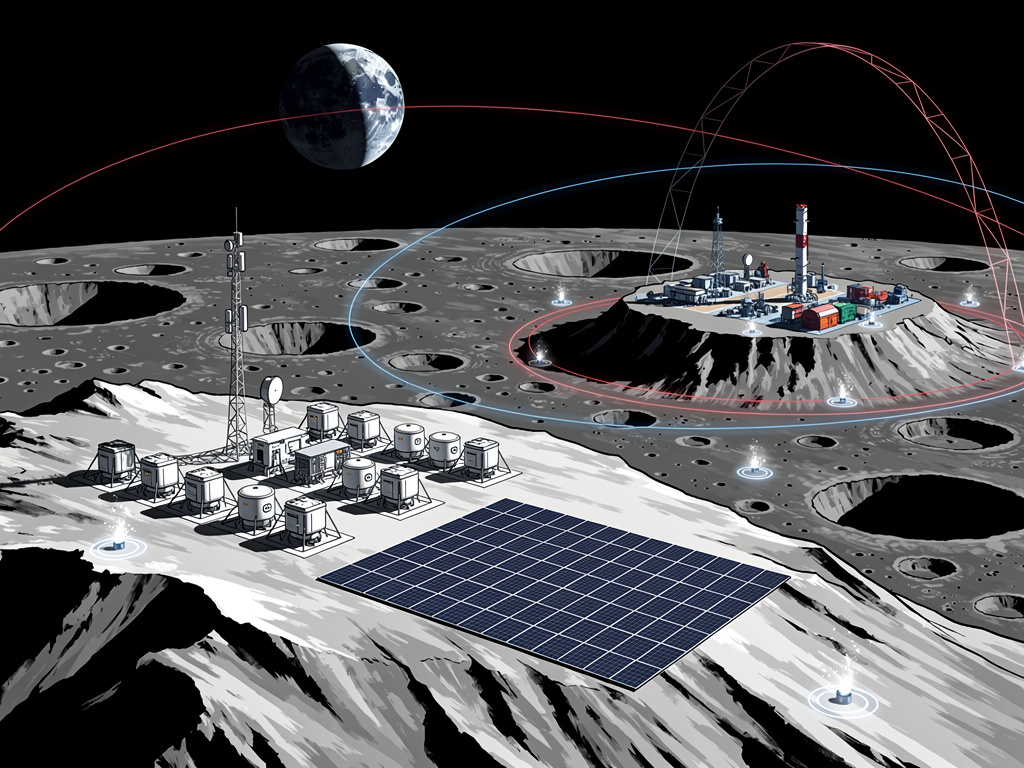
A team of Chinese scientists has published a detailed proposal identifying specific candidate landing sites on the lunar south pole for what would become a permanent crewed base — the International Lunar Research Station (ILRS). The proposal, reported by Futurism, represents a significant escalation in the specificity and seriousness of China’s lunar ambitions, moving the program from broad aspirations into concrete mission architecture. And it arrives at a moment when the United States’ own return-to-the-Moon timeline under NASA’s Artemis program continues to slip.
The research, published in the journal Science China Technological Sciences, lays out a multi-criteria evaluation framework for selecting optimal sites near the Moon’s south pole. The scientists assessed factors including sunlight availability, terrain slope, communication line-of-sight with Earth, and proximity to permanently shadowed craters believed to contain water ice. Water is the prize. It can sustain astronauts, be split into hydrogen and oxygen for rocket fuel, and fundamentally change the economics of deep-space exploration. The team narrowed candidates to areas on the rim of Shackleton Crater and nearby ridgelines — the same general region NASA has been eyeing for Artemis landings.
That overlap is no coincidence.
The lunar south pole has become the most strategically valuable territory off Earth. Both superpowers understand this. Whichever nation establishes a sustained presence there first gains not just scientific prestige but practical access to resources that could underpin decades of space operations. The Chinese proposal makes clear that Beijing views site selection not as an abstract exercise but as an engineering prerequisite for missions it intends to fly within the next decade.
China’s broader lunar timeline has been remarkably consistent — and remarkably on schedule. The Chang’e 5 mission successfully returned lunar samples in 2020. Chang’e 6, launched in 2024, achieved the first-ever sample return from the Moon’s far side. Chang’e 7, targeting the south pole for detailed reconnaissance, is planned for around 2026. Chang’e 8, intended to test technologies for in-situ resource utilization and construction, is expected before 2030. The crewed landing itself is targeted for approximately 2030, with the ILRS base buildout to follow in phases through the 2030s.
Each mission feeds the next. The site-selection study fits squarely into this pipeline, providing the analytical groundwork for where Chang’e 7 and 8 will land and, ultimately, where Chinese astronauts — taikonauts — will set foot.
Compare this with Artemis. NASA’s Artemis II crewed flyby, originally scheduled for late 2024, has been pushed to April 2026 at the earliest. Artemis III, the mission that would put astronauts on the lunar surface for the first time since Apollo 17 in 1972, is now targeting mid-2027 — though many observers consider even that date optimistic given ongoing development challenges with SpaceX’s Starship lunar lander and Axiom Space’s next-generation spacesuits. The Government Accountability Office and NASA’s own inspector general have repeatedly flagged schedule and cost risks.
None of this means the U.S. program is doomed. SpaceX’s iterative testing cadence on Starship has accelerated dramatically, with multiple flight tests in 2024 and 2025 demonstrating rapid progress on the booster catch and upper-stage reentry. But the gap between China’s disciplined, state-directed schedule adherence and NASA’s contractor-dependent, politically buffeted timeline is becoming harder to ignore.
The geopolitical dimension is sharpening. The ILRS is explicitly positioned as an alternative to the U.S.-led Artemis Accords, a set of bilateral agreements governing lunar exploration norms that now count more than 40 signatories. China and Russia, which signed a memorandum of understanding in 2021 to jointly build the ILRS, have been recruiting their own coalition of partner nations. Pakistan, Venezuela, South Africa, Egypt, Thailand, Nicaragua, Azerbaijan, and Belarus have signed on, among others. The station is designed to be open to international participation — on Beijing’s terms.
So the Moon is becoming a venue for great-power competition in a way it hasn’t been since the 1960s. But the nature of the competition has changed. This isn’t about flags and footprints. It’s about infrastructure, resource access, and the norms that will govern activity on celestial bodies for generations.
The site-selection paper itself is technically rigorous. The researchers used high-resolution topographic data from China’s own Chang’e missions as well as NASA’s Lunar Reconnaissance Orbiter to model illumination conditions across candidate sites with fine spatial and temporal granularity. South pole sites are tricky. Because the Moon’s axial tilt is only about 1.5 degrees, the sun at the poles barely rises above the horizon, creating a patchwork of peaks that receive near-continuous sunlight and adjacent craters plunged in permanent darkness. A base needs both: sunlight for solar power, and access to shadowed craters for water ice extraction.
The Shackleton Crater rim consistently scores highest across multiple studies, including this one. Its elevated ridgeline receives sunlight roughly 80 to 90 percent of the time during a lunar day cycle, while the crater’s interior floor — one of the coldest spots in the solar system — likely harbors significant ice deposits. The Chinese team also identified secondary candidate sites on connecting ridges between Shackleton and nearby de Gerlache and Sverdrup craters, offering potential for a distributed base architecture with multiple outposts linked by surface routes.
A distributed approach would be strategically shrewd. Rather than a single monolithic base, multiple smaller installations could cover more terrain, access diverse resource deposits, and provide redundancy. It also maps well onto the phased construction timeline China has outlined, where each successive robotic mission adds a module or capability before humans ever arrive.
The technological building blocks are coming together in parallel. China’s next-generation crew launch vehicle, the Long March 10, completed its first full-scale static fire test in 2024 and is on track for a maiden flight around 2027. The new Mengzhou crew capsule, larger than Shenzhou and designed for lunar missions, is in advanced development. A lunar-surface spacesuit has been publicly displayed. And China’s track record with its Tiangong space station — assembled on schedule and now continuously crewed — provides institutional confidence that complex programs can be executed as planned.
There are risks, of course. No country has landed humans on the Moon in over half a century. The engineering challenges of sustained south pole operations — extreme thermal cycling, abrasive lunar dust, communication blackouts, radiation exposure — remain formidable regardless of nationality. China has experienced launch failures and mission anomalies, though fewer and less publicly than some Western counterparts. And the ILRS partnership with Russia, once a headline feature, has become somewhat ambiguous as Russia’s space program struggles under the weight of sanctions, brain drain, and the financial demands of the war in Ukraine. Whether Roscosmos can meaningfully contribute hardware and expertise to the ILRS on the stated timeline is an open question.
Still, the momentum is real. China’s space budget, while not publicly disclosed in full, is estimated by the Center for Strategic and International Studies to be the world’s second-largest, and it’s growing. The program benefits from centralized decision-making, long-term planning horizons unconstrained by election cycles, and a deep bench of engineering talent cultivated over two decades of ambitious missions.
For the American space community, the Chinese site-selection paper should be read as a signal, not a threat. It says: we’re doing the homework. We know where we want to go. And we’re building the machines to get there.
Whether that signal accelerates or complicates U.S. efforts depends entirely on how Washington responds. The Artemis program has bipartisan support in Congress, but funding levels, contractor performance, and political attention are never guaranteed across administrations. The commercial space sector — SpaceX, Blue Origin, Intuitive Machines, Astrobotic — adds dynamism and capability that China’s state-run system can’t easily replicate. But dynamism without direction is just motion.
The Moon doesn’t care about politics. It just sits there, ancient and indifferent, waiting for whoever shows up first with the tools to stay. Right now, China is making a very public case that it intends to be that someone. The site-selection study is one more brick in a wall being built with unusual discipline and transparency.
The next few years will determine whether this becomes a genuine two-player race or something more lopsided. Chang’e 7’s south pole landing, expected around 2026, will provide the first direct ground-truth data at or near the proposed base sites. If it succeeds — and China’s recent track record suggests it will — the ILRS will transition from proposal to reality in a way that demands a response.
Not eventually. Soon.


 WebProNews is an iEntry Publication