
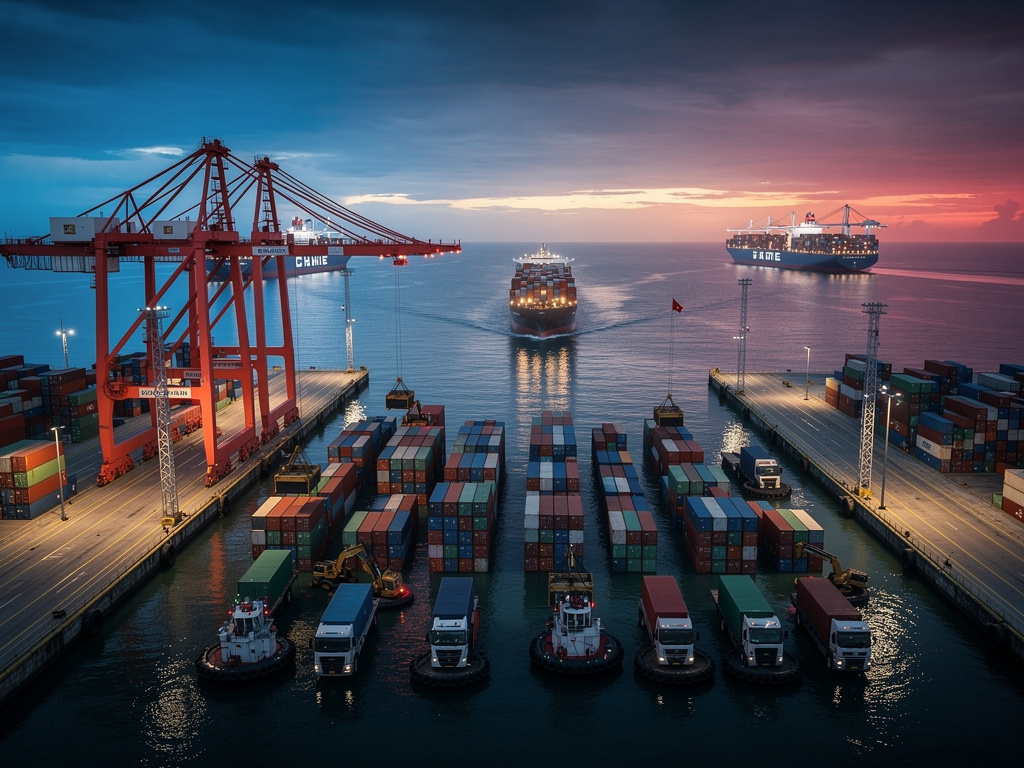
A recent arbitration court decision has ignited diplomatic tensions between Washington and Beijing, after a tribunal ruled in favor of terminating Chinese conglomerate CK Hutchison’s long-standing port operations at both ends of the Panama Canal. The ruling, which President Donald Trump hailed as a major victory for American strategic interests, has prompted sharp criticism from Chinese officials who view the decision as part of a broader campaign to curtail China’s global infrastructure footprint. The case represents a significant flashpoint in the ongoing competition between the world’s two largest economies for influence over critical maritime chokepoints.
According to CNBC, the arbitration panel sided with Panama’s government in its dispute with CK Hutchison Holdings, the Hong Kong-based conglomerate that has operated port facilities at Balboa and Cristóbal since 1997. The decision effectively ends the company’s control over these strategic terminals, which handle a substantial portion of cargo transiting between the Atlantic and Pacific oceans. Chinese Foreign Ministry spokesperson Lin Jian condemned the ruling as “politically motivated” and warned that it could undermine international investment confidence in Panama.
The Trump administration has celebrated the outcome as vindication of its aggressive stance toward Chinese infrastructure projects near sensitive U.S. trade routes. In a statement released shortly after the ruling, President Trump declared that “America will not stand by while foreign adversaries control our hemisphere’s most vital waterways.” The decision marks the culmination of years of escalating tensions over Chinese commercial presence in Panama, which began intensifying after Panama switched diplomatic recognition from Taiwan to mainland China in 2017.
Historical Context of Chinese Port Operations in Panama
CK Hutchison’s involvement in Panama dates back nearly three decades, when the company’s subsidiary Hutchison Whampoa won concessions to operate the Balboa port on the Pacific side and the Cristóbal port on the Atlantic entrance. These 25-year contracts, which were set to expire in 2022 but included renewal options, positioned the Hong Kong conglomerate as a dominant player in trans-Pacific shipping logistics. The ports handle approximately 40 percent of all container traffic passing through the canal, making them strategically significant for global trade flows.
The arrangement initially drew little controversy, as Panama sought private investment to modernize its port infrastructure following the handover of the canal from U.S. control in 1999. However, geopolitical concerns began mounting during the Obama administration, when U.S. defense officials started questioning whether Chinese commercial entities operating near the canal could pose national security risks. These concerns intensified dramatically under both the Trump and Biden administrations, as U.S.-China relations deteriorated across multiple fronts including technology, trade, and military positioning.
Panama’s decision to pursue arbitration against CK Hutchison stemmed from allegations that the company failed to meet contractual obligations regarding infrastructure investments and operational standards. Panamanian officials claimed the conglomerate had not adequately modernized the facilities as required under the concession agreements, though CK Hutchison vigorously disputed these claims throughout the arbitration proceedings. Industry analysts suggest that political pressure from Washington may have influenced Panama’s decision to pursue the legal challenge, though Panamanian authorities have consistently denied any external interference in the matter.
The Arbitration Ruling and Its Immediate Implications
The three-member arbitration panel, operating under the rules of the International Chamber of Commerce, issued its binding decision after eighteen months of hearings and evidence review. The tribunal found that CK Hutchison had materially breached several provisions of its concession agreements, including requirements to invest specific amounts in terminal upgrades and to maintain certain service level standards. The ruling orders the company to cease operations within 180 days and to transfer all port facilities and equipment to the Panamanian government without compensation for the remaining value of the concessions.
CK Hutchison immediately announced its intention to challenge the ruling in Panamanian courts, arguing that the arbitration panel exceeded its authority and failed to properly consider evidence of the company’s substantial investments in the facilities. In a statement to the Hong Kong Stock Exchange, the company disclosed that it had invested more than $800 million in the Panama port operations since acquiring the concessions, and that the forced termination would result in significant financial losses. Legal experts suggest that while arbitration rulings are generally difficult to overturn, the company may pursue parallel litigation in multiple jurisdictions to protect its interests.
The financial impact extends beyond CK Hutchison to the broader Hong Kong business community, which has historically viewed Panama as a stable investment destination with strong legal protections for foreign capital. The ruling has prompted concerns among Asian investors about the reliability of long-term concession agreements in Latin America, particularly when geopolitical considerations intersect with commercial disputes. Hong Kong’s Hang Seng Index saw shares of CK Hutchison decline by 4.3 percent in trading following the announcement, reflecting investor anxiety about the precedent this case might establish.
China’s Diplomatic Response and Strategic Concerns
Beijing’s reaction to the arbitration outcome has been swift and pointed, with Chinese officials characterizing the decision as part of a coordinated U.S. effort to exclude Chinese companies from strategic infrastructure projects worldwide. Foreign Ministry spokesperson Lin Jian stated during a regular press briefing that “certain countries are using security pretexts to discriminate against Chinese enterprises and undermine normal international business cooperation.” The statement stopped short of threatening retaliatory measures but emphasized that China would “take all necessary steps to protect the legitimate rights and interests of Chinese companies abroad.”
The Panama Canal dispute represents just one front in a broader infrastructure competition between Washington and Beijing that spans the globe. China’s Belt and Road Initiative has funded port projects in dozens of countries, from Sri Lanka to Greece to Peru, prompting U.S. officials to warn about the strategic implications of Chinese control over critical maritime infrastructure. The Trump administration has specifically targeted Chinese port operations in the Western Hemisphere, viewing them as potential vulnerabilities in the event of future military or economic conflicts between the two powers.
Chinese state media outlets have amplified Beijing’s criticism of the ruling, with the Global Times publishing an editorial arguing that “the United States is weaponizing commercial disputes to advance its geopolitical agenda in Latin America.” The editorial noted that CK Hutchison is a private Hong Kong company rather than a state-owned enterprise, suggesting that the security concerns raised by U.S. officials are exaggerated. However, Western intelligence agencies have long maintained that Beijing can exert significant influence over Hong Kong-based companies when national interests are at stake, particularly following the implementation of Hong Kong’s national security law in 2020.
Regional Dynamics and Panama’s Balancing Act
Panama finds itself in an increasingly delicate position as it attempts to balance economic relationships with both the United States and China. The Central American nation’s decision to recognize Beijing in 2017 opened doors to Chinese investment and trade opportunities, with bilateral commerce growing substantially in subsequent years. However, Panama remains deeply integrated with the U.S. economy, with American companies representing major users of the canal and significant investors in the country’s financial services sector.
President José Raúl Mulino, who took office in mid-2024, has sought to reassure both Washington and Beijing that Panama’s decisions regarding canal operations are based solely on national interests and contractual compliance rather than external political pressure. In public statements, Mulino has emphasized Panama’s sovereignty over the canal and its commitment to maintaining the waterway as a neutral international passage open to vessels of all nations. Nevertheless, the timing of the arbitration decision has fueled speculation about whether the Mulino administration coordinated with U.S. officials before proceeding with the case against CK Hutchison.
The outcome may influence other Latin American countries weighing Chinese infrastructure investments against potential complications in their relationships with Washington. Several nations in the region have accepted Chinese financing for port projects, including Peru, Brazil, and Ecuador, and will be closely monitoring how this dispute affects Panama’s ability to attract future foreign investment. Regional analysts suggest that the case could make governments more cautious about granting long-term concessions to Chinese companies, particularly for assets that Washington might view as strategically sensitive.
Future Control of Panama’s Port Facilities
With CK Hutchison’s forced exit from the Balboa and Cristóbal terminals, attention now turns to who will assume control of these crucial facilities. Panamanian officials have indicated that the government will conduct an open bidding process for new concession agreements, with operations potentially beginning under temporary state management during the transition period. Several major international port operators, including Denmark’s APM Terminals and Singapore’s PSA International, have reportedly expressed preliminary interest in the concessions, though formal tender procedures have not yet been announced.
The Trump administration has signaled that it would view American involvement in the new port operations favorably, with some officials privately suggesting that U.S. companies should be given preference in the bidding process. However, major American port operators have historically shown limited interest in Latin American terminal concessions, preferring to focus on domestic facilities and select high-volume international locations. The involvement of U.S. companies could also prove politically sensitive in Panama, where memories of the American-controlled Canal Zone era remain part of the national consciousness.
Industry experts anticipate that the transition period could create operational disruptions for shippers relying on the Panama Canal route, particularly if the changeover is not managed smoothly. The Balboa and Cristóbal terminals handle time-sensitive cargo including perishable goods and manufactured components for just-in-time supply chains. Any extended interruption in efficient port operations could push some shipping lines to consider alternative routes, including the Suez Canal or all-water routes around South America, potentially affecting Panama’s position as a critical node in global maritime trade networks.
Broader Implications for U.S.-China Competition
The Panama Canal arbitration ruling arrives at a moment of heightened tension between Washington and Beijing across multiple domains, from semiconductor technology restrictions to military activities in the South China Sea. The Trump administration’s second term has brought renewed focus on countering Chinese influence in the Western Hemisphere, with officials explicitly invoking the Monroe Doctrine to justify greater scrutiny of Chinese commercial activities in Latin America. This case provides a template for how the administration might approach other situations where Chinese companies control infrastructure deemed sensitive to U.S. interests.
For Beijing, the Panama decision reinforces concerns that Chinese overseas investments face growing political risks as U.S.-China competition intensifies. Chinese officials have repeatedly called for separating commercial relationships from geopolitical disputes, arguing that economic interdependence benefits all parties. However, the reality of great power competition increasingly means that major infrastructure projects become entangled in broader strategic rivalries, regardless of the commercial merits of individual investments. This dynamic is likely to make Chinese companies more cautious about pursuing projects in regions where U.S. influence remains strong, potentially reshaping global investment patterns.
The case also highlights the evolving nature of international arbitration in an era of heightened geopolitical competition. While arbitration tribunals are designed to provide neutral forums for resolving commercial disputes based on contractual terms and established law, the Panama ruling demonstrates how difficult it is to fully insulate such proceedings from broader political contexts. The perception among Chinese officials that the arbitration was influenced by geopolitical considerations—regardless of whether such influence actually occurred—may undermine confidence in international dispute resolution mechanisms and lead parties to seek alternative approaches to managing cross-border investment risks.
Economic and Security Considerations Moving Forward
The forced termination of CK Hutchison’s Panama operations raises important questions about how governments should balance economic openness with national security concerns in an era of strategic competition. While the Trump administration has framed the issue primarily through a security lens, emphasizing the risks of Chinese control over strategic infrastructure, others argue that overly broad security restrictions could discourage foreign investment and reduce economic efficiency. Finding the appropriate balance between these considerations will remain a central challenge for policymakers in the United States, China, and countries caught between these competing powers.
For the global shipping industry, the Panama case adds another element of uncertainty to an already complex operating environment. Shipping lines must navigate not only traditional commercial considerations like costs, transit times, and port efficiency, but also geopolitical factors that can suddenly alter the reliability of key routes and facilities. This uncertainty may lead companies to diversify their routing options and reduce dependence on any single chokepoint, potentially increasing overall logistics costs but improving resilience against political disruptions.
As the 180-day transition period unfolds, all parties will be watching closely to see how Panama manages the changeover and whether the new operators can maintain the efficiency that has made the canal route attractive to global shippers. The outcome will have implications far beyond this single case, potentially influencing how dozens of other Chinese infrastructure investments around the world are perceived and managed. In an interconnected global economy increasingly shaped by great power rivalry, the Panama Canal dispute offers a preview of the complex challenges that lie ahead for international commerce and investment.


 WebProNews is an iEntry Publication