
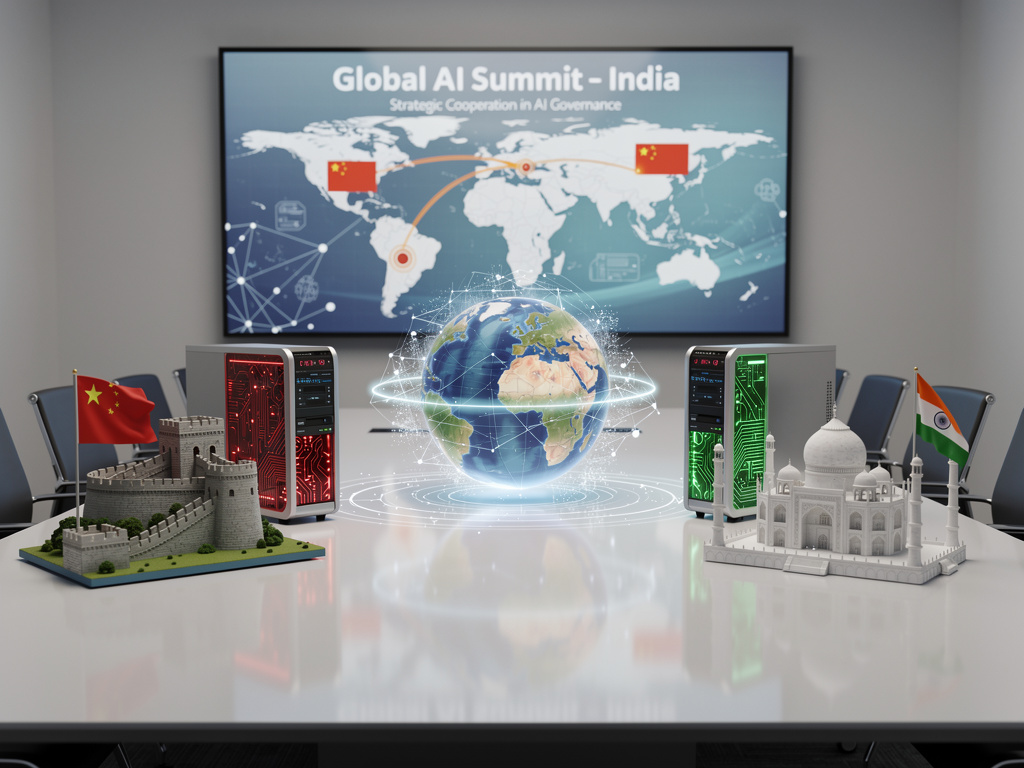
In a significant diplomatic development that could mark a turning point in one of Asia’s most consequential bilateral relationships, China has confirmed its participation in India’s upcoming Global AI Summit, scheduled for early March in New Delhi. The decision represents the highest-level engagement between the two nuclear-armed neighbors in years, coming after decades of border tensions and economic rivalry that have defined their modern relationship.
According to CNBC, Chinese officials will send a delegation including representatives from leading technology firms and government ministries to participate in discussions on artificial intelligence governance, cross-border data flows, and collaborative research initiatives. The move follows months of behind-the-scenes negotiations between Beijing and New Delhi, aimed at compartmentalizing their strategic competition while identifying areas of mutual technological interest.
The timing of China’s participation is particularly noteworthy, coming just months after both countries completed a phased disengagement of troops along their disputed Himalayan border. While military tensions have eased considerably since the deadly 2020 Galwan Valley clash that killed at least 20 Indian soldiers and an undisclosed number of Chinese troops, diplomatic relations have remained frosty, with trade restrictions and visa limitations continuing to hamper bilateral exchanges.
Technology as a Bridge Between Rivals
The AI summit represents a calculated gamble by both nations to leverage technology cooperation as a confidence-building measure. India’s Ministry of External Affairs has positioned the event as part of New Delhi’s broader strategy to engage with all major powers on critical emerging technologies, regardless of political differences. The summit is expected to draw participants from more than 50 countries, with sessions focused on AI ethics, semiconductor supply chains, and the development of large language models.
For China, participation in India’s AI summit serves multiple strategic objectives. Beijing has been working to counter its growing technological isolation from Western nations, particularly following increased export controls on advanced semiconductors and AI chips imposed by the United States and its allies. By engaging with India’s rapidly growing technology sector, Chinese firms gain access to one of the world’s largest pools of engineering talent and a massive consumer market for AI applications.
Industry analysts suggest that the thaw in relations could open opportunities for collaboration in specific AI domains where both countries face similar challenges. Healthcare diagnostics, agricultural optimization, and climate modeling have been identified as potential areas of cooperation, where the competitive dynamics are less intense than in strategic sectors like autonomous weapons systems or surveillance technology.
Economic Imperatives Driving Diplomatic Pragmatism
The economic dimension of improved China-India relations cannot be understated. Despite political tensions, bilateral trade reached approximately $136 billion in 2023, making China India’s largest trading partner. However, the relationship remains heavily imbalanced, with India running a substantial trade deficit. Indian policymakers have been exploring ways to leverage their market access as a bargaining chip while simultaneously reducing dependence on Chinese manufacturing.
The technology sector has emerged as a critical arena for this recalibration. India’s ambitious plans to become a global semiconductor manufacturing hub and its growing prowess in software development have created potential synergies with China’s hardware manufacturing capabilities and AI research infrastructure. Several Indian startups have quietly maintained research collaborations with Chinese universities and companies, despite the political headwinds.
However, significant obstacles remain. India’s decision to ban hundreds of Chinese mobile applications following the 2020 border clash, including popular platforms like TikTok and WeChat, has created lasting commercial grievances. Chinese investment in Indian startups has plummeted from over $4 billion in 2020 to less than $200 million in 2024, according to industry tracking data. The AI summit could provide a forum for addressing some of these restrictions, though few expect immediate policy reversals.
Geopolitical Calculations and the American Factor
The warming of China-India technological ties occurs against a complex geopolitical backdrop. India has deepened its security partnership with the United States through the Quad alliance, which also includes Japan and Australia, explicitly aimed at countering Chinese influence in the Indo-Pacific region. New Delhi has also strengthened defense cooperation with Washington, including agreements on sharing sensitive military technology.
American policymakers are watching the AI summit developments with concern. The United States has invested considerable diplomatic capital in positioning India as a democratic counterweight to China in Asia. Any significant technology cooperation between Beijing and New Delhi could complicate American efforts to build a unified front on issues like technology standards, data governance, and export controls on advanced computing systems.
Yet India has consistently maintained that it will pursue an independent foreign policy that serves its national interests, refusing to be drawn into a new Cold War dynamic. Indian officials have emphasized that engagement with China on specific technical issues does not represent a fundamental realignment of New Delhi’s strategic priorities. The country continues to modernize its military capabilities along the disputed border and has shown no signs of softening its territorial claims.
Regulatory Frameworks and Standards Competition
One of the most substantive areas of potential cooperation emerging from the AI summit involves the development of regulatory frameworks for artificial intelligence deployment. Both China and India are grappling with questions about algorithmic transparency, data privacy, and the societal impacts of automation. While their political systems differ dramatically, both face similar challenges in governing AI technologies that are developing faster than traditional regulatory mechanisms can adapt.
China has already implemented comprehensive AI governance regulations, including rules requiring algorithm disclosures and restrictions on recommendation systems. India is in the process of developing its own AI regulatory framework, with draft legislation expected later this year. There may be opportunities for technical exchanges on implementation challenges, even if the underlying political philosophies diverge significantly.
The standards-setting dimension carries particular weight. As Western nations and China compete to establish global norms for AI development and deployment, India’s position as a major technology power gives it significant influence. If China and India can find common ground on certain technical standards, it could shift the balance in international forums like the International Telecommunication Union and the International Organization for Standardization.
Corporate Interests and Strategic Autonomy
Major technology companies in both countries are quietly supportive of improved bilateral relations, seeing substantial commercial opportunities in expanded cooperation. Chinese firms like Huawei, Alibaba, and Tencent, which once had significant operations in India, are eager to regain market access. Indian IT services giants including Tata Consultancy Services, Infosys, and Wipro see potential in China’s massive enterprise market for AI implementation services.
However, both governments maintain extensive restrictions on foreign technology companies in sectors deemed strategically sensitive. China’s cybersecurity laws require data localization and impose strict controls on cross-border data transfers. India has implemented similar requirements for certain categories of data and maintains investment screening mechanisms that effectively block Chinese acquisitions in technology sectors.
The AI summit may provide a venue for exploring limited pilot programs that could test the waters for expanded cooperation. Potential initiatives could include joint research projects on non-sensitive applications, student and researcher exchange programs, or collaborative efforts on open-source AI development tools. Such incremental steps would allow both sides to build trust while maintaining safeguards around strategic technologies.
Regional Implications and Third-Party Interests
Improved China-India relations would have ripple effects throughout South and Southeast Asia. Smaller nations in the region have often found themselves caught between the competing influences of their two giant neighbors. A reduction in China-India tensions could create space for more multilateral cooperation on regional challenges, from climate change to infrastructure development.
Countries like Bangladesh, Sri Lanka, and Nepal, which maintain close ties with both China and India, would welcome a more stable regional environment. The Belt and Road Initiative, China’s massive infrastructure investment program, has been a source of tension with India, which has refused to participate due to concerns about sovereignty and debt sustainability. While the AI summit is unlikely to resolve these fundamental disagreements, it could open channels for dialogue on complementary development approaches.
Japan and South Korea, both major players in AI and semiconductor technology, are also watching these developments closely. Both countries have complex relationships with China involving deep economic ties coupled with security concerns. India’s approach to balancing technological cooperation with strategic competition could provide a model for other democracies navigating similar challenges.
The Path Forward Remains Uncertain
Despite the positive symbolism of China’s participation in India’s AI summit, significant challenges remain in translating diplomatic gestures into substantive cooperation. The border dispute continues to cast a long shadow over the relationship, with both militaries maintaining enhanced force deployments along the Line of Actual Control. Any future border incident could quickly derail progress on technology cooperation, as occurred following the 2020 Galwan Valley clash.
Domestic political considerations also constrain both governments. In India, public opinion remains deeply skeptical of China, with nationalist sentiment making it politically risky for leaders to be seen as too accommodating toward Beijing. Chinese officials face their own domestic pressures, with expectations that any engagement with India must not compromise China’s territorial claims or strategic position.
The AI summit represents a tentative first step toward a more pragmatic phase in China-India relations, one that acknowledges both the inevitability of competition and the potential benefits of selective cooperation. Whether this approach can be sustained will depend on both countries’ ability to manage their differences while identifying genuine areas of mutual interest. For now, the technology sector offers one of the few domains where such an approach might prove viable, making the upcoming summit a critical test of whether Asia’s two giants can find a path beyond perpetual rivalry.


 WebProNews is an iEntry Publication