
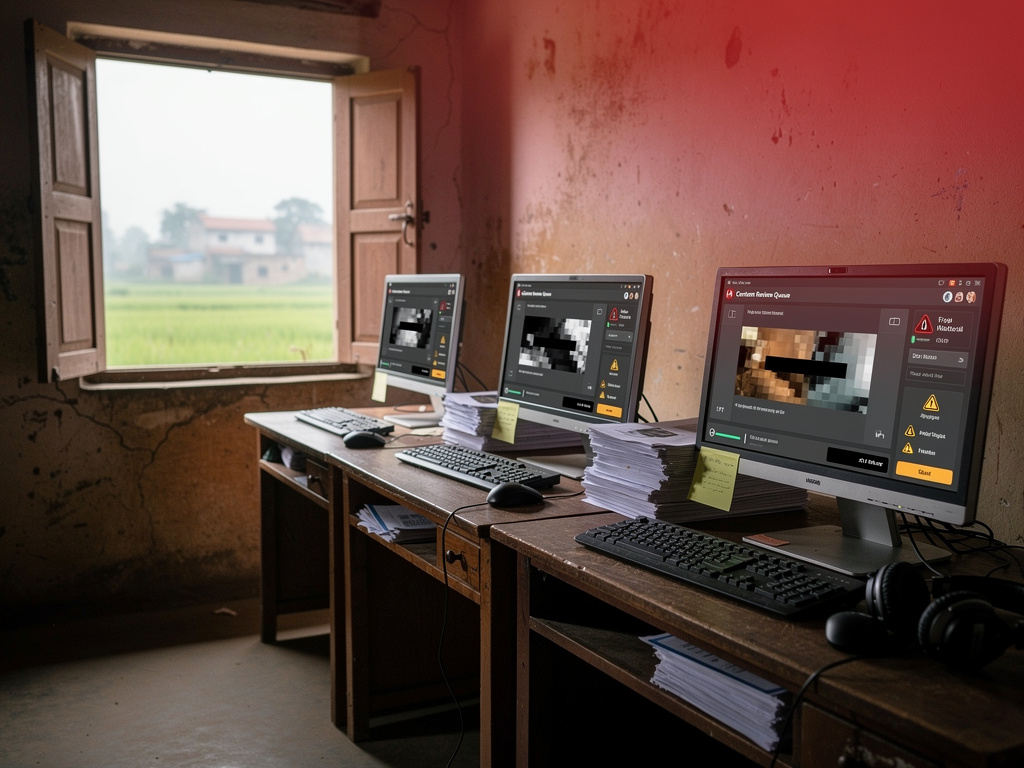
In dimly lit rooms across rural India, thousands of women sit before computer screens, scrolling through an unrelenting stream of humanity’s darkest content — graphic violence, child sexual abuse material, and hardcore pornography — all in the name of making artificial intelligence safer for the rest of the world. They are the hidden workforce behind the algorithms that power platforms used by billions, and the psychological toll of their labor is only now beginning to surface in devastating detail.
A sweeping investigation by The Guardian has laid bare the harrowing experiences of female data annotators in India who spend their working hours categorizing and labeling violent and sexually explicit content so that AI models can learn to detect and filter it. These women, many of whom come from conservative communities where discussing sex or violence is deeply taboo, describe experiencing profound psychological trauma, recurring nightmares, and a pervasive emotional numbness that follows them long after they log off for the day.
The Assembly Line of Human Suffering
Data annotation — the painstaking process of labeling images, videos, and text so that machine learning models can be trained — has become one of the fastest-growing segments of India’s outsourcing economy. India, with its vast English-speaking workforce and comparatively low labor costs, has emerged as a primary hub for this work, which is contracted out by major Silicon Valley technology companies and AI startups alike. The work ranges from the mundane, such as labeling street signs in photographs for self-driving car algorithms, to the deeply disturbing task of reviewing and categorizing content that depicts extreme violence, sexual exploitation, and abuse.
For women in rural parts of India, data annotation initially presented itself as an unprecedented economic opportunity — a chance to earn a living without migrating to distant cities, a way to contribute to household income while remaining close to family. Recruitment drives by Business Process Outsourcing (BPO) firms and specialized data labeling companies often marketed the work as simple computer-based tasks requiring minimal technical skills. What many recruits were not told, or were only vaguely warned about, was the nature of the content they would be required to engage with on a daily basis.
‘In the End, You Feel Blank’: The Voices of the Women
The Guardian’s reporting includes testimony from multiple women who describe being psychologically shattered by the work. One worker, whose identity was protected, told the publication: “In the end, you feel blank.” The phrase captures a condition that psychologists recognize as emotional blunting or dissociation — a defense mechanism the brain employs when subjected to repeated exposure to traumatic material. Workers described losing the ability to feel joy, experiencing intrusive thoughts about the violent and sexual content they had reviewed, and struggling to maintain normal relationships with their husbands and children.
Several women reported that they were given little to no psychological preparation before being assigned to review explicit content. Training sessions, when they existed, focused on the technical aspects of annotation — how to use the labeling software, how to categorize content according to specific taxonomies — rather than on the emotional and psychological challenges of the work. Access to mental health support, including counseling services, was described as either nonexistent or woefully inadequate. Some workers said they were told to “just not think about it” by supervisors when they raised concerns about the impact the work was having on their wellbeing.
A Global Supply Chain Built on Invisible Labor
The data annotation industry operates through a complex web of subcontracting relationships that often obscure the ultimate client. Major technology companies — including those developing large language models, content moderation systems, and image recognition tools — typically contract with intermediary firms, which in turn subcontract to smaller outfits in regions where labor is cheapest. This layered structure creates plausible deniability for the tech giants at the top of the chain while pushing the most harmful aspects of the work onto the most vulnerable workers at the bottom.
This is not the first time the human cost of training AI has come under scrutiny. In 2023, Time magazine published an investigation revealing that OpenAI had used Kenyan workers, paid less than $2 per hour, to review toxic content as part of the development of ChatGPT. That reporting, which focused on the firm Sama, a San Francisco-based company that employed workers in Nairobi, drew international attention to the exploitative conditions under which much of this work is performed. The Indian context, however, introduces additional layers of complexity related to gender, caste, and the particular vulnerabilities of women in rural communities.
The Gendered Dimension of Digital Exploitation
In many parts of rural India, women’s access to employment outside the home remains severely constrained by social norms and family expectations. Data annotation work, which can sometimes be performed from home or from local offices, was seen as a culturally acceptable form of employment — it didn’t require women to travel far, interact with male strangers in public settings, or violate the norms of purdah that still govern women’s mobility in parts of northern and central India. This made women in these communities particularly susceptible to recruitment into annotation work without full knowledge of what it entailed.
The irony is bitter: the very social restrictions that limited these women’s employment options also made them less likely to speak up about the nature of the content they were reviewing. Several workers told The Guardian that they felt unable to discuss what they had seen with family members, not only because of non-disclosure agreements imposed by their employers but because the content — particularly the pornographic material — was so far removed from what was considered acceptable to discuss in their communities that raising it would bring shame upon them. This enforced silence compounded the psychological damage, trapping women in a cycle of trauma with no outlet for processing their experiences.
Regulatory Gaps and Corporate Accountability
India’s regulatory framework for protecting gig workers and data annotators remains underdeveloped. While the country’s Information Technology Act and various labor codes provide some protections, enforcement is inconsistent, particularly in rural areas where labor inspections are rare and workers often lack formal employment contracts. The data annotation industry, which has grown rapidly in recent years, has largely operated in a regulatory gray zone — not quite traditional manufacturing, not quite conventional IT services, and therefore not clearly covered by existing workplace safety regulations.
Globally, there has been growing pressure on technology companies to take responsibility for the welfare of the workers who train their AI systems. The European Union’s AI Act, which began phased implementation in 2025, includes provisions related to transparency in AI development, but critics argue that it does not go far enough in addressing the labor conditions of annotation workers in third countries. In the United States, legislative efforts have been largely piecemeal, with no comprehensive federal framework governing the treatment of overseas workers in AI supply chains.
The Psychological Research: What Prolonged Exposure Does to the Brain
Mental health professionals who study the effects of prolonged exposure to graphic content — a field that has grown alongside the expansion of content moderation and data annotation work — warn that the consequences can be severe and long-lasting. Research has documented rates of post-traumatic stress disorder (PTSD), anxiety, depression, and substance abuse among content moderators and annotators that are significantly higher than in the general population. Dr. Sarah Roberts, a professor at UCLA who has studied commercial content moderation extensively, has described the work as a form of “computational labor” that treats human psychological capacity as an expendable resource.
For the women in rural India profiled in The Guardian’s investigation, the effects manifest in ways that are both clinically recognizable and deeply personal. Some described being unable to be intimate with their partners. Others spoke of flinching when their children touched them unexpectedly, their nervous systems rewired by hours of watching violence. Still others reported a pervasive sense of contamination — a feeling that they had been made impure by what they had witnessed, a particularly devastating psychological wound in communities where notions of purity carry profound social and spiritual weight.
What Must Change: Industry Reckoning and the Path Forward
Advocates for data annotation workers are calling for a multi-pronged response. First, they argue that technology companies must be held directly accountable for the working conditions throughout their supply chains, regardless of how many layers of subcontracting separate them from the workers who train their models. This means mandatory due diligence requirements, regular third-party audits, and the establishment of industry-wide standards for psychological support, including mandatory pre-employment screening, ongoing access to licensed mental health professionals, and reasonable limits on the amount of time any individual worker can spend reviewing harmful content.
Second, there is a growing call for fair compensation that reflects the true nature and risk of the work. Data annotation workers in India often earn between 15,000 and 25,000 rupees per month — roughly $175 to $300 — for work that would command significantly higher wages if performed in the countries where the technology companies are headquartered. This wage disparity is not merely an economic issue; it is a moral one, reflecting the degree to which the global technology industry has externalized the human costs of AI development onto communities least equipped to bear them.
The women of rural India who sit before their screens each day, categorizing the worst of what humans do to one another so that algorithms can learn to recognize it, are performing a service that is essential to the functioning of the modern digital world. They deserve far more than to feel blank at the end of it. The question now is whether the technology industry — and the governments that regulate it — will act before the damage becomes irreversible, or whether these women will remain invisible casualties of the artificial intelligence revolution, their suffering annotated and filed away like just another data point.


 WebProNews is an iEntry Publication