
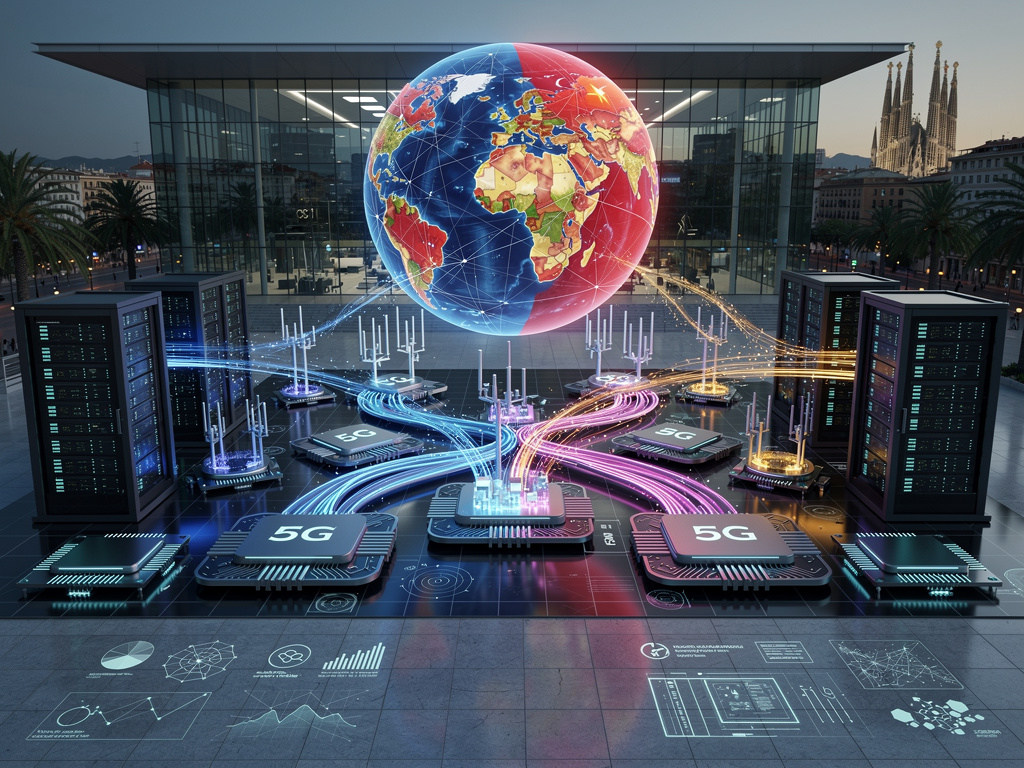
BARCELONA — When more than 100,000 technology executives, government officials, and telecom leaders descend on Barcelona this week for Mobile World Congress 2025, the conversations will be shaped by two intersecting forces: the global race to control artificial intelligence infrastructure and a rising tide of techno-nationalism that is redrawing the boundaries of the digital economy.
The annual gathering, which runs from March 3 to 6 at the Fira Gran Via convention center, has long served as the premier showcase for the mobile telecommunications industry. But this year’s edition arrives at a moment when the strategic implications of AI deployment and data sovereignty have become front-page concerns for governments from Brussels to Beijing to Washington. As MSN reported, the convergence of tech sovereignty ambitions and AI fever will define the tone and substance of MWC 2025.
Europe’s Push to Own Its AI Future Collides With American and Chinese Dominance
The European Union has spent the better part of the last decade attempting to carve out a regulatory identity distinct from the laissez-faire approach of the United States and the state-directed model of China. The EU’s AI Act, which began phased implementation in 2024, represents the world’s most comprehensive attempt to regulate artificial intelligence. But regulation alone has not answered the more fundamental question haunting European policymakers: Can the continent build its own competitive AI industry, or will it remain dependent on American hyperscalers and Chinese hardware manufacturers?
At MWC 2025, that question will be addressed head-on. European Commission officials are expected to use the event to outline new industrial policy measures aimed at bolstering the continent’s AI capabilities. According to MSN, the concept of “tech sovereignty” — the idea that nations or blocs should control the critical technologies underpinning their economies and security — has moved from the margins of policy debate to its center. For European telecom operators like Deutsche Telekom, Orange, and Telefónica, the sovereignty agenda presents both an opportunity and a challenge: an opportunity to position themselves as trusted custodians of AI infrastructure, and a challenge to invest at scale when American rivals like Microsoft, Google, and Amazon are pouring tens of billions of dollars into data centers and AI models.
Telecom Giants Seek a New Role in the AI Value Chain
For years, telecom operators have worried about being reduced to “dumb pipes” — mere conduits for data generated and monetized by others. The AI boom has intensified that anxiety. The large language models driving generative AI require enormous computing power, vast datasets, and low-latency connectivity. Telecom companies control the networks that deliver that connectivity, but they have struggled to capture value further up the stack.
MWC 2025 is expected to feature a wave of announcements from operators seeking to change that dynamic. Several major carriers are investing in edge computing infrastructure that would allow AI workloads to be processed closer to end users, reducing latency and keeping data within national borders — a key selling point for sovereignty-minded governments. Others are developing their own AI-powered network management tools, arguing that telecom-specific AI can improve efficiency, reduce energy consumption, and enable new services for enterprise customers. The GSMA, the industry body that organizes MWC, has made AI and its implications for connectivity a central theme of this year’s programming.
The Geopolitical Dimension: U.S.-China Tensions Cast a Long Shadow
The sovereignty conversation at MWC cannot be separated from the intensifying geopolitical rivalry between the United States and China. Washington’s escalating restrictions on semiconductor exports to China, combined with pressure on allies to exclude Chinese vendors like Huawei from 5G networks, have forced telecom operators worldwide to make choices that are as much political as they are technical. European operators that once relied heavily on Huawei equipment have been gradually diversifying their supply chains, turning to Nordic vendors Ericsson and Nokia as well as South Korea’s Samsung.
But the AI era introduces new dependencies. The most advanced AI chips are designed by Nvidia, an American company, and manufactured by TSMC in Taiwan. Access to these chips has become a matter of national security for multiple governments. At MWC, expect significant discussion about whether Europe can develop its own AI chip capabilities — a goal that has been articulated by EU officials but remains far from realization. The European Chips Act, which aims to mobilize more than €43 billion in public and private investment, is one piece of the puzzle, but industry executives privately acknowledge that closing the gap with Nvidia and TSMC will take years, if not decades.
AI-Native Networks and the Promise of 5G Advanced
Beyond the geopolitical maneuvering, MWC 2025 will also serve as a proving ground for the next generation of network technology. The industry is increasingly talking about “AI-native” networks — infrastructure designed from the ground up to support AI workloads. This concept goes beyond simply adding AI features to existing networks; it envisions a fundamental rearchitecting of how networks are built, managed, and optimized.
5G Advanced, the next evolutionary step for fifth-generation wireless technology, is expected to be a major topic at the conference. The standard, finalized by the 3GPP standards body, introduces capabilities such as ambient IoT (Internet of Things), enhanced positioning, and improved support for extended reality applications. For operators, 5G Advanced represents an opportunity to finally deliver on some of the more ambitious promises of 5G — promises that, in many markets, have yet to materialize in ways that consumers and businesses can readily perceive. Meanwhile, early discussions about 6G, which is not expected to be commercially deployed until the early 2030s, will also feature prominently, with research consortia and government-backed initiatives from the EU, the U.S., South Korea, and Japan all vying to shape the next standard.
The Energy Question: AI’s Insatiable Appetite for Power
One of the less glamorous but increasingly urgent topics at MWC 2025 will be energy consumption. AI workloads are extraordinarily power-hungry, and the proliferation of data centers required to support them is straining electrical grids in multiple countries. The International Energy Agency has projected that data center electricity consumption could double by 2026 compared to 2022 levels, driven in large part by AI demand.
For telecom operators, which already account for a significant share of national electricity consumption in many countries, the energy question is existential. Several operators have made ambitious net-zero commitments, but reconciling those pledges with the demands of AI infrastructure will require significant innovation in energy efficiency, renewable energy procurement, and potentially nuclear power. At MWC, expect to see demonstrations of liquid cooling systems for data centers, AI-driven energy management tools, and partnerships between telecom companies and energy providers aimed at securing reliable, low-carbon power supplies.
Startups, Sovereigns, and the Battle for Influence
MWC has always been more than a trade show; it is a diplomatic event. Heads of state, government ministers, and regulatory chiefs from dozens of countries attend, using the gathering to sign memoranda of understanding, announce investment deals, and signal policy directions. This year, the diplomatic dimension is particularly charged. Countries in the Gulf region, including Saudi Arabia and the United Arab Emirates, have been aggressively investing in AI infrastructure and are expected to have a significant presence at MWC, courting partnerships with Western technology companies and telecom operators.
At the same time, the startup ecosystem around AI and connectivity continues to expand. The 4YFN (Four Years From Now) startup event, held alongside MWC, will feature hundreds of early-stage companies working on everything from AI-powered health diagnostics to autonomous drone management systems. Venture capital investment in AI-related startups reached record levels in 2024, and MWC serves as a key matchmaking venue for founders seeking funding and corporate partners.
What the Industry Is Really Watching
For all the keynote speeches and product demonstrations, the most consequential conversations at MWC 2025 may happen behind closed doors. Telecom CEOs will be meeting with chipmakers, cloud providers, and government officials to negotiate the terms of a new industrial order — one in which control over AI infrastructure is as strategically significant as control over oil reserves was in the 20th century. The outcomes of those conversations will shape not only the telecommunications industry but the broader trajectory of the global economy.
As the Barcelona event opens its doors, the message from industry leaders and policymakers alike is clear: the era of treating technology as a purely commercial matter is over. AI has raised the stakes, and the fight for technological self-determination is now inseparable from the fight for economic and geopolitical power. MWC 2025 will not resolve these tensions, but it will make them impossible to ignore.


 WebProNews is an iEntry Publication