
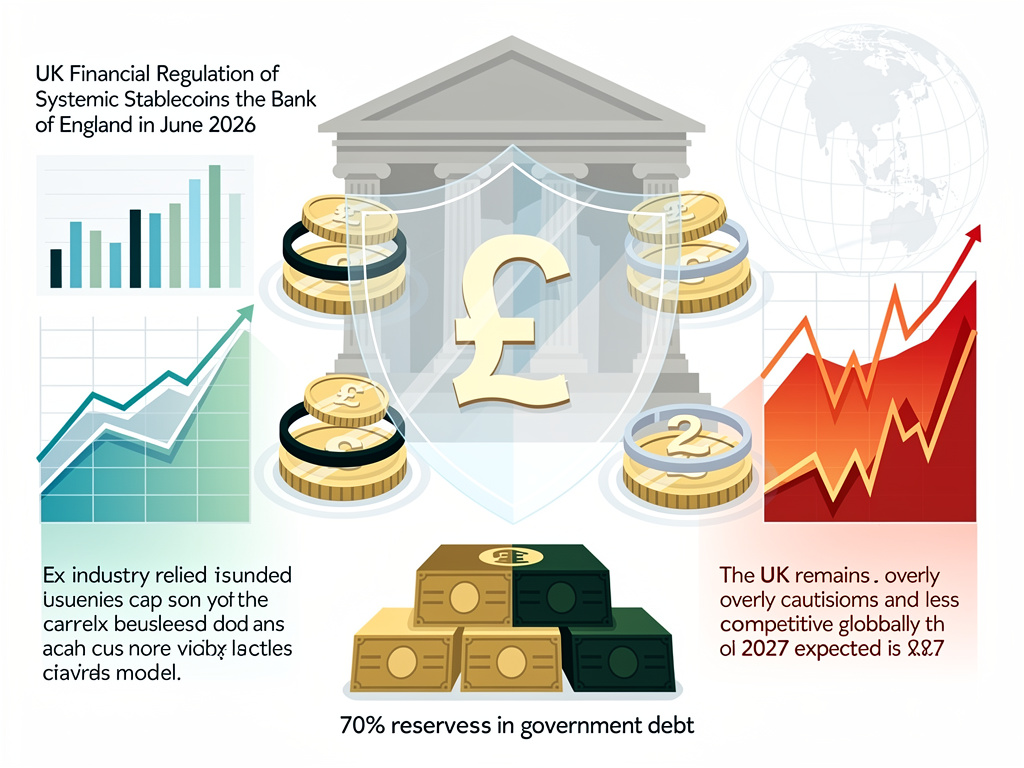
The Bank of England has blinked. After months of industry warnings that its initial proposals would strangle a fledgling sterling stablecoin market before it could take off, the central bank published a revised framework on June 22. Individual holding caps are gone. A temporary £40 billion issuance limit per systemic stablecoin takes their place. Issuers can now park 70% of reserves in short-term UK government debt, up from 60%. The rest sits in non-interest-bearing central bank deposits.
These adjustments mark a pragmatic retreat. They respond to feedback that the earlier draft risked making sterling tokens uncompetitive against dollar and euro rivals already scaling faster under lighter or more established rules. Yet the core safeguards remain tight. Redemption must happen in real time or by end of day. Assets stay under statutory trust. No interest payments to holders. The regime still prioritizes stability over speed to market.
Sarah Breeden, the Bank’s deputy governor for financial stability, called the update “a major milestone in delivering greater choice and innovation in UK payments.” She added that “innovation thrives on trust” and the new rules lay “foundations of that trust for a new form of money — with prompt redemption, strong protections and central bank support.” (Bank of England)
The policy statement and accompanying draft Code of Practice reflect extensive talks with industry after the November 2025 consultation. Officials listened. They dropped per-user limits that would have capped individuals at £20,000 and businesses at £10 million in any single systemic coin. Such restrictions, critics argued, would have crippled everyday and wholesale adoption alike. The new aggregate issuance guardrail aims for equivalent protection against large-scale shifts out of bank deposits that could crimp lending. Stress tests and historical parallels, including SVB and USDC runs, shaped the £40 billion figure. It will be reviewed regularly and lifted once credit risks ease. (Bank of England policy statement)
Backing asset rules received the biggest tweak. Issuers gain more room to earn a return on reserves through government securities while keeping 30% in central bank deposits as a liquidity anchor. Repo and reverse repo transactions on eligible assets are permitted under strict conditions. The calibration draws on episodes of market stress to balance viability with resilience. No commercial bank deposits or riskier assets allowed. A financial risk reserve covers potential repo losses. These changes, the Bank says, support business models without compromising the 1:1 backing requirement or exposing the system to contagion.
Safeguarding relies on statutory trusts. Legislation will give the Bank powers to impose them, creating clear separation from issuer creditors. Coinholders gain a direct legal claim. Daily reconciliations, third-party due diligence and segregation rules apply. Redemption cannot be suspended. Fees must be transparent and cannot eat into face value. The framework prohibits interest or yield tied to simply holding the coin, reinforcing its role as payment instrument rather than store of value.
Industry Reaction: Welcome Moves, But Not Enough for Global Race
Market participants offered cautious approval mixed with calls for more. Adam Jackson of Innovate Finance said the “fundamentals haven’t changed” and described the regime as “the most cautious in the world.” Mark Fairless, chief executive of ClearBank, warned the UK “cannot win global race if sterling stablecoins less viable.” Katie Harries of Coinbase found the reserve mix “workable” and capital rules “proportionate.” (Reuters)
The critique lands at a delicate moment. US stablecoin legislation has advanced. Europe’s MiCA framework is live. Sterling issuance lags. The Bank’s paper notes potential daily payment volumes of £1.4 billion to £2.2 billion and wholesale cash-leg use in the Digital Securities Sandbox ranging from £4.4 billion to £28 billion. Those figures remain theoretical until issuers can operate at meaningful scale from 2027, once the Code of Practice finalizes by year-end and supporting materials emerge in 2027.
Joint work with the Financial Conduct Authority continues. Non-systemic stablecoins stay under FCA rules alone. A managed transition path exists as firms grow. Direct access to payment systems, rather than reliance on sponsors, reduces tiering risks. A central bank liquidity facility will backstop solvent issuers facing redemption pressure, with details due next year.
But, the temporary guardrail and conservative asset mix still draw fire. Some bankers and token issuers argue the framework favors incumbents and limits programmable money’s upside in cross-border or tokenized asset settlement. Others praise the clarity. Prompt redemption, statutory trusts and explicit wind-down rules create confidence absent in many offshore stables. No deposit insurance applies. Coinholders bear residual risk, a deliberate choice to avoid blurring lines with bank deposits.
The Bank has walked a narrow path. It wants sterling stablecoins to succeed as part of a “multi-money” system alongside commercial deposits and any future digital pound. At the same time, it refuses to let them become a backdoor to monetary policy transmission or a source of financial instability. The revisions show willingness to adapt. Whether they suffice to attract serious issuance will play out over the next 18 months as firms decide where to build.
Consultation on the draft Code closes September 22. Final rules land by December 2026. Regulated sterling systemic stablecoins could then launch in 2027. Global competition won’t wait. Nor will technology. The Bank has softened its stance. The question now is whether the market finds the new rules firm enough to trust — and flexible enough to grow.


 WebProNews is an iEntry Publication