
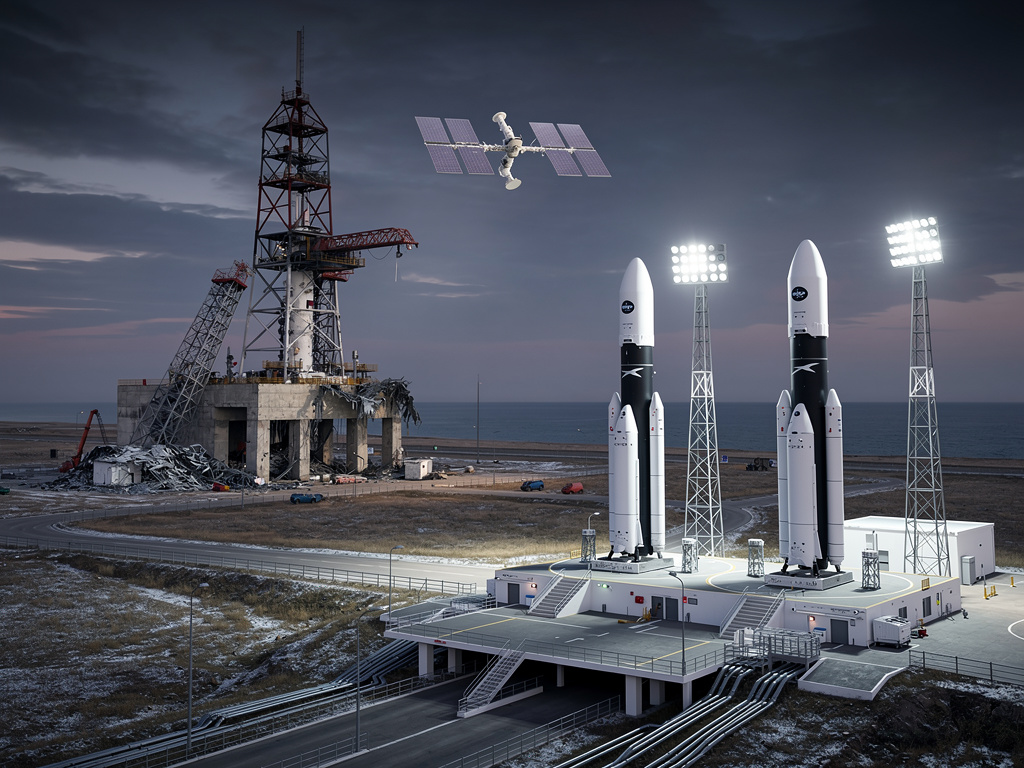
In the intricate web of international space cooperation, a recent mishap at Russia’s Baikonur Cosmodrome has sent ripples through the operations of the International Space Station (ISS), prompting NASA to ramp up its reliance on SpaceX’s Cargo Dragon missions. The incident, which occurred during a Soyuz launch on November 27, 2025, damaged the only active pad for crewed Russian flights, casting uncertainty over Moscow’s ability to sustain its commitments to the orbiting laboratory. As a result, NASA has expedited two upcoming Dragon resupply flights, advancing CRS-34 from June to May 2026 and CRS-35 from November to August 2026, according to internal schedules reported by Ars Technica.
The damage stemmed from a colossal oversight: a 20-ton service platform was not properly retracted before liftoff, leading to its collapse and severe impairment of Launch Site 31/6. This pad, leased by Russia from Kazakhstan, is critical for Soyuz rockets that ferry cosmonauts and supplies to the ISS. Roscosmos, Russia’s space agency, has acknowledged the setback but provided scant details on repair timelines, fueling speculation among experts that fixes could take months or even years. Industry insiders point out that Baikonur’s aging infrastructure, combined with geopolitical tensions, exacerbates the challenge, potentially sidelining Russian crew rotations indefinitely.
NASA’s swift adjustment underscores the fragility of the U.S.-Russian partnership on the ISS, a collaboration that has endured since 1998 despite terrestrial conflicts. With the station’s deorbit planned for 2030, any prolonged disruption could strain resources and accelerate the shift toward commercial alternatives. Sources familiar with the matter indicate that the accelerated Dragon missions are a direct response to the Baikonur incident, ensuring uninterrupted provisioning for the seven astronauts currently aboard, including those from NASA, Roscosmos, and other partners.
Shifting Dependencies in Orbital Logistics
The Cargo Dragon, built by SpaceX under NASA’s Commercial Resupply Services contract, has proven its mettle with reliable deliveries of food, experiments, and hardware. Unlike Russia’s Progress vehicles, which burn up on reentry, Dragon can return valuable cargo to Earth, adding a layer of flexibility. NASA’s decision to pull forward these launches highlights a broader pivot: with Russia’s launch capabilities compromised, the U.S. is leaning harder on private sector innovations to maintain ISS operations.
Recent posts on X from space enthusiasts and analysts reflect growing concern over the incident’s fallout. Users have shared images and discussions suggesting the damage might involve structural failures beyond initial reports, with some speculating on repair costs exceeding hundreds of millions. One post from a verified aerospace account noted the acceleration of Dragon missions as a “strategic hedge,” emphasizing NASA’s proactive stance amid uncertainty. These online sentiments align with expert analyses, painting a picture of a space program at a crossroads.
Meanwhile, the incident has spotlighted Baikonur’s vulnerabilities. Built during the Soviet era, the cosmodrome has seen better days, with Site 31 being the sole operational pad for human spaceflight after Site 1/5 was mothballed. A report from The New York Times details how the platform’s failure during the Soyuz MS-28 launch—carrying two Russian cosmonauts and one NASA astronaut—caused debris to scatter, potentially affecting fuel lines and support structures. Roscosmos has downplayed the extent, but independent assessments suggest a timeline of at least six months for partial restoration.
Geopolitical Ripples and Contingency Planning
The broader implications extend to international relations. Russia’s space program, already strained by sanctions and the ongoing war in Ukraine, now faces a crisis that could diminish its role in the ISS. Experts quoted in Space.com estimate repairs might stretch to two years, forcing NASA to consider alternatives like extending astronaut stays or relying solely on SpaceX’s Crew Dragon for crew transport. This shift could mark the end of an era where Soyuz served as a backup to American vehicles, a mutual assurance born from Cold War detente.
NASA’s internal deliberations, as gleaned from industry sources, reveal a multifaceted contingency plan. Accelerating Dragon flights not only bolsters supplies but also tests the scalability of commercial partnerships. SpaceX, under Elon Musk’s leadership, has launched over 30 resupply missions since 2012, with a success rate that outshines traditional state-run programs. The company’s ability to reuse Dragon capsules reduces costs, making it an attractive option as Russia grapples with its setback.
On the web, news outlets have highlighted the human element: astronauts aboard the ISS, including NASA’s Butch Wilmore and Suni Williams, who have been stranded longer than planned due to prior Boeing Starliner issues, now face potential supply chain hiccups. A piece from Futurism notes NASA’s acknowledgment of the damage, framing it as an accidental “blow-up” that underscores the risks of shared dependencies. Posts on X echo this, with users debating whether this incident accelerates the ISS’s decommissioning or prompts a reevaluation of international collaborations.
Technological Alternatives and Future Trajectories
Looking ahead, NASA’s acceleration of Dragon missions signals a deeper investment in domestic capabilities. The CRS-34 and CRS-35 flights will carry critical payloads, including life support systems and scientific instruments, ensuring the station’s habitability. Industry analysts suggest this move could pave the way for more frequent commercial resupply, potentially involving competitors like Northrop Grumman’s Cygnus or Sierra Space’s Dream Chaser.
The Baikonur incident also raises questions about Russia’s alternative launch sites. Vostochny Cosmodrome in the Russian Far East was intended as a modern replacement, but delays and technical issues have limited its use to uncrewed missions. A prior Ars Technica report from November discussed similar concerns, noting that leadership in Moscow might reassess the ISS’s priority amid domestic pressures. Referencing that coverage, it’s clear the recent damage amplifies longstanding worries about the program’s sustainability.
From a technical standpoint, repairing Site 31 involves intricate engineering challenges. Experts in orbital mechanics and launch infrastructure point to the need for reinforced gantries and updated safety protocols. Web searches reveal discussions on forums and news sites about potential international aid, though geopolitical frictions make this unlikely. Instead, NASA is bolstering its own ecosystem, with SpaceX ramping up production at its Hawthorne facilities to meet the expedited schedule.
Strategic Implications for Global Space Efforts
The fallout extends beyond immediate logistics, influencing the future of human spaceflight. With China’s Tiangong station operating independently, the ISS remains a symbol of multilateralism, but Russia’s diminished capacity could hasten its twilight. NASA officials, speaking anonymously, have indicated that while cooperation continues, the agency is preparing for scenarios where U.S. and allied partners dominate station operations.
Posts on X from space policy watchers highlight sentiment that this incident might spur innovation, with calls for diversified launch options. One thread analyzed satellite imagery of the damage, suggesting craters and debris patterns indicative of extensive repairs, though these claims remain unverified. Such online buzz complements formal reporting, like that from CNN, which confirmed Roscosmos’s announcement of the pad’s impairment during the launch.
In the realm of supply chain resilience, NASA’s actions demonstrate foresight. By advancing Dragon missions, the agency mitigates risks to experiments in microgravity, from crystal growth to biomedical research. This proactive stance, informed by past disruptions like the 2014 Antares failure, positions the U.S. as a leader in adaptive space operations.
Evolving Partnerships and Long-Term Visions
As repairs drag on, the incident could reshape crew assignments. Currently, the ISS hosts a mix of nationalities under a barter system where NASA provides transport for cosmonauts via Crew Dragon, and Russia reciprocates with Soyuz seats. A prolonged outage might force renegotiations, potentially leading to all-American crews or increased European Space Agency involvement.
Drawing from New Scientist, the article explores scenarios where Russia’s absence prompts NASA to sustain the ISS solo, questioning the station’s viability without joint propulsion from Progress vehicles. This perspective underscores the intertwined nature of the program, where Russian thrusters maintain the station’s orbit.
Ultimately, the Baikonur damage serves as a catalyst for evolution in space exploration. NASA’s accelerated Dragon deployments not only safeguard current missions but also herald a more commercialized future, where private enterprises like SpaceX bridge gaps left by traditional powers. As the space community watches repairs unfold, the incident reminds us of the delicate balance required to keep humanity’s outpost in orbit thriving.


 WebProNews is an iEntry Publication