
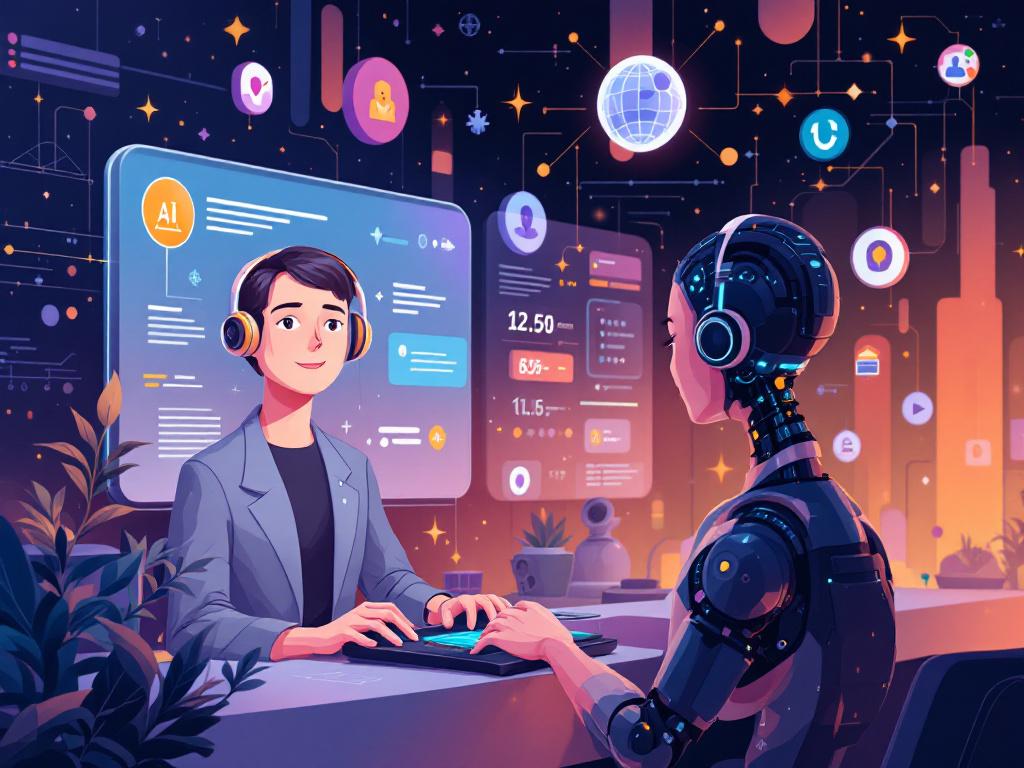
In the rapidly evolving world of artificial intelligence, Amazon Web Services is pushing boundaries to infuse its AI agents with greater intelligence and more lifelike qualities, aiming to bridge the gap between machine efficiency and human intuition. At the heart of this effort is a suite of enhancements unveiled at the recent AWS re:Invent conference, where the company detailed plans to make AI agents smarter, more intuitive, and capable of handling complex interactions with a touch of human-like empathy. Drawing from announcements covered in TechRadar, these updates focus on Amazon Connect, the cloud-based contact center service, integrating advanced AI to elevate customer service beyond scripted responses.
The core innovation lies in enabling AI agents to reason more deeply, remember past interactions, and adapt in real-time, much like a seasoned human operator. For instance, AWS is introducing features that allow agents to evaluate their own performance, learn from errors, and refine responses on the fly. This isn’t just about faster processing; it’s about creating systems that can anticipate user needs, infer context from incomplete information, and even exhibit emotional intelligence by detecting frustration in a customer’s tone or text. Industry insiders note that such capabilities could transform sectors like retail, healthcare, and finance, where personalized, empathetic interactions drive loyalty and efficiency.
Beyond basic chat functions, these agents are being equipped with tools for multi-step reasoning, allowing them to break down complex queries into manageable parts. Imagine an AI handling a banking dispute: it doesn’t just pull account details but analyzes transaction history, cross-references policies, and proposes resolutions while explaining its logic in plain language. This level of sophistication stems from AWS’s investment in foundation models like those powering Amazon Bedrock, which provide the underlying intelligence for these agents.
Enhancing Autonomy Through Frontier Agents
Recent developments highlight AWS’s launch of “frontier agents,” a new category designed to operate autonomously for extended periods, tackling intricate tasks without constant human oversight. As reported in About Amazon, these include agents like Kiro, which can manage software development workflows, from debugging code to deploying updates, potentially working for days on end. This autonomy is bolstered by memory features that retain context across sessions, ensuring continuity in long-term projects.
In parallel, AWS is integrating evaluation tools into its agent-building platform, allowing developers to test and iterate on agent behaviors. Posts on X from technology enthusiasts, such as those discussing predictions for AI in 2025, emphasize a shift toward “agentic” systems that automate workflows and interact seamlessly with enterprise data. One such post noted the progression from simple chatbots in 2023 to advanced reasoners in 2024, forecasting fully autonomous agents by next year that could handle months of work in hours.
These frontier agents represent a leap in scalability, enabling businesses to deploy AI teams that collaborate internally. For example, one agent might specialize in data analysis while another focuses on creative problem-solving, mimicking a human team’s division of labor. AWS’s approach here draws on its vast cloud infrastructure, ensuring these agents can scale to handle massive datasets without performance dips.
Human-Like Traits in AI Interactions
To make agents feel more human, AWS is embedding natural language understanding that goes beyond keywords, incorporating sentiment analysis and contextual awareness. This means an AI agent in a customer service scenario could detect sarcasm, adjust its tone accordingly, and offer proactive solutions, reducing escalation to human supervisors. Insights from CX Today suggest this hybrid model—blending AI autonomy with human oversight—avoids forcing companies to choose between fully automated or entirely manual operations.
Moreover, AWS’s updates include safeguards for ethical AI use, such as bias detection in responses and transparency in decision-making processes. Developers can now customize agents with “personas” that align with brand voices, ensuring consistency while allowing flexibility. This customization is crucial for industries where trust is paramount, like healthcare, where an AI might explain medical billing with empathy rather than robotic detachment.
The integration of these features into Amazon Connect also extends to voice interactions, where agents can modulate speech patterns to sound more natural, pausing for emphasis or varying pitch to convey reassurance. Recent news from TechCrunch details how memory and evaluation tools enhance this, allowing agents to recall previous calls and build on them, fostering a sense of ongoing relationship with users.
Accelerating Enterprise Adoption
For enterprise leaders, the appeal lies in how these intelligent agents streamline operations, cutting costs and boosting productivity. AWS’s Transform service, enhanced with agentic AI, helps modernize legacy systems by automating code migration and app updates, as outlined in Petri. This reduces technical debt, freeing teams to innovate rather than maintain outdated infrastructure.
Adoption is accelerating, with AWS providing ready-made solutions alongside custom development tools. The company’s agentic AI page on its site explains how businesses can build or deploy agents for tasks like workflow automation and business intelligence. Posts on X echo this sentiment, with users predicting that by 2025, organizations might employ hundreds of such agents to handle everything from data processing to customer engagement.
Challenges remain, including ensuring data privacy and managing the computational demands of these advanced systems. AWS addresses this through its secure cloud environment, but insiders warn that without proper governance, over-reliance on AI could lead to errors in high-stakes scenarios. Nonetheless, the potential for agents to evolve into indispensable tools is evident, as they learn from interactions and improve over time.
Innovations in Agentic Frameworks
Diving deeper into the technical underpinnings, AWS’s agentic frameworks enable multi-agent collaboration, where specialized agents tackle different aspects of a problem. For instance, in software development, one agent might handle planning while another executes code, as described in SiliconANGLE. This modular approach enhances efficiency, allowing for parallel processing that mirrors human teamwork.
Recent calls for proposals from Amazon Science, focusing on AI in robotics, underscore the broader applications. These initiatives seek to develop agents with human-robot interaction capabilities, extending beyond digital realms into physical automation. X posts from AI experts highlight tools like multi-agent frameworks that simplify building such systems, predicting widespread use in 2025.
AWS Professional Services now offers AI-powered consulting agents that embed intelligence into project lifecycles, accelerating solutions for clients. This transformation, as noted in AWS’s own machine learning blog, promises faster value delivery by automating routine consulting tasks.
Balancing Intelligence with Ethical Considerations
As AI agents gain human-like capabilities, ethical questions arise about accountability and transparency. AWS is proactive here, incorporating features that log agent decisions and allow human intervention when needed. Coverage in Investing.com highlights how these agents free developers for high-level work, but emphasize the need for robust oversight.
In customer-facing roles, the human touch is amplified through adaptive learning, where agents refine their empathy based on feedback loops. This could revolutionize contact centers, making interactions feel personal even at scale. However, experts caution against over-anthropomorphizing AI, as it might set unrealistic expectations.
Looking ahead, AWS’s roadmap includes further integrations with multimodal inputs, allowing agents to process text, voice, and visuals seamlessly. X discussions predict this will lead to AI that understands 3D spaces and real-time data, expanding possibilities in fields like logistics and virtual reality.
Pushing Boundaries in AI Development
The competitive edge for AWS comes from its ecosystem, where developers access a vast array of tools to craft bespoke agents. The company’s AI page details how these solutions build on proven infrastructure, ensuring reliability. Recent X posts from industry figures like those forecasting AGI timelines suggest 2025 could see agents achieving near-human problem-solving.
In robotics, AWS’s push into dexterous manipulation and locomotion, as per Amazon Science calls, points to agents that interact physically with the world. This convergence of digital and physical intelligence could redefine automation in warehouses and manufacturing.
Ultimately, these advancements position AWS as a leader in making AI agents not just tools, but collaborative partners that enhance human capabilities. By focusing on intelligence that feels intuitive and human, the company is setting the stage for a future where AI seamlessly integrates into daily operations, driving innovation across industries.


 WebProNews is an iEntry Publication