
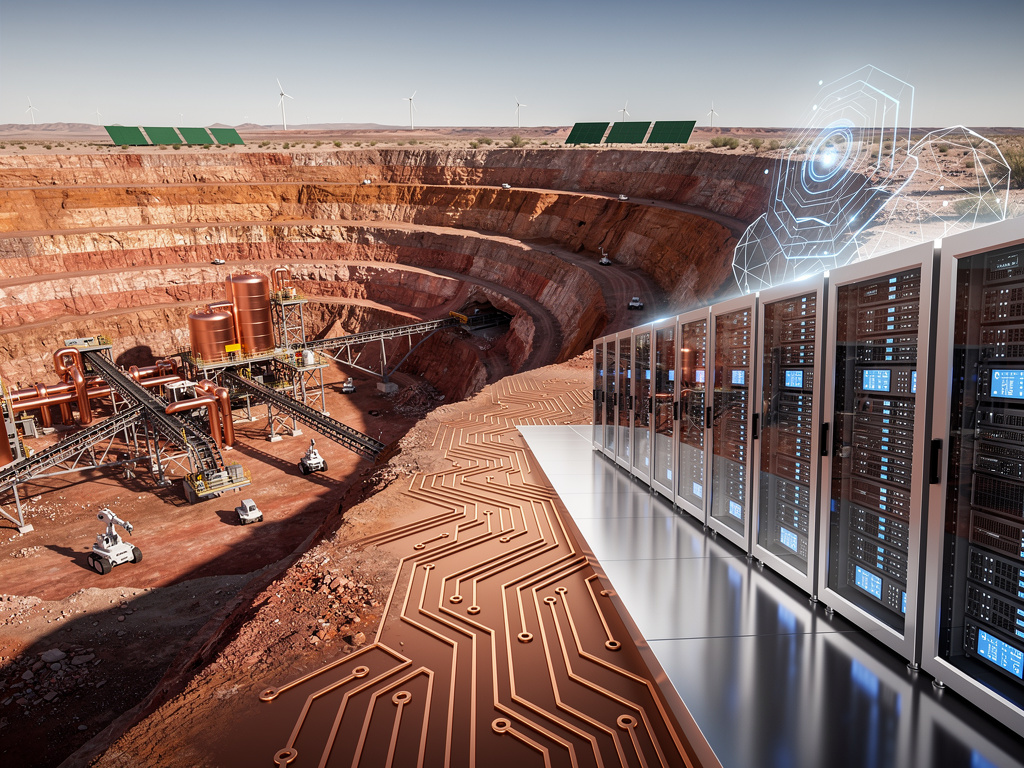
In the high-stakes world of cloud computing and resource extraction, Amazon Web Services (AWS) has forged an unlikely alliance with mining giant Rio Tinto, securing a two-year supply of copper from an innovative Arizona operation. This deal, announced in mid-January 2026, marks AWS as the inaugural buyer of copper produced via Rio Tinto’s Nuton bioleaching technology at the Johnson Camp mine. The partnership not only addresses the surging demand for copper driven by artificial intelligence data centers but also integrates AWS’s cloud analytics to refine the mining process itself.
At its core, the agreement involves Rio Tinto supplying copper extracted from low-grade deposits that were previously uneconomical to mine. Using bioleaching—a process that employs bacteria to dissolve metals from ore heaps—this method promises lower carbon emissions compared to traditional smelting. AWS, in turn, will incorporate this copper into its U.S. data center infrastructure, where the metal is essential for everything from electrical cabling to heat sinks in servers.
The timing couldn’t be more critical. As AI applications explode, data centers are consuming vast quantities of resources, with copper playing a pivotal role in efficient power distribution and cooling systems. Industry analysts estimate that a single large-scale data center can require thousands of tons of copper, amplifying supply chain pressures amid global shortages.
The Bioleaching Breakthrough
Rio Tinto’s Nuton technology represents a significant advancement in sustainable mining. Deployed at industrial scale for the first time at Johnson Camp last month, it targets waste piles and low-grade ores, potentially unlocking billions of pounds of copper without the environmental footprint of new open-pit mines. According to a report in The Information, the deal includes AWS providing cloud and analytics services to optimize these operations, creating a symbiotic relationship between tech and mining.
This isn’t just about supply; it’s about innovation. Bioleaching reduces energy consumption by up to 60% compared to conventional methods, aligning with both companies’ sustainability goals. Rio Tinto projects extracting around 14,000 metric tons of copper over four years from this site, a fraction of global needs but a proof-of-concept for scaling similar technologies.
For AWS, the copper will bolster its expansion plans. With data centers proliferating across the U.S. to support AI workloads, securing domestic, low-carbon materials mitigates risks from volatile international markets. Posts on X highlight growing sentiment that tech giants are increasingly turning to direct resource partnerships to fuel their growth, echoing broader trends in the sector.
Data Centers’ Insatiable Hunger for Copper
The AI boom has transformed copper from a commodity staple into a strategic asset. Data centers rely on copper for high-conductivity wiring, transformers, and circuit boards, with demand projected to surge as hyperscalers like AWS build out infrastructure. A recent article in Bloomberg notes that this Arizona mine represents the first new U.S. copper source in over a decade, a boon amid geopolitical tensions disrupting supplies from Chile and Peru.
Experts point out that AI training models and inference tasks require immense computational power, which in turn demands robust electrical systems. Copper’s superior conductivity makes it irreplaceable, yet global production struggles to keep pace. The Johnson Camp project, operated by Gunnison Copper, could serve as a model for revitalizing dormant U.S. mines, reducing reliance on imports that account for about 40% of domestic consumption.
Moreover, the deal underscores a shift toward vertically integrated supply chains. AWS isn’t just buying copper; it’s investing in the technology that produces it, using its analytics platforms to simulate heap-leach performance and accelerate extraction efficiency. This integration could set a precedent for other tech firms facing similar resource constraints.
Environmental and Economic Ripples
Sustainability is a cornerstone of this partnership. Nuton’s bioleaching process minimizes water usage and avoids harmful chemicals, producing copper with a lower carbon intensity. As detailed in Rio Tinto’s own announcement on their website, AWS will leverage this “green” copper in data center components, helping meet corporate emissions targets amid regulatory scrutiny.
Economically, the deal injects vitality into Arizona’s mining sector. The Johnson Camp mine, long idle, now employs advanced biotech methods to tap into reserves estimated at over 1 billion pounds of copper. Local stakeholders see this as a revival, with potential job creation and investment in rural communities. However, challenges remain, including scaling bioleaching to larger operations without compromising efficiency.
Broader market dynamics add intrigue. Copper prices have hovered near record highs, driven by AI and electrification trends. Sentiment on X suggests investors are eyeing mining mergers, like potential Rio Tinto-Glencore tie-ups, to consolidate supply amid rising demand from tech and renewables.
Strategic Implications for Tech and Mining
For AWS, this pact is more than a procurement win; it’s a hedge against supply disruptions. With data center builds accelerating—Amazon plans dozens of new facilities—the company is positioning itself as a leader in sustainable sourcing. Insights from MINING.COM indicate that over the two-year term, AWS will integrate Nuton copper across its U.S. operations, potentially influencing industry standards for material traceability.
Rio Tinto benefits equally, gaining a high-profile customer and tech expertise to refine Nuton. The collaboration could accelerate adoption of bioleaching globally, with Rio Tinto eyeing applications in other metals like nickel. Analysts predict this could disrupt traditional mining economics, making marginal deposits viable and extending mine lives.
Yet, questions linger about scalability. Bioleaching works best on specific ore types, and while Johnson Camp is a success story, replicating it elsewhere requires significant R&D. AWS’s data analytics role—simulating leach cycles and optimizing bacterial strains—could be the key to unlocking wider potential.
Market Reactions and Future Horizons
Investor reactions have been positive, with Rio Tinto’s shares ticking up post-announcement. Coverage in Fox Business highlights expectations of 14,000 metric tons extracted, fueling AWS’s AI-driven expansion. This comes as copper demand from data centers alone could add millions of tons annually by 2030, per industry forecasts.
On X, discussions emphasize the intersection of tech and commodities, with users noting how AI’s energy needs are reshaping mining investments. One thread points to the U.S. power grid’s aging infrastructure, underscoring the need for domestic copper to support electrification and data growth.
Competitors are watching closely. Microsoft and Google have their own data center ambitions, potentially sparking similar deals. For Rio Tinto, this validates Nuton as a commercial venture, possibly attracting more tech partners eager for low-carbon materials.
Innovation at the Crossroads
The AWS-Rio Tinto deal exemplifies how technology is infiltrating traditional industries. By combining cloud computing with bioengineering, the partnership addresses dual challenges of resource scarcity and environmental impact. As outlined in Mining Weekly, AWS’s analytics support will help fine-tune Nuton’s processes at Johnson Camp, potentially boosting recovery rates from low-grade ores.
This innovation extends beyond copper. Bioleaching could revolutionize extraction of critical minerals like lithium and rare earths, vital for batteries and electronics. For the U.S., it bolsters strategic autonomy in supply chains, reducing vulnerability to foreign disruptions.
However, hurdles include regulatory approvals for new mining tech and community concerns over environmental risks, even with greener methods. Rio Tinto’s track record on sustainability will be under scrutiny as it scales Nuton.
Global Supply Chain Shifts
Looking globally, this deal signals a pivot toward localized production. With China dominating refined copper output, Western firms are seeking alternatives. The Arizona project, as reported in AZFamily, positions the U.S. as a hub for innovative mining, potentially drawing more investment.
Economic multipliers are evident: enhanced data center capacity supports AI advancements, driving job growth in tech hubs. Yet, copper’s price volatility—exacerbated by AI hype—could inflate costs for end-users, as noted in recent X posts warning of inflationary pressures on the sector.
Ultimately, this partnership may redefine industry boundaries, blending silicon and ore in unprecedented ways. As AWS expands its footprint, the copper from Johnson Camp will power the algorithms shaping our digital future.
Sustaining Momentum in Uncertain Times
Maintaining this momentum requires ongoing collaboration. Rio Tinto plans to use AWS platforms for real-time data analysis, improving bioleach efficiency. This could lead to breakthroughs in predictive modeling, forecasting ore behavior under varying conditions.
For insiders, the deal highlights investment opportunities in hybrid tech-mining ventures. Funds are already flowing into sustainable extraction tech, with Nuton poised for spin-offs or acquisitions.
As the industry evolves, expect more such alliances, where data drives digging and mining fuels computation. This AWS-Rio Tinto tie-up, detailed further in Value The Markets, isn’t just a transaction—it’s a blueprint for the resource-intensive era of AI.
Pioneering a New Era
Pioneering efforts like this could alleviate bottlenecks in critical materials. With data centers projected to consume 8% of U.S. electricity by 2030, efficient copper use is paramount. Bioleaching offers a path to meet that demand sustainably.
Challenges aside, the optimism is palpable. X users are abuzz with predictions of copper’s role in AI’s ascent, likening it to “the new oil” for tech.
In essence, this deal bridges worlds, ensuring that as AI scales, the materials underpinning it evolve in tandem, fostering resilience in an interconnected global economy.


 WebProNews is an iEntry Publication