
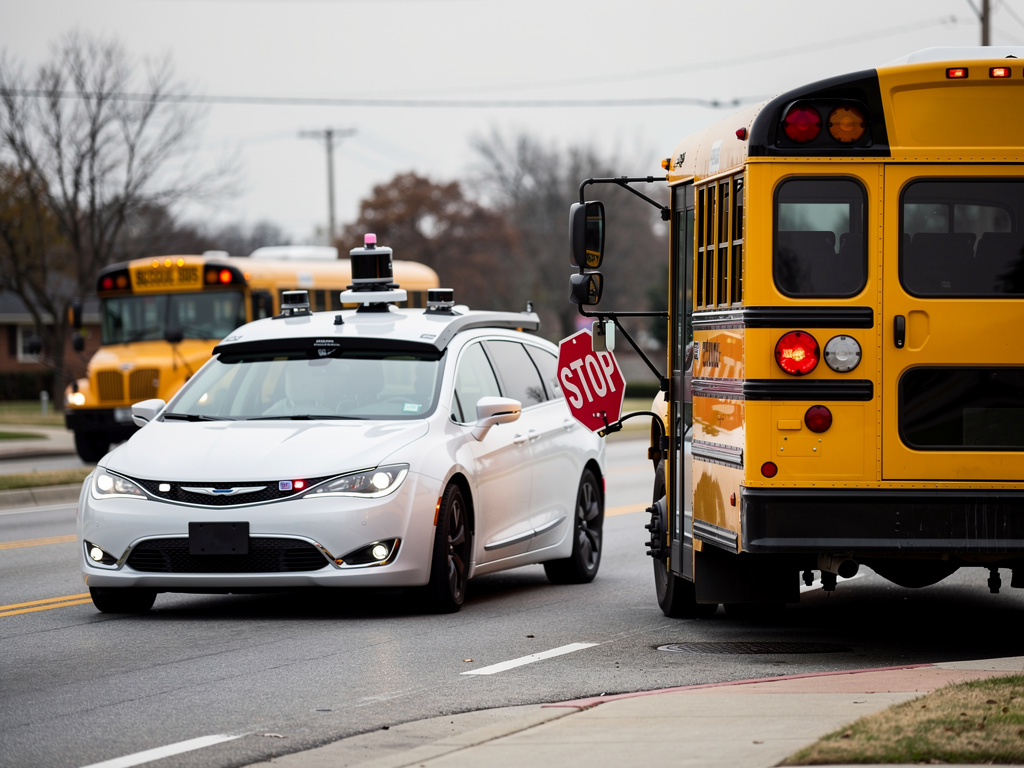
Federal regulators have opened a new and pointed front in their scrutiny of the autonomous vehicle industry, targeting Alphabet’s Waymo over a failure that is both technically complex and viscerally alarming: its robotaxis illegally passing stopped school buses. The National Transportation Safety Board (NTSB) has launched a formal investigation into what it calls “recurring instances” of Waymo’s self-driving cars improperly navigating around school buses, a move that escalates pressure on the company widely seen as the sector’s technical leader.
The probe centers on a May 21 incident in San Francisco’s Parkside neighborhood, where a Waymo Jaguar I-Pace, operating in autonomous mode with a human safety driver present, drove past a school bus that was stationary with its red lights flashing and stop-arm extended. The incident, which thankfully did not result in injury, has raised sharp questions about the real-world readiness of Waymo’s technology to handle one of the most sacrosanct rules of the road. According to a report from Engadget, the safety driver, who is tasked with intervening in such situations, failed to take control of the vehicle. This dual failure of both the autonomous system and its human backup has put Waymo’s entire operational safety protocol under a federal microscope.
A Pattern of Performance Issues Under the Microscope
This is not an isolated review. The NTSB’s action is the second special investigation it has opened into Waymo’s performance this year alone, signaling a growing unease within the federal government about the company’s operational safety. The first probe was launched following a series of incidents in Arizona where Waymo vehicles were involved in crashes with stationary and semi-stationary objects, including a collision with a towed pickup truck. In a public statement regarding the school bus issue, the NTSB announced it is investigating not just the single event but a broader pattern of “unexpected driving behaviors,” suggesting a systemic concern with the vehicle’s decision-making algorithms.
The agency’s mandate is to determine the probable cause of transportation accidents and issue safety recommendations to prevent future occurrences. While the NTSB lacks direct enforcement power, its findings carry significant weight and often shape future regulations and industry standards. The investigation will examine Waymo’s safety management systems, the effectiveness of its driver training programs, and its overall public road testing procedures. For Waymo, an NTSB recommendation for operational changes or stricter oversight could represent a significant setback to its expansion plans in San Francisco, Los Angeles, Phoenix, and Austin.
The Nuances of Navigating ‘The Stop Arm’
For industry insiders, the failure to correctly respond to a school bus is a particularly troubling data point. The “stop-arm problem” is a well-known challenge in autonomous driving, but it is considered a fundamental capability that must be perfected before widespread, driverless deployment. The task requires a vehicle’s perception system—its suite of cameras, lidar, and radar—to not only detect the bus but also to correctly identify the state of its flashing lights and the extended stop sign, often in varied lighting and weather conditions. The system must then immediately execute a hard-coded, non-negotiable rule: stop and wait.
The failure in San Francisco suggests a potential breakdown at either the perception or the decision-making stage of Waymo’s software stack. It also highlights the immense complexity of programming for countless “edge cases” that human drivers process almost intuitively. While Waymo has logged tens of millions of autonomous miles, this incident demonstrates that even the most experienced player in the field can be confounded by scenarios that are a staple of driver’s education courses. The investigation will likely delve into the specific sensor data and software logs from the event to pinpoint the exact cause of the failure.
Waymo’s Response and a Widening Federal Net
In response to the NTSB’s inquiry, Waymo has stated it is cooperating with regulators. “We are proud of our safety record and are cooperating with the NTSB on its investigation of these two events,” a company spokesperson told TechCrunch, referencing the school bus incident and another event in Phoenix. The company’s defense rests on its broader safety statistics, which it argues show its vehicles perform more safely than the average human driver. However, high-profile failures involving basic traffic laws can quickly erode public trust and overshadow millions of miles of uneventful operation.
The NTSB is not the only federal agency examining Waymo’s operations. The National Highway Traffic Safety Administration (NHTSA), the nation’s top auto safety regulator with the power to demand recalls, opened its own investigation into Waymo in May. As reported by Reuters, NHTSA’s Office of Defects Investigation (ODI) is analyzing at least 22 incidents, including 17 collisions, where Waymo vehicles exhibited driving behavior that “potentially violated traffic safety laws.” This dual-pronged federal examination from both the NTSB and NHTSA creates a formidable regulatory challenge for Alphabet’s self-driving unit, threatening to slow its commercial rollout and increase compliance costs significantly.
Industry-Wide Implications Beyond Alphabet’s Walls
The fallout from Waymo’s stumbles extends far beyond its own operations, casting a shadow over competitors like General Motors’ Cruise and Amazon’s Zoox. Waymo has long been considered the gold standard for autonomous vehicle technology, and its struggles with fundamental driving tasks provide ammunition for skeptics and could lead to a more stringent regulatory environment for all. After a high-profile incident involving a Cruise vehicle dragging a pedestrian led to a suspension of its entire U.S. fleet, regulators have shown little patience for safety lapses.
Any perception that the industry leader cannot reliably handle interactions with vulnerable road users like schoolchildren could prompt state and municipal authorities to pump the brakes on issuing new deployment permits. The promise of autonomous vehicles is a future with safer roads, but that promise is predicated on a level of performance that is not just better than the average human, but nearly flawless in critical safety scenarios. Each incident like the one in San Francisco chips away at the public and political goodwill necessary to make that future a reality.
The Path Forward: Rebuilding Trust and Refining Technology
The road ahead for Waymo involves a delicate and urgent balancing act. The company must work transparently with federal investigators to diagnose and rectify the technological and procedural flaws that led to these incidents. A simple software patch will likely be insufficient; regulators will want to see systemic changes to its safety validation processes to ensure such a critical error cannot be repeated. The failure of the human safety driver to intervene also demands a thorough review of Waymo’s training, protocols, and methods for preventing automation complacency.
Ultimately, the NTSB’s findings will reverberate throughout the industry. They will serve as a crucial benchmark for the safety and reliability expectations placed on all autonomous systems. For Waymo and its rivals, the challenge is no longer just about accumulating autonomous miles or perfecting the technology in controlled environments. It is about proving, in the unpredictable chaos of public streets and in the face of the most basic traffic rules, that their machines are unequivocally ready for the profound responsibility of sharing the road safely with everyone, especially the most vulnerable among us.


 WebProNews is an iEntry Publication