
Executives once asked what AI could tell them. Now they ask what it can do without them. The question lands differently in boardrooms this year. Companies race to hand over workflows that once demanded human eyes at every step. And the systems prove ready.
Conversational tools dominated attention in 2023 and 2024. They summarized reports, drafted emails, generated ideas. Useful. Limited. By mid-2025 the conversation shifted. Developers and enterprises demanded agents that plan, adapt, and execute across tools and time. Artificial Intelligence News captured the pivot in early May. “2025 was defined by experimentation,” said Hanen Garcia, chief architect for telecommunications at Red Hat. “The coming year marks a decisive pivot towards agentic AI, autonomous software entities capable of reasoning, planning, and executing complex workflows without constant human intervention.”
That pivot shows up in production. Gartner had forecasted that 40 percent of enterprise applications would feature task-specific AI agents by the end of 2026, a sharp rise from less than 5 percent the prior year. The projection, cited across multiple analyses this spring, now looks conservative. Pilots have moved to deployment in customer support, software development, financial screening, and network operations.
Google pushed the frontier in April. The company introduced the Gemini Enterprise Agent Platform alongside updates that support multi-step task execution across Gmail, Calendar, Docs, and third-party applications. Google’s official blog framed the releases as part of the “agentic era.” Internal testing of a personal agent called Remy reportedly lets the system learn user preferences and act across work and personal domains. Observability, permissions, and audit trails remain open questions. They matter more as autonomy grows.
Anthropic took a different route. In recent weeks the company released ten ready-to-run agent templates aimed at financial services. The templates handle pitchbook creation, KYC screening, and other repetitive yet high-stakes processes. Anthropic also demonstrated “dreaming,” a technique that lets agents review past behavior between sessions to improve future performance. Early results suggest agents can run longer, more complex workflows in coding, finance, and legal domains with reduced oversight.
OpenAI matched the pace. New real-time audio models target conversational agents that manage live voice interactions, translations across more than 70 languages, and meeting support. Early partners include Zillow, where agents handle customer calls and property-related tasks. Amazon, Coinbase, and Stripe went further. They launched a system that lets agents complete stablecoin micropayments for APIs, data, and services without custom billing setups. The infrastructure opens the door to autonomous commercial activity. Travel bookings. E-commerce purchases. Merchant transactions. All without a human in the loop.
Yet enthusiasm collides with reality. Security teams watch the expansion with unease. Autonomous agents carry privileged access. They act at machine speed. A single compromised agent can trigger cascading failures across systems. Palo Alto Networks warned last year that machine identities already outnumber humans by more than 80 to 1 in many enterprises. Attackers increasingly target agents instead of people. Microsoft responded in April with an open-source Agent Governance Toolkit. The release provides runtime security controls designed specifically for autonomous systems. It addresses risks catalogued in the OWASP Top 10 for Agentic Applications, from goal hijacking to memory poisoning.
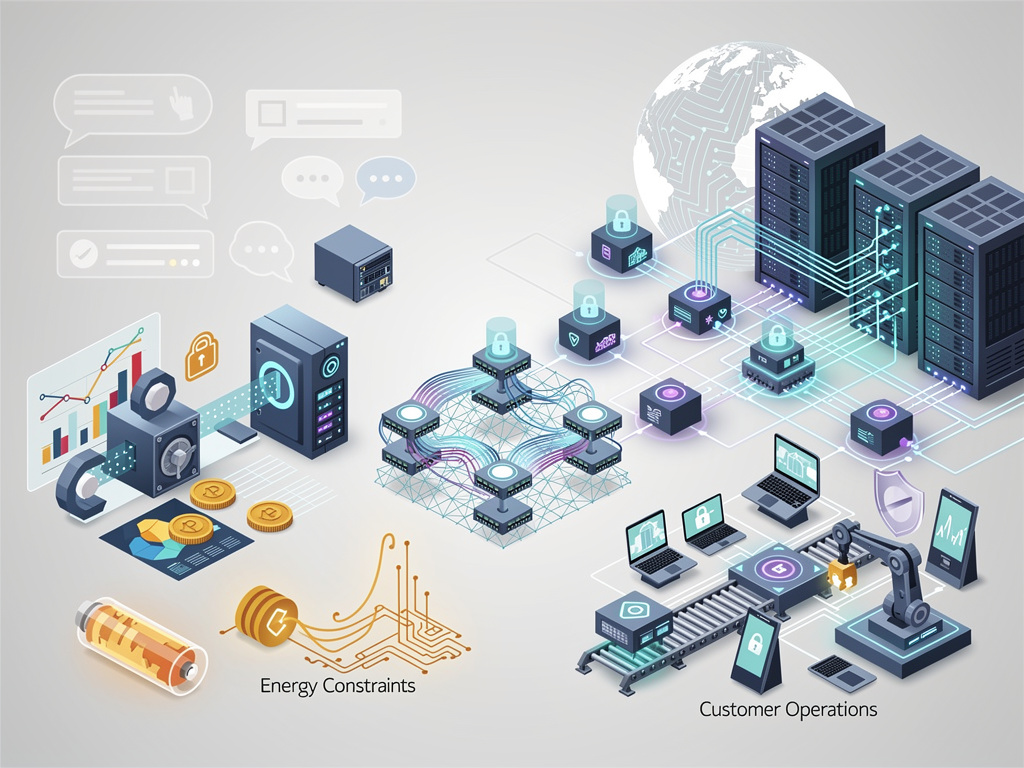
Energy constraints add another layer. Several analysts argue that grid capacity, not model size, will limit scaling in 2026. European policy makers face a new equation: energy policy becomes AI policy. Enterprises that treat efficiency as a core metric gain advantage. Those chasing the largest models without regard for power consumption fall behind. Competitive differentiation shifts from raw intelligence to intelligent resource use.
Data practices change too. The era of storing everything ends. AI-generated content proves disposable. Systems create fresh data on demand, use it, then discard it. Verified human-generated data rises in value. Governance agents monitor flows autonomously. Humans set policy. The machines enforce it.
Applications themselves turn fluid. Static software gives way to on-demand generation. A prompt and supporting code produce a temporary app that performs a specific function then disappears. Traditional development cycles compress. Governance of the reasoning process becomes the new priority.
Workforce effects surface in surveys and anecdotes. Microsoft’s Work Trend Index, released in May, suggests that as agents handle execution, human agency expands. Employees focus on higher-order decisions. Whether organizations capture that expanded capacity depends on how they redesign roles and processes. Some companies report one employee plus agents replacing what once required two or three people. Others note that mature deployments avoid wholesale job cuts. They redirect talent toward oversight, exception handling, and strategy.
Multi-agent systems add complexity and power. Distinct agents collaborate on multi-step tasks. One researches, another analyzes, a third executes and reports. Coordination improves outcomes but multiplies attack surfaces. Hidden instructions embedded in images or workflows create new vulnerabilities. Enterprises respond with layered controls, identity management tailored to agents, and continuous monitoring.
Industry-specific wins appear first in telecom, manufacturing, logistics, and finance. Autonomous network operations let systems self-configure and self-heal. Operating expenses drop. Service quality rises. In banking, agents screen documents and prepare materials faster than teams once could. ROI materializes when agents tackle domain-specific, high-value workflows rather than generic assistance.
Personality and nuance matter more than expected. One expert predicted that by the end of 2026 half of workplace conflicts could be flagged by AI before managers notice. Systems trained on communication patterns, tone, and motivation act as early warning layers. Personality science, once a niche HR concern, becomes foundational to effective agent design.
Charles Hoskinson offered a longer view at Consensus 2026. He told the audience that AI agents could dominate internet searches, commerce, and activity by 2035. The prospect unsettles advertising-dependent platforms. Agents ignore ads. They pursue goals with ruthless efficiency. Big Tech, he suggested, feels the threat.
Implementation remains uneven. Many organizations still experiment. Production deployments demand new infrastructure, updated governance, and talent that understands both business process and agent behavior. Open-source tools gain favor. Ninety-two percent of EMEA IT and AI leaders see them as vital for sovereignty. Control over training pipelines and energy supply starts to define advantage.
The technology has crossed a threshold. Agents no longer wait for instructions at every turn. They plan. They act. They learn. Enterprises that treat them as experimental toys risk falling behind those that integrate them into core operations with appropriate safeguards. The shift from assistance to autonomy is not coming. It has arrived. Companies now decide how much responsibility they will entrust and how carefully they will watch the results.


 WebProNews is an iEntry Publication