
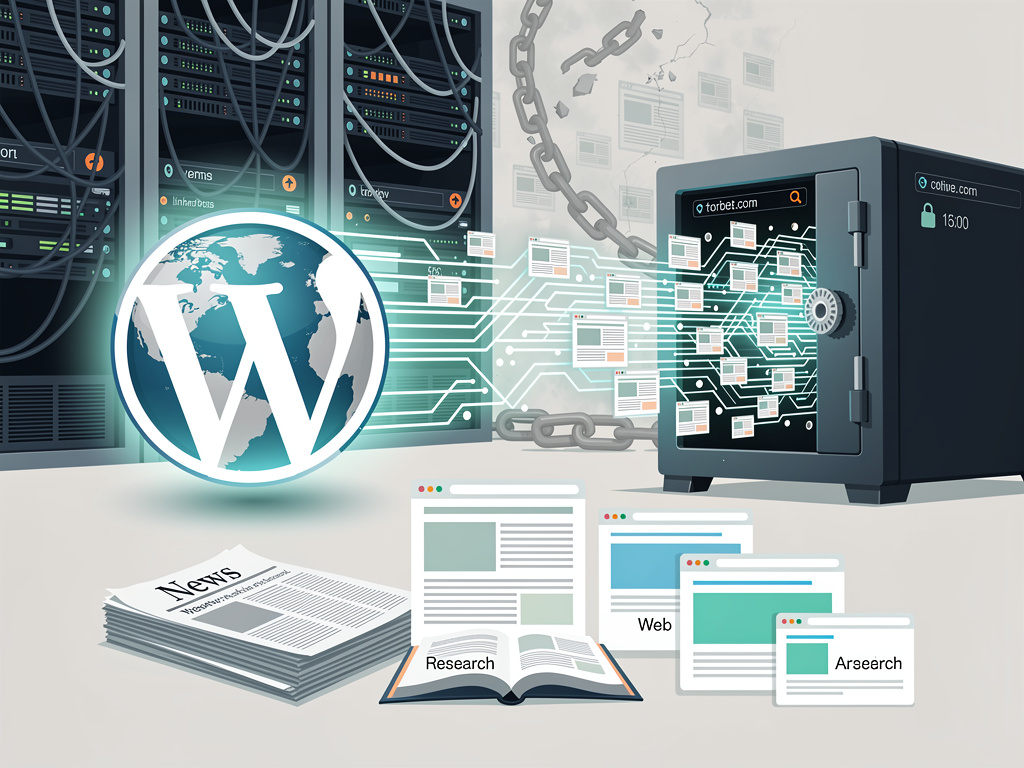
In an era where digital information disappears at an alarming rate, two of the internet’s most influential organizations have forged a partnership that could fundamentally reshape how we preserve online content. Automattic, the company behind WordPress.com and owner of Tumblr, has joined forces with the Internet Archive to combat what technologists call “link rot”—the phenomenon where hyperlinks break and web pages vanish into the digital void.
The collaboration, announced in early February 2025, represents a significant escalation in the fight against digital ephemerality. According to Slashdot, the partnership will integrate the Internet Archive’s Wayback Machine directly into WordPress infrastructure, potentially protecting billions of web pages from permanent deletion. This move comes as researchers estimate that approximately 25% of all web pages that existed between 2013 and 2023 are no longer accessible.
The stakes extend far beyond mere convenience. Academic research, legal documentation, journalistic citations, and historical records increasingly exist solely in digital form. When these links break, knowledge itself becomes fragmented. A 2024 study published in Nature found that one in five scientific papers contains broken links in their references, undermining the reproducibility of research and the integrity of the scientific record.
The Architecture of Digital Preservation
Automattic’s involvement brings unprecedented scale to digital preservation efforts. WordPress powers more than 43% of all websites globally, representing a vast swath of human knowledge and creative expression. By embedding Internet Archive functionality directly into the WordPress ecosystem, the partnership creates an automatic safety net for content that might otherwise disappear when domains expire, servers fail, or companies shut down.
The technical implementation involves several layers of protection. When a WordPress user publishes content containing external links, the system will automatically trigger archival snapshots through the Wayback Machine. If those external links later break, WordPress can automatically redirect users to archived versions, maintaining the continuity of information flow. This seamless integration represents a departure from the manual archival process that has characterized digital preservation efforts for decades.
Corporate Motivations and Public Good
Matt Mullenweg, founder and CEO of Automattic, has long positioned his company as a steward of the open web rather than merely a profit-maximizing enterprise. This partnership aligns with that philosophy, though it also serves strategic business interests. By reducing link rot within the WordPress ecosystem, Automattic enhances the long-term value of content created on its platform, potentially making WordPress more attractive to publishers, researchers, and institutions concerned with digital permanence.
The Internet Archive, for its part, gains access to a massive distribution network and technological infrastructure that could dramatically expand its preservation capabilities. Founded by Brewster Kahle in 1996, the nonprofit organization has operated on a shoestring budget relative to its ambitions, relying on donations and grants to maintain its sprawling digital collections. The partnership with Automattic provides both technical resources and mainstream visibility that could prove transformative.
The Economics of Digital Decay
Link rot represents more than a technical nuisance; it imposes real economic costs. Legal professionals spend countless hours tracking down disappeared case citations. Journalists struggle to verify sources when referenced articles vanish. Businesses lose access to contracts and communications when email services shut down or cloud storage providers change terms of service. A 2023 analysis by Harvard Law School’s Library Innovation Lab found that approximately 50% of URLs cited in Supreme Court opinions no longer function as originally intended.
The financial implications extend to content creators themselves. Broken links degrade search engine rankings, reduce referral traffic, and undermine the cumulative value of digital archives. Publishers who have invested decades in building online presences watch helplessly as older content becomes progressively less discoverable and useful. This degradation creates a bias toward recent content, regardless of quality or relevance, simply because newer links are more likely to function.
Technical Challenges and Scalability Questions
Despite the partnership’s promise, significant technical hurdles remain. The Internet Archive’s Wayback Machine currently stores more than 735 billion web pages, but even this massive collection represents only a fraction of the internet’s total content. Automatically archiving every link published through WordPress could exponentially increase storage requirements and computational demands. The organizations have not publicly disclosed how they will manage these scaling challenges or what criteria they will use to prioritize archival efforts.
Privacy concerns also loom large. Not all content creators want their work preserved indefinitely, and the line between preservation and unwanted surveillance can blur. The partnership must navigate complex questions about consent, copyright, and the right to be forgotten—particularly in jurisdictions like the European Union where data protection regulations impose strict requirements. Both organizations have indicated they will respect robots.txt files and provide opt-out mechanisms, but the details of these implementations remain to be clarified.
Competitive Dynamics and Industry Response
The Automattic-Internet Archive partnership may pressure other major platforms to develop their own preservation strategies. Google, which discontinued its popular Google Cache feature in 2024, faces renewed criticism for contributing to link rot rather than combating it. Microsoft, Amazon, and other cloud infrastructure providers have thus far treated archival as a premium service rather than a public good, charging substantial fees for long-term data retention.
Some industry observers suggest that decentralized technologies could provide alternative solutions to link rot. Blockchain-based storage systems and distributed networks like IPFS (InterPlanetary File System) promise content-addressed storage that makes information theoretically permanent and censorship-resistant. However, these technologies remain largely experimental and face their own scalability and governance challenges. The Automattic-Internet Archive approach, by contrast, builds on proven infrastructure and established institutional trust.
Implications for Journalism and Scholarship
The partnership holds particular significance for journalism and academic research, fields that depend heavily on verifiable citations and accessible sources. News organizations have watched decades of digital archives become inaccessible as websites reorganize, publications fold, or paywalls shift. The Columbia Journalism Review has documented numerous cases where important investigative reporting effectively disappeared from public view due to link rot, undermining accountability journalism’s long-term impact.
Academic institutions have begun implementing their own preservation strategies, but these efforts remain fragmented and underfunded. University libraries increasingly license access to digital archives rather than maintaining permanent collections, creating dependencies on commercial vendors whose long-term viability is uncertain. The Automattic-Internet Archive partnership could provide a more stable foundation for scholarly communication, particularly for open-access publications that lack institutional backing.
Regulatory and Policy Dimensions
The initiative arrives as policymakers worldwide grapple with questions of digital preservation and platform responsibility. The European Union’s Digital Services Act includes provisions related to content moderation and transparency, but stops short of mandating preservation. In the United States, the Library of Congress has expanded its web archiving programs, but lacks the resources to comprehensively capture the internet’s explosive growth.
Some legal scholars argue that digital preservation should be treated as critical infrastructure, similar to utilities or transportation networks. This perspective would justify public investment and regulatory oversight to ensure continuity. Others contend that preservation is best left to private initiatives and nonprofit organizations, avoiding government control over information access. The Automattic-Internet Archive partnership represents a third way—a public-private collaboration that leverages commercial infrastructure for public benefit without direct government involvement.
The Road Ahead for Digital Memory
As the partnership moves from announcement to implementation, its success will depend on technical execution, user adoption, and sustained commitment from both organizations. Early indicators suggest strong support from the WordPress community, where developers and content creators have long advocated for better preservation tools. However, translating enthusiasm into practical functionality across millions of websites will require careful coordination and substantial engineering resources.
The broader question remains whether any single partnership, however well-intentioned, can adequately address the internet’s preservation challenges. Link rot stems from fundamental aspects of how the web works—the distributed nature of hosting, the impermanence of commercial ventures, the constant evolution of technologies and standards. Solving these problems comprehensively may require not just better tools but new protocols and perhaps even reimagining how we structure digital information.
What the Automattic-Internet Archive partnership demonstrates is that digital preservation has moved from niche concern to mainstream priority. As more of human knowledge and culture exists exclusively in digital form, the stakes of link rot grow exponentially. Whether this particular initiative succeeds or fails, it marks an important moment in the ongoing struggle to ensure that the internet serves not just as a medium for ephemeral communication but as a durable repository of human achievement and memory. The digital age has given us unprecedented ability to create and share information; now we must develop equivalent capacity to preserve it.


 WebProNews is an iEntry Publication