
DETROIT—U.S. auto executives enter 2026 with a familiar mantra amid mounting headwinds: hope for the best, prepare for the worst. The industry, which accounts for about 4.8% of gross domestic product according to CNBC, has weathered supply-chain snarls, chip shortages and policy shifts since the Covid-19 era. Now, affordability woes, evaporating electric-vehicle incentives and impending trade talks loom large.
Hyundai North America CEO Randy Parker captured the mood at a recent industry gathering. ‘We’ve got to plan for the worst and hope for the best,’ he said, as reported by CNBC. Wall Street echoes the caution. UBS analyst Joseph Spak anticipates flat sales volumes after 2025’s 16.3 million units—the highest since 2020 but still below pre-pandemic peaks of over 17 million.
Jefferies analyst Owen Paterson foresees ‘more external shocks and share price divergence,’ urging readiness for impairments and strategic pivots, per investor notes cited in CNBC.
Affordability Wall Hits Buyers Hard
Average new-vehicle transaction prices hovered near $50,000 by late 2025, a 30% jump from $38,747 in 2020, according to Cox Automotive data referenced in CNBC. Inflation, 13% annual insurance hikes over five years and rising maintenance costs compound the strain. Cox interim chief economist Jeremy Robb noted the ‘cumulative weight… accelerating the affordability crisis.’
Weeks of median household income required for a new vehicle climbed to 36.3 from 33.7 in 2019, per Cox figures. Erin Keating of Cox Automotive explained how pandemic constraints ‘restructured pricing dynamics… anchored at higher price points.’
Executives respond by eyeing cheaper options. Ford CEO Jim Farley, speaking at the January Detroit Auto Show, said ‘never say never’ on sedans after exiting the segment in 2020, as covered by CNBC.
Tariffs and Trade Talks Reshape Strategies
Toyota U.S. sales chief David Christ warned prices ‘are going to go up for us and for our competitors’ due to tariffs, during a reporter call cited in CNBC. Honda’s Lance Woelfer stressed focusing on lower trims and certified pre-owned vehicles, acknowledging ‘every automaker must face the reality that the American market has changed.’
The USMCA renegotiation, slated for later 2026, adds urgency. Current rules favor imports from South Korea and Japan over Canada and Mexico based on U.S. content, per CNBC. President Donald Trump’s 25% tariffs on imported vehicles and parts, implemented in March 2025, already ripple through supply chains, as noted in Detroit Free Press.
A postponed Senate hearing led by Sen. Ted Cruz on affordability, involving Ford, GM and Stellantis CEOs, underscores political pressure, according to Politico.
Sales Forecasts Signal Slowdown
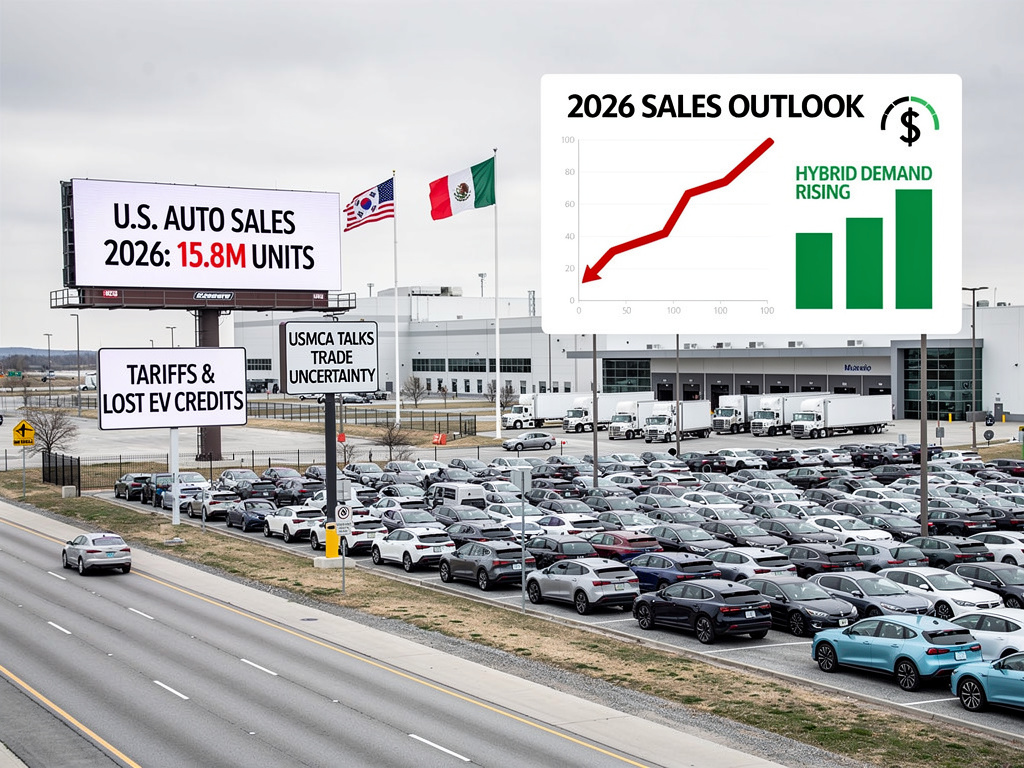
Cox Automotive projects 15.8 million units in 2026, down 2.4% from 2025’s 16.3 million, citing slower growth, job weakness and lost EV tax credits in its forecast. Retail sales dip 1.5%, fleet 6.1%. J.D. Power’s Thomas King called 2025 a ‘sales roller coaster,’ warning of tougher times ahead in Reuters.
Edmunds expects steady or slightly lower volumes around 16 million, with tariff costs and economic uncertainty weighing in, per its analysis. GM CEO Mary Barra offered a brighter note, predicting 2026 ‘will be better than 2025,’ as quoted in CNBC.
Analyst Jonathan Smoke of Cox foresees USMCA and tariffs as the ‘biggest twist,’ risking higher EV costs amid depreciation and no incentives, according to Detroit Free Press.
EV Momentum Stalls Amid Policy Shifts
The $7,500 federal EV tax credit expired September 2025, slashing December retail share to 6.6% from 11.2% prior year, per J.D. Power in CBT News. Automakers pivot to hybrids and gas models. GM plans EV production cuts, while Toyota and Hyundai press on with investments.
Toyota’s Andrew Gilleland predicted ‘fairly significant price-ups’ in 2026 from tariffs, as reported in Virginia Business. Fastmarkets analysts see U.S. producers hit by subsidy cuts and tariffs, shifting to internal-combustion engines in its outlook.
Hyundai’s Parker called 2026 ‘very challenging’ in Reuters, amid broader EV malaise.
Production and Supply Chain Recalibrations
Expect more trade-downs to affordable used vehicles as lease returns flood markets. Manheim Used Vehicle Value Index rises 2% by year-end 2026, per Cox in its report. Policy volatility—tariffs, fuel rules, USMCA—dominates, with AI aiding dealer efficiency.
WardsAuto highlights hybrids, software-defined vehicles and tariff mitigation as trends, quoting analysts on plant relocation challenges in its preview. Automotive News flags North American trade talks and Supreme Court tariff rulings as pivotal in its analysis.
GM leads 2025 sales at over 2.8 million but faces Q4 momentum loss entering 2026, Cox data shows.
Executive Strategies Amid Volatility
Ford’s Farley urged caution on demand at the auto show, per CNBC. Canaccord’s George Gianarikas sees Tesla poised for 2026 growth via Cybercab and Optimus, despite subsidy drag, in a note shared on X.
Fragmentation favors disciplined players. Cox’s 2026 forces include policy shocks and EV off-lease influx, promising a dynamic year for survivors.


 WebProNews is an iEntry Publication