
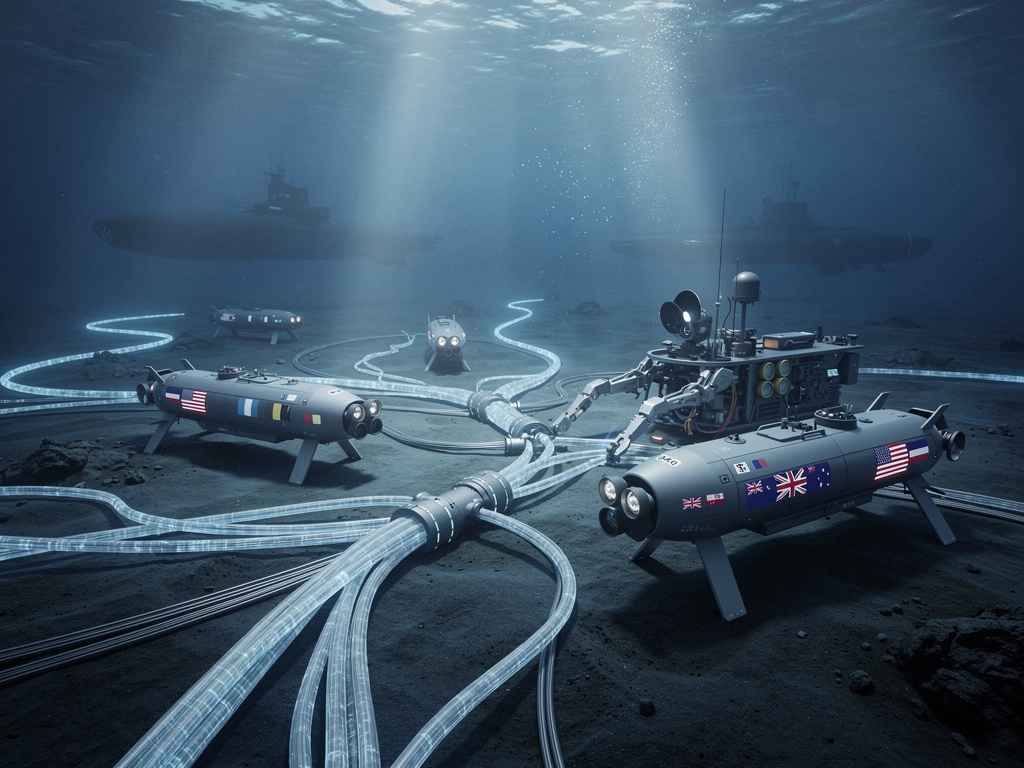
The United States, Australia, and the United Kingdom have announced a joint initiative to develop advanced unmanned underwater vehicles designed specifically to safeguard the vast network of undersea data cables that carry the majority of global internet traffic. This collaborative effort, revealed through official statements from the three nations, represents a significant step in addressing growing concerns about the vulnerability of critical submarine infrastructure to both physical damage and potential sabotage.
The project falls under the AUKUS security pact, which the three countries formed in 2021 to enhance defense cooperation across the Indo-Pacific region. According to reports from Slashdot, the new unmanned vehicles will focus on monitoring, inspecting, and potentially repairing the thousands of miles of fiber-optic cables that lie on the ocean floor. These cables transmit more than 95 percent of international data, including financial transactions, military communications, and everyday internet usage for billions of people worldwide.
Undersea cables have become increasingly attractive targets for adversaries seeking to disrupt global connectivity without triggering conventional military responses. Incidents such as the suspected sabotage of the Nord Stream pipelines in 2022 highlighted how fragile underwater infrastructure can be, even though those particular structures carried gas rather than data. Intelligence assessments from multiple governments suggest that both Russia and China have developed capabilities to interfere with cable systems, including specialized submarines and remotely operated vehicles capable of cutting or tapping into lines in remote ocean areas.
The proposed unmanned systems aim to provide persistent surveillance in areas where cables are most exposed. Traditional methods of cable protection rely heavily on periodic inspections by manned ships, which can take weeks to reach distant locations and offer only snapshots of conditions on the seafloor. Autonomous underwater vehicles, by contrast, could remain on station for extended periods, using sophisticated sensors to detect unusual activity, identify cable damage from anchors or natural disasters, and even perform basic repair tasks without requiring immediate human intervention.
Australia brings particular expertise to the table through its work on autonomous systems for the Royal Australian Navy. The country has invested heavily in developing large autonomous underwater vehicles as part of its defense modernization program. These platforms already demonstrate advanced navigation capabilities in challenging underwater environments, including the ability to operate for months without surfacing. British contributions will likely center on sensor technology and artificial intelligence algorithms developed through the UK’s Defense Science and Technology Laboratory, which has pioneered machine learning applications for maritime domain awareness.
American involvement provides access to substantial research funding and integration with existing U.S. Navy programs focused on unmanned systems. The Pentagon has allocated significant resources toward developing a family of unmanned underwater vehicles ranging from small inspection drones to large displacement vessels capable of carrying substantial payloads. The AUKUS project will build upon these separate national efforts to create interoperable systems that can share data and coordinate operations across vast distances.
Technical specifications for the new vehicles remain classified, but experts anticipate they will incorporate several key features. High-resolution sonar systems will map cable routes with centimeter-level accuracy, while optical sensors and laser scanners can inspect cable integrity without physical contact. Advanced acoustic arrays will listen for the distinctive sounds of submarines or remotely operated vehicles operating nearby. The vehicles will likely employ artificial intelligence to distinguish between normal marine activity and potential threats, reducing the burden on human operators who monitor the systems from shore-based control centers.
Energy management represents one of the greatest challenges in developing long-endurance underwater vehicles. Current battery technology limits most autonomous systems to operations measured in days rather than months. The AUKUS partners are reportedly exploring several solutions, including fuel cells that can extract oxygen from seawater and hybrid systems that combine traditional batteries with more exotic power sources. Some designs may incorporate docking stations on the seafloor where vehicles can recharge and upload data before resuming their patrols.
The strategic importance of protecting undersea cables extends far beyond simple connectivity. Modern economies depend on instantaneous data transfer for everything from stock market operations to supply chain management. A coordinated attack that severs multiple cables simultaneously could cause widespread disruption, potentially costing billions of dollars per day in lost economic activity. Military planners worry particularly about cables connecting military installations or carrying sensitive government communications.
China has expanded its deep-sea capabilities dramatically over the past decade, developing both manned and unmanned vehicles capable of operating at extreme depths. The Chinese research vessel Yuan Wang series has conducted extensive surveys of cable routes in the Pacific and Indian Oceans, activities that some Western analysts interpret as preparation for potential future operations against critical infrastructure. Russian naval doctrine has long emphasized the disruption of enemy communications networks, with specific attention paid to submarine cable vulnerabilities dating back to the Cold War era.
The AUKUS announcement comes amid heightened tensions in the Indo-Pacific, where competing territorial claims and military modernization programs have raised concerns about potential conflict. The three nations have emphasized that the unmanned vehicle program serves defensive purposes and aims to maintain stability by deterring aggressive actions against critical infrastructure. They have invited other like-minded countries to participate in future phases of development, suggesting the initiative could expand beyond the original partnership.
Implementation timelines call for initial prototypes to undergo testing within the next two years, with operational systems potentially entering service by the early 2030s. The program will require substantial investment, though exact figures have not been disclosed. Costs will likely run into the hundreds of millions of dollars as the partners develop not only the vehicles themselves but also the supporting infrastructure for deployment, recovery, and data analysis.
Beyond immediate security applications, the technology developed through this program could have civilian benefits. Commercial cable operators face constant challenges from fishing activities, natural disasters, and the sheer difficulty of maintaining infrastructure across remote ocean basins. Autonomous inspection vehicles could reduce the need for expensive cable ships while providing more frequent and detailed assessments of cable conditions. Improved monitoring might also help scientists better understand deep-sea ecosystems and the effects of climate change on ocean environments.
International law governing activities around undersea cables remains somewhat ambiguous, particularly regarding the rights of nations to monitor or protect cables that pass through international waters. The United Nations Convention on the Law of the Sea provides basic protections but was written before modern autonomous systems existed. The AUKUS partners will need to work with other maritime nations to establish norms of behavior that prevent escalation while preserving legitimate security interests.
Public reaction to the announcement has been mixed. Technology analysts praise the proactive approach to protecting critical infrastructure that most people take for granted. Privacy advocates, however, express concern about the potential for these systems to conduct broad surveillance operations that could capture data from multiple cable systems simultaneously. The three governments have stated that operations will focus exclusively on protection and monitoring rather than intelligence collection, though distinguishing between these activities can prove challenging in practice.
The development of these unmanned vehicles reflects a broader shift in naval strategy toward distributed systems that reduce reliance on large, expensive manned platforms. Rather than depending on a handful of specialized ships that might take days to reach an incident site, future cable protection will likely involve networks of smaller autonomous systems working in concert with satellite surveillance and shore-based analysis centers. This approach offers greater flexibility and resilience against potential attacks on the protection assets themselves.
As the program progresses, technical challenges will test the ingenuity of engineers from all three nations. Operating reliably in the crushing pressures of the deep ocean while maintaining communications with surface vessels or satellites requires solutions to problems that have vexed underwater vehicle designers for decades. Acoustic communications remain slow and unreliable over long distances, while surfacing to transmit data via radio makes the vehicles vulnerable to detection.
The AUKUS partners have established working groups to address standardization issues that could affect interoperability between American, Australian, and British systems. Common data formats, control interfaces, and maintenance procedures will allow the three nations to share vehicles and support infrastructure during joint operations. This level of integration represents a significant departure from traditional approaches where allies often developed incompatible systems that complicated coalition operations.
Looking ahead, the success of this initiative could influence how other nations approach the protection of their own undersea infrastructure. Countries with extensive cable networks, including those in Europe and Asia, may accelerate their own development programs or seek partnerships with the AUKUS nations. The technology could eventually become a standard component of maritime security, much as satellite surveillance transformed naval operations in previous decades.
The collaboration demonstrates how shared strategic interests can drive technological innovation in areas that benefit both military and civilian sectors. By combining their respective strengths in autonomous systems, sensor development, and operational experience, the United States, Australia, and the United Kingdom aim to create capabilities that will help secure the invisible arteries of the global information economy for generations to come. The project stands as a concrete example of how traditional allies can work together to address emerging threats in domains that lie beyond the reach of conventional military forces.


 WebProNews is an iEntry Publication