
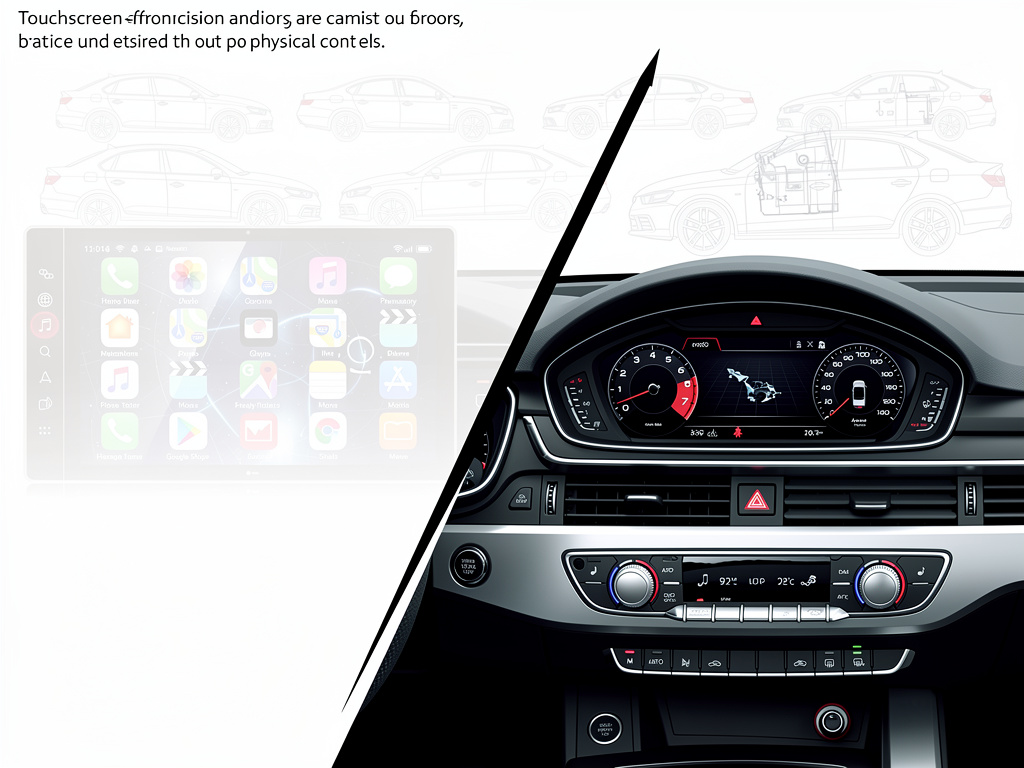
The automotive industry stands at a pivotal crossroads as Audi, one of Germany’s most prestigious automakers, signals a dramatic reversal in its approach to vehicle interior design. After years of enthusiastically embracing expansive touchscreen interfaces that dominated dashboards across the industry, the company’s design leadership is now championing a return to tactile, physical controls—a shift that reflects broader consumer dissatisfaction with the all-digital cockpit experience.
According to TechRadar, Audi’s design boss has explicitly acknowledged that the pendulum has swung too far toward touchscreen-dominated interiors. This admission comes as the automaker prepares to reintroduce physical buttons and controls in upcoming models, responding to mounting criticism from both automotive journalists and customers who have found themselves frustrated by the usability challenges of purely digital interfaces. The company’s evolving philosophy represents more than mere aesthetic preference—it signals a fundamental reassessment of how drivers interact with increasingly complex vehicle systems.
The implications of this strategic pivot extend far beyond Audi’s product lineup. As one of the Volkswagen Group’s premium brands and a trendsetter in automotive design, Audi’s decisions often ripple throughout the industry. When the company embraced minimalist, screen-heavy interiors in recent years, competitors rushed to follow suit. Now, as Audi reverses course, the entire automotive sector must reconsider whether the pursuit of technological sophistication has inadvertently compromised fundamental usability and driver safety.
The Touchscreen Takeover and Its Discontents
The migration toward touchscreen-dominated vehicle interiors accelerated dramatically over the past decade, driven by multiple converging factors. Automakers, inspired by the consumer electronics industry’s success with smartphones and tablets, viewed large displays as symbols of technological advancement and modernity. These screens offered manufacturers significant cost advantages in production, allowing a single hardware platform to serve multiple markets and trim levels through software configuration alone. Additionally, touchscreens provided the flexibility to update interfaces through over-the-air software updates, theoretically extending a vehicle’s functional lifespan.
However, the reality of living with these interfaces has proven considerably less appealing than the showroom presentation suggested. Drivers have consistently reported frustration with systems that require multiple menu layers to access basic functions like climate control or audio volume adjustment. The lack of tactile feedback means drivers must divert their visual attention from the road to accomplish tasks that previously required only muscle memory and a simple button press. This usability deficit becomes particularly pronounced during challenging driving conditions—adjusting the temperature while navigating heavy traffic or changing radio stations on a winding road transforms from trivial tasks into potentially dangerous distractions.
Safety Concerns Drive Regulatory and Consumer Pushback
The safety implications of touchscreen-heavy interfaces have not escaped the attention of regulators and safety organizations. European automotive safety assessment programs have begun incorporating usability evaluations into their testing protocols, with vehicles receiving lower ratings when critical functions are buried within touchscreen menus. This regulatory pressure has created tangible incentives for manufacturers to reconsider their interface design strategies, as safety ratings directly influence consumer purchasing decisions and, in some markets, insurance premiums.
Consumer advocacy groups have amplified these concerns, conducting studies that demonstrate measurably increased reaction times when drivers interact with touchscreen systems compared to traditional physical controls. The issue transcends mere inconvenience—it represents a genuine safety hazard that has prompted some industry observers to question whether the rush toward digital interfaces prioritized aesthetics and cost savings over driver welfare. Audi’s acknowledgment of these problems and commitment to reintroducing physical controls suggests the company recognizes that premium positioning requires not just technological sophistication but genuine usability excellence.
The Engineering Challenge of Hybrid Interface Design
Reintroducing physical controls into modern vehicle interiors presents substantial engineering challenges that extend beyond simply reinstalling buttons from previous-generation vehicles. Contemporary automobiles incorporate vastly more functions than their predecessors, from advanced driver assistance systems to sophisticated infotainment features and complex powertrain management options. Designers must determine which functions merit dedicated physical controls and which can reasonably remain within touchscreen menus, a calculus that requires careful consideration of usage frequency, safety criticality, and ergonomic accessibility.
The solution emerging from Audi and other manufacturers pursuing similar strategies involves hybrid interfaces that strategically combine touchscreens with carefully selected physical controls. Climate control systems, audio volume adjustment, and critical driving mode selections are returning to button, dial, and switch formats, while less frequently accessed functions remain within digital menus. This approach attempts to capture the benefits of both paradigms—the flexibility and updatability of touchscreens alongside the immediate accessibility and tactile feedback of physical controls. However, executing this balance successfully requires sophisticated user experience research and a willingness to prioritize function over the minimalist aesthetic that has dominated recent automotive design trends.
Market Dynamics and Competitive Responses
Audi’s strategic shift arrives amid broader market turbulence in the premium automotive segment. Electric vehicle adoption rates have fallen short of many manufacturers’ projections, forcing companies to reassess their product strategies and investment priorities. In this environment, addressing concrete customer complaints about interface usability offers a relatively low-cost opportunity to improve product appeal and differentiate from competitors. Physical controls represent a tangible improvement that customers can immediately appreciate during test drives, unlike abstract promises about future software updates or autonomous driving capabilities.
Other manufacturers have begun signaling similar strategic recalibrations. Volkswagen Group brands beyond Audi have acknowledged customer feedback regarding touchscreen interfaces, while some competitors have maintained or even expanded their commitment to physical controls as a differentiating feature. This divergence in approaches creates a natural experiment that will reveal consumer preferences through market performance. Manufacturers betting heavily on continued touchscreen dominance risk finding themselves misaligned with customer desires, while those reintroducing physical controls too aggressively might appear technologically regressive in a market that still values innovation and modernity.
The Premium Positioning Paradox
For premium manufacturers like Audi, the interface design question carries particular significance because it directly impacts brand positioning and perceived value. Luxury automotive brands have traditionally justified their price premiums through superior materials, craftsmanship, and user experience. When digital interfaces frustrate customers and compromise usability, they undermine these core value propositions. A luxury vehicle that requires drivers to navigate complex menu structures to adjust cabin temperature delivers an objectively inferior experience compared to a mass-market vehicle with intuitive physical controls, regardless of screen size or resolution specifications.
This realization has prompted Audi’s design leadership to reframe the conversation around automotive interfaces. Rather than viewing physical controls as anachronistic elements of legacy design, the company now positions them as premium features that demonstrate attention to user experience and driver-focused engineering. This repositioning aligns with broader luxury market trends emphasizing authenticity, craftsmanship, and human-centered design over purely technological specifications. By championing physical controls, Audi attempts to reclaim the usability high ground while simultaneously differentiating its products from competitors still pursuing screen-maximalist strategies.
Implementation Timelines and Product Strategy
The practical implementation of Audi’s renewed commitment to physical controls will unfold gradually across the company’s product portfolio. Vehicles currently in production or late-stage development will retain their existing interface designs, as the costs and complexity of fundamental interior redesigns make mid-cycle changes impractical. However, upcoming model generations and significant refreshes will incorporate the new design philosophy, with the extent of physical control reintroduction varying based on vehicle segment, target market, and competitive positioning.
This phased implementation approach allows Audi to refine its hybrid interface strategy based on customer feedback and market response before committing to company-wide standards. Early adopters of the new interface designs will effectively serve as large-scale user experience testing groups, providing data that informs subsequent product development. The company’s willingness to publicly acknowledge its previous missteps and commit to corrective action demonstrates a level of organizational flexibility that has not always characterized large automotive manufacturers, suggesting that Audi’s leadership recognizes the urgency of addressing customer concerns in an increasingly competitive market.
Industry-Wide Implications and Future Trajectories
Audi’s strategic pivot on interior interfaces carries implications that extend throughout the automotive industry and potentially into adjacent sectors. If the company’s renewed emphasis on physical controls proves successful in improving customer satisfaction and driving sales, competitors will face pressure to follow suit or risk appearing unresponsive to user needs. This potential shift could reshape supplier relationships, as manufacturers increase demand for traditional control components after years of reducing their presence in vehicle interiors. Component suppliers who maintained capabilities in physical control production during the touchscreen boom may find themselves advantageously positioned.
The broader lesson from Audi’s experience transcends specific interface design choices, highlighting the dangers of uncritically adopting technological trends without rigorous evaluation of their impact on core product functions. The automotive industry’s embrace of expansive touchscreens reflected assumptions about consumer preferences that proved partially incorrect when tested against real-world usage patterns. As vehicles incorporate increasingly sophisticated technologies—from advanced driver assistance systems to vehicle-to-infrastructure communication—manufacturers must ensure that technological capability serves genuine user needs rather than becoming an end unto itself. Audi’s willingness to acknowledge this principle and adjust its strategy accordingly may ultimately prove as significant as the specific design changes it implements.


 WebProNews is an iEntry Publication