
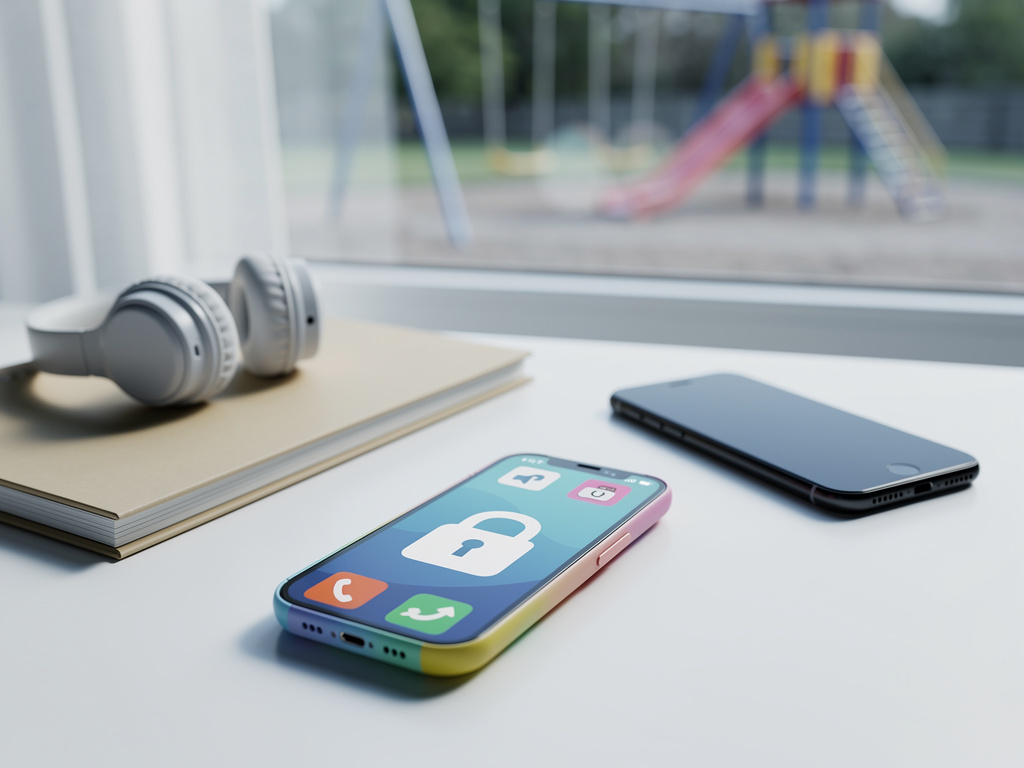
In an era when smartphones have become synonymous with childhood anxiety, cyberbullying, and social media addiction, AT&T is making an audacious bet that less technology—not more—is what American families actually want. The telecom giant has unveiled the Amigo Jr., a purpose-built mobile phone for children that deliberately strips away the features that have made smartphones a lightning rod for parental concern. It is a move that places AT&T squarely at the intersection of a growing cultural backlash against children’s screen time and a nascent but fast-growing market for kid-safe devices.
The Amigo Jr., as first reported by Business Insider, is not a smartphone in any traditional sense. It is a deliberately limited device designed to give children the ability to call and text their parents and approved contacts without opening the door to the internet, social media, app stores, or the endless scroll that has become the defining feature of modern digital life. AT&T is positioning the phone as a safety tool rather than an entertainment device—a philosophical distinction that carries significant implications for how the telecom industry thinks about its youngest potential customers.
A Device Born From a Mental Health Crisis
The timing of AT&T’s launch is anything but accidental. The United States is in the grip of what U.S. Surgeon General Vivek Murthy has called a youth mental health crisis, with rising rates of anxiety, depression, and self-harm among adolescents that multiple researchers have linked, at least in part, to the proliferation of smartphones and social media. Murthy issued an advisory in 2023 warning about the effects of social media on young people’s mental health, and in 2024 called for warning labels on social media platforms similar to those on tobacco products. Legislation restricting children’s access to social media has advanced in dozens of states, and the federal Kids Online Safety Act has gained bipartisan momentum in Congress.
Against this backdrop, a growing number of parents have begun seeking alternatives to handing their children a fully connected smartphone. The “Wait Until 8th” movement, which encourages parents to delay giving children smartphones until at least eighth grade, has gained hundreds of thousands of pledges. Schools across the country have banned or severely restricted phone use during the school day, with states like Florida, Indiana, and Virginia enacting legislation to enforce phone-free classrooms. The cultural tide, it seems, has turned—and AT&T wants to ride it.
Inside the Amigo Jr.: What It Does and What It Deliberately Doesn’t
The Amigo Jr. is built around a philosophy of intentional limitation. According to Business Insider, the device allows children to make and receive phone calls and send text messages to a parent-approved contact list. It includes GPS location tracking so parents can see where their child is at any given time. What it does not include is equally telling: there is no web browser, no app store, no social media access, no camera in some configurations, and no ability for the child to download or install software of any kind.
This approach puts the Amigo Jr. in a category of devices sometimes called “dumb phones for kids,” though AT&T would likely bristle at that characterization. The company has instead emphasized the phone’s safety features, including emergency SOS functionality and the ability for parents to manage the device remotely through a companion app. The parental controls are not an afterthought bolted onto a smartphone operating system; they are the foundational architecture of the device itself. This is a critical distinction. Many parents who have tried to limit their children’s smartphone use through parental control apps have found those tools easy for tech-savvy kids to circumvent. The Amigo Jr. is designed so that there is simply nothing to circumvent.
AT&T’s Strategic Calculus: Capturing Families Early
For AT&T, the Amigo Jr. is not merely a product launch—it is a strategic play to capture family accounts at a critical inflection point. The wireless industry has long understood that the moment a child gets their first phone is often the moment a family evaluates and potentially switches carriers. By offering a compelling first-phone option for younger children, AT&T can lock in family plans years before those children age into full smartphone users. It is a long game, and it is one that AT&T’s competitors have been slower to play.
Verizon and T-Mobile both offer parental control features and have partnered with various kid-friendly device makers, but neither has launched a proprietary children’s phone with the same level of marketing commitment that AT&T is bringing to the Amigo Jr. The move gives AT&T a first-mover advantage in a market segment that analysts believe could grow substantially as legislative and cultural pressure on children’s smartphone use intensifies. If even a fraction of the roughly 50 million American households with children under 18 decide that a limited phone is the right first device for their kids, the addressable market is enormous.
The Competitive Field: Gabb, Bark, Pinwheel, and the Rise of Kid-Safe Tech
AT&T is not entering an empty field. A number of startups have already staked out positions in the children’s phone market, and their growth trajectories suggest that demand is real and accelerating. Gabb Wireless, founded in 2018, has sold hundreds of thousands of phones designed specifically for kids, offering devices that allow calls and texts but block internet access and social media. Bark Technologies offers both a phone and a monitoring service that alerts parents to potential dangers in their children’s digital communications. Pinwheel has taken a slightly different approach, offering a smartphone with a curated app library that parents can expand as their child demonstrates readiness.
What distinguishes AT&T’s entry from these smaller players is scale. AT&T has the marketing budget, retail footprint, and existing customer base to bring the Amigo Jr. to mainstream awareness in a way that niche startups simply cannot. The company can bundle the device with family plans, sell it in thousands of retail locations, and leverage its brand recognition to reach parents who may never have heard of Gabb or Pinwheel. For the startups, AT&T’s entry is a double-edged sword: it validates the market they helped create, but it also introduces a competitor with vastly greater resources.
Parental Sentiment and the Data Behind the Demand
The data supporting AT&T’s bet is compelling. A 2024 Pew Research Center survey found that roughly two-thirds of American parents believe smartphones are having a negative effect on children’s ability to focus, and a majority expressed concern about the impact of social media on their children’s mental health. A separate survey by Common Sense Media found that the average age at which American children receive their first smartphone has dropped to around 11, but that a growing number of parents report wishing they had waited longer. The gap between when parents give their children phones and when they believe children are actually ready for them represents a market opportunity—one that the Amigo Jr. is designed to fill.
Parents who spoke to various media outlets about their interest in limited phones for children frequently cited a common dilemma: they want their children to be reachable for safety reasons, particularly as kids begin walking to school, attending extracurricular activities, or spending time at friends’ houses, but they do not want to hand over a device that provides unrestricted access to the internet. The Amigo Jr. is engineered to resolve that tension directly. It gives parents the peace of mind that comes with connectivity without the anxiety that comes with a smartphone.
Regulatory Winds and the Political Moment
AT&T’s timing also aligns with a political environment that is increasingly hostile to children’s unrestricted technology use. The Kids Online Safety Act, which would require social media platforms to enable the strongest privacy settings by default for minors, passed the Senate with overwhelming bipartisan support in 2024 and continues to advance. Multiple states have passed or are considering laws that restrict social media access for minors, with Utah, Arkansas, Texas, and others leading the charge. In this regulatory environment, a device that sidesteps the entire issue by simply not providing internet access has a certain elegant simplicity.
For AT&T, the Amigo Jr. also offers a reputational benefit. Telecom companies have faced criticism for their role in facilitating children’s access to harmful content. By proactively offering a child-safe alternative, AT&T can position itself as a responsible corporate actor in the children’s technology debate—a narrative that is valuable not only with consumers but with regulators and legislators. It is a form of corporate preemption: by offering a solution to the problem, AT&T reduces the likelihood that it will be targeted as part of the problem.
Questions That Remain: Pricing, Adoption, and the Road Ahead
Despite the favorable conditions, significant questions remain about the Amigo Jr.’s prospects. Pricing will be critical. Parents who are already paying for family phone plans may balk at adding another device and line, particularly if the Amigo Jr. is priced at a premium relative to the basic phones available from competitors. AT&T will need to make the economics compelling, potentially through subsidized device pricing or bundled plan discounts that make the Amigo Jr. an easy add-on rather than a significant new expense.
There is also the question of whether children themselves will accept a device that their peers may view as inferior. The social dynamics of childhood are unforgiving, and a phone that cannot access TikTok, YouTube, or Snapchat may carry a stigma among older elementary and middle school students. AT&T appears to be targeting the device at younger children—roughly ages 5 through 12—where the social pressure to have a smartphone is less intense, but the boundary between “kid phone” and “real phone” is one that every child eventually pushes against.
A Bellwether for the Industry’s Relationship With Young Users
Perhaps the most significant aspect of the Amigo Jr. launch is what it signals about the broader technology industry’s evolving relationship with children. For years, the default assumption was that more connectivity was always better, and that the role of technology companies was to provide access while leaving questions of appropriateness to parents. That assumption is now being challenged from virtually every direction—by parents, by researchers, by legislators, and now by the telecom companies themselves.
AT&T’s decision to build and market a phone defined by what it cannot do represents a meaningful philosophical shift. It is an acknowledgment that the product the industry has been selling to families—the fully connected smartphone—may not be the right product for every member of the family. Whether the Amigo Jr. becomes a blockbuster product or a niche offering, it has already succeeded in one respect: it has forced a conversation about what responsible technology for children actually looks like, and it has placed one of America’s largest corporations squarely on the side of restraint. In an industry that has historically equated progress with more features, more access, and more screen time, that is a notable development indeed.


 WebProNews is an iEntry Publication