
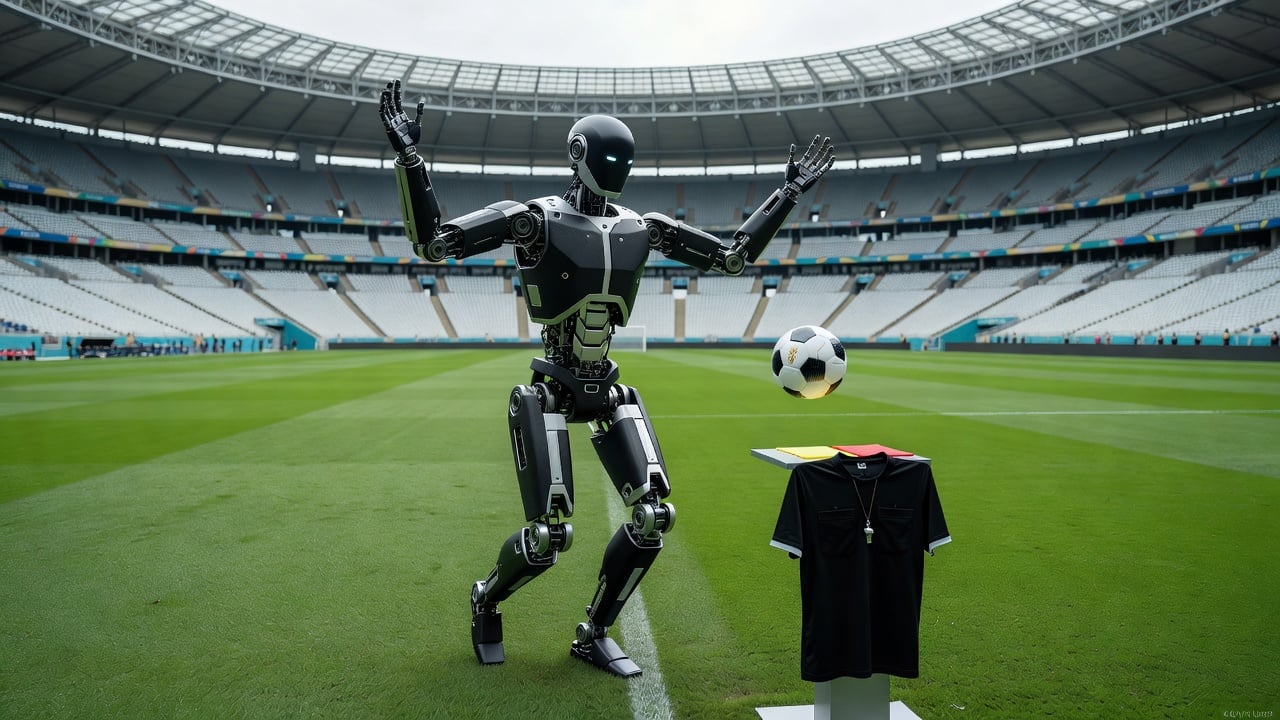
In the middle of a tense Round of 16 clash at New York/New Jersey Stadium, the match paused. Eighty thousand fans fell quiet. Then a five-foot-tall humanoid machine strode onto the grass. It paused. It mimicked goal celebrations from Harry Kane, Erling Haaland, Matheus Cunha and Son Heung-min. Finally it turned to the referee and delivered the official match ball. The moment belonged to Atlas. The Brazil-Norway encounter at the 2026 FIFA World Cup had just witnessed history.
That Saturday halftime scene, broadcast to millions, marked the public debut of a robot five years in development. Fortune captured the details hours later. Atlas didn’t just walk out. It performed. It adapted. And it did so on natural grass in front of a live crowd that had never seen anything like it.
But this wasn’t a stunt pulled from thin air. Hyundai Motor Company owns Boston Dynamics. The carmaker has sponsored FIFA for nearly three decades. Its latest campaign, “Next Starts Now,” turned football into a training ground for robotics. Sungwon Jee, Hyundai’s executive vice president and global chief marketing officer, put it plainly. “By placing Atlas at the heart of football’s most sacred ritual, we made a statement no commercial ever could.” The ball delivery, he added, represented the moment Atlas “enters public consciousness for the first time.”
Atlas stands as the fifth-generation humanoid from Boston Dynamics. Fully electric. Human-sized. Equipped with 56 degrees of freedom. It reaches 2.3 meters and lifts 110 pounds. It swaps its own batteries without help. Those specs matter for factory floors. Yet the real breakthrough showed on the pitch. The robot no longer runs on fixed code. It learns behaviors. Alberto Rodriguez, Boston Dynamics’ director of robot behavior, explained the shift. “It used to be programmed. Now it’s no longer programmed—it’s learned.”
The training process started with video. Atlas watched hours of professional players. It studied their drills, their balance, their reactions. Engineers added motion-capture data from humans performing the same moves. They fed everything into physics-based simulations. The system ran millions of parallel attempts on cloud GPUs. What might take a human athlete a year of practice, the robot compressed into roughly 24 hours. The result felt like muscle memory. Fast. Adaptive. Reliable even under pressure.
Grass introduced complications no lab floor ever did. Sometimes feet slip. Sometimes they catch. Rodriguez described the adjustments. “We’ve had to change the training regime for how Atlas learns to walk and run to make sure that it can do it well on concrete, but also on complex surfaces like grass.” Simulations threw in surprises. Changing friction. Misplaced balls. Obstacles. The robot learned to recover anyway. “It kind of has to not just learn to do something, but learn to adapt to whatever conditions it’s actually going to encounter in the real world.”
Earlier demonstrations laid the groundwork. In May, Boston Dynamics released footage of Atlas observing past World Cup matches on a large screen, then replicating movements in a practice area. It raised its arms in celebration. It dropped to one knee. It shifted weight and guided the ball with surprising poise. Interesting Engineering reported those initial steps on May 27, 2026. The project fell under Hyundai’s “School of Football” campaign. That effort included a five-part film series, a cinematic spot featuring Son Heung-min, and real-world activations at youth camps and fan festivals.
Hyundai’s broader plans extend far beyond stadiums. The company pledged $26 billion in U.S. investments over four years. A new robotics factory near Savannah, Georgia, aims to produce 30,000 Atlas units a year by 2028. Early tests already focus on automotive tasks such as part sequencing. Jee framed the strategy clearly. “We see robotics not as a side venture, but as a strategic capability that will shape how we compete. Mobility isn’t just about cars anymore. It’s about autonomous systems, robotics, and smart infrastructure.” The World Cup appearance, he said, signals a pivot “from internal exploration to public demonstration.”
Other robots shared the spotlight this summer. Boston Dynamics deployed four customized Spot quadrupeds to patrol venues, including the broadcast center and certain stadiums, for security. Design News detailed those deployments in June. Meanwhile, fully autonomous humanoid soccer matches took place in China and at RoboCup in South Korea. Those events featured smaller machines chasing balls with growing precision. They underscored a global race. Yet none matched Atlas stepping onto a World Cup pitch and handing the ball to a referee.
The technology still faces limits. Current Atlas models operate with learned behaviors that work best in controlled or well-modeled settings. Real-time reasoning remains limited. Battery life, terrain variability and safety around humans require continued refinement. Rodriguez acknowledged the progress while noting the distance left. “We’ve shown that this brand-new humanoid hardware can perform in the most extreme environments, operating reliably in record high temperatures, performing exciting and engaging athletic feats.” He believes public exposure helps. “The more the public sees robotics doing things they never thought possible, in person, the more prepared they will be as these robots become more and more a part of our daily lives.”
Reactions poured in immediately after the match. Social media lit up with clips of the celebrations. Some viewers called it a gimmick. Others saw the start of something bigger. FIFA stayed silent on future roles. Hyundai gave no timeline for Atlas returning to the field or attempting a kickoff. The company continues to emphasize transferable skills. Balance. Timing. Coordination under uncertainty. Those traits matter as much in a warehouse as they do on grass.
And so a simple act—delivering a ball—became a marker. Not because the robot scored a goal. Not because it outplayed anyone. But because it walked out, performed without falling, and handed over the match ball on the biggest stage in sports. The moment felt small. Its implications stretch further. Factories. Homes. Public spaces. All of them may look different once machines like Atlas move from simulation to the real world with confidence.
Hyundai and Boston Dynamics have bet heavily on that future. Their sponsorship, their training methods, their hardware bets all point one direction. The ball has been delivered. Now the real match begins.


 WebProNews is an iEntry Publication